
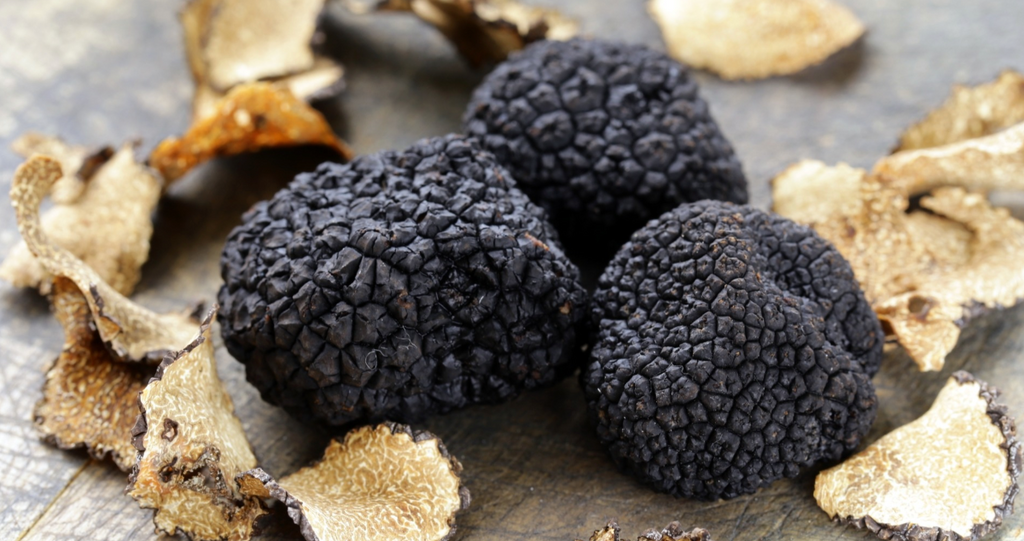
How to identify Périgord Black Truffle
Tuber melanosporum
Got a photo? Identify mushrooms instantly with the Mushby app
Open the appTo correctly identify Périgord Black Truffle (Tuber melanosporum), check each of these features in order. Misidentification is the most common cause of mushroom poisoning, so cross-reference multiple sources.
Step-by-step identification
- 1
Cap
Shape, color, surface texture, and diameter.
Not applicable as it is a subterranean fungus without a cap.
- 2
Gills
Attachment to stem, color, and spacing.
Not applicable, as truffles are ascomycetes and do not produce gills.
- 3
Stem
Length, shape, surface, and any ring.
Not applicable, as truffles are subterranean and do not possess a stem.
- 4
Flesh
Color, texture, and bruising reaction.
The gleba (interior flesh) is initially whitish and gradually darkens to very dark brown or purplish-black at maturity, contrasting sharply with the fine, maze-like, non-anastomosing white to off-white sterile veins that traverse it. These veins do not change color upon exposure to air. The texture is firm and dense.
- 5
Fruiting body
Overall growth pattern.
Globose to irregular in shape, typically 2-10 cm in diameter, though larger specimens can occur. The peridium (outer skin) is firm, rough, and covered in small, pyramidal warts, 2-5 mm wide, often with a slight depression at the apex of each wart. Initially reddish-brown, it matures to a deep charcoal black or purplish-black. The interior (gleba) is solid, firm, and when mature, dark purplish-brown to black, marbled with fine, intricate white or pale, anastomosing veins that do not change color when exposed to air. Spores are brown, ellipsoid to globose, 20-45 x 17-30 µm, reticulate-spiny.
- 6
Habitat
Where it grows and on what substrate.
Tuber melanosporum is an ectomycorrhizal fungus, forming symbiotic relationships predominantly with oak trees (Quercus species, especially Q. robur, Q. ilex, Q. pubescens), but also with hazel (Corylus avellana), beech (Fagus sylvatica), and linden (Tilia spp.). It prefers calcareous (limestone-rich) soils, well-drained, with a pH between 7.5 and 8.5. It typically grows in relatively shallow soil, often in association with the 'brûlé' phenomenon where vegetation under the host tree is suppressed.
Key Facts
- Cap surfaces
- Absent (peridium is black, warty with pyramidal warts)
- Growth Form
- Solitary or in small clusters underground
- Spore Print
- Brown (the color of the mature gleba due to spores)
- Body color
- Dark purplish-black to charcoal black (peridium); dark purplish-brown to black with white veins (gleba)
- Odor
- Strongly aromatic, earthy, musky, complex
- Flesh bruises
- Veins remain white; gleba maintains its dark color without bruising.
- Height
- Not applicable (subterranean)
- Cap Diameter
- 2-10 cm (diameter of the fruiting body)
Fruit body characteristics
- Gill attachment: Not applicable
- Stem shape: Not applicable
- Stem surface: Not applicable
- Ring: Not applicable
- Stem cross-section: Not applicable
Explore Périgord Black Truffle
Identify mushrooms anywhere
Free on iOS, Android, and Web. Photo identification, full database, and your personal collection.