
Got a photo? Identify mushrooms instantly with the Mushby app
Open the appDescription
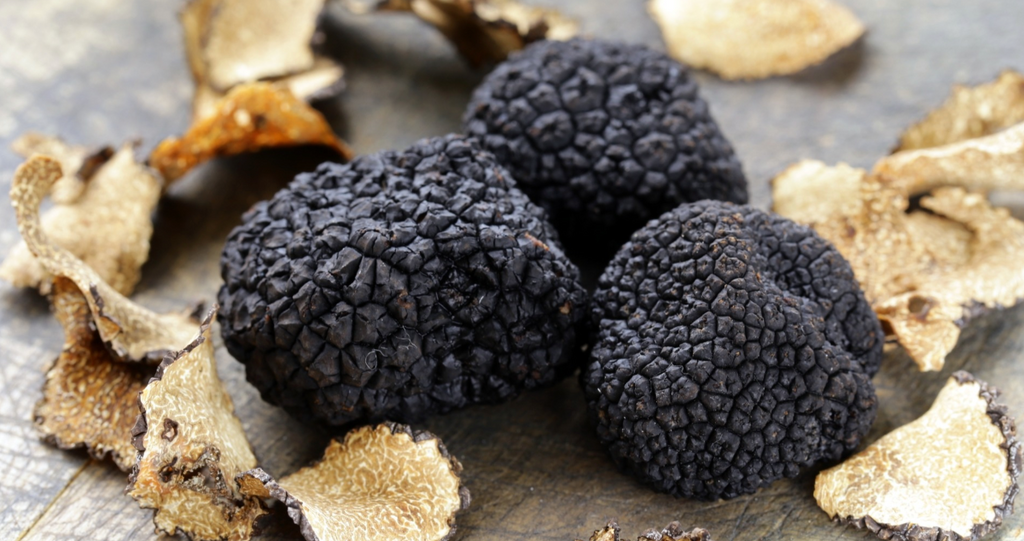
Tuber melanosporum is arguably the most famous and highly prized edible truffle species, renowned for its intense aroma and flavor. It is an ectomycorrhizal fungus, forming a symbiotic relationship with the roots of certain trees. It grows exclusively underground, developing globose to irregular fruiting bodies (ascocarps) that are sought after by specialized truffle hunters. Its distinct aroma, often described as earthy, musky, and faintly sweet, makes it a valuable culinary ingredient. The 'burning' or 'brûlé' phenomenon, a characteristic sterile zone created around the host tree due to the truffle's allelopathic effects, is an important indicator for foragers.
How to Identify
- Cap
- Not applicable as it is a subterranean fungus without a cap.
- Gills
- Not applicable, as truffles are ascomycetes and do not produce gills.
- Stem
- Not applicable, as truffles are subterranean and do not possess a stem.
- Flesh
- The gleba (interior flesh) is initially whitish and gradually darkens to very dark brown or purplish-black at maturity, contrasting sharply with the fine, maze-like, non-anastomosing white to off-white sterile veins that traverse it. These veins do not change color upon exposure to air. The texture is firm and dense.
- Fruiting body
- Globose to irregular in shape, typically 2-10 cm in diameter, though larger specimens can occur. The peridium (outer skin) is firm, rough, and covered in small, pyramidal warts, 2-5 mm wide, often with a slight depression at the apex of each wart. Initially reddish-brown, it matures to a deep charcoal black or purplish-black. The interior (gleba) is solid, firm, and when mature, dark purplish-brown to black, marbled with fine, intricate white or pale, anastomosing veins that do not change color when exposed to air. Spores are brown, ellipsoid to globose, 20-45 x 17-30 µm, reticulate-spiny.
- Habitat
- Tuber melanosporum is an ectomycorrhizal fungus, forming symbiotic relationships predominantly with oak trees (Quercus species, especially Q. robur, Q. ilex, Q. pubescens), but also with hazel (Corylus avellana), beech (Fagus sylvatica), and linden (Tilia spp.). It prefers calcareous (limestone-rich) soils, well-drained, with a pH between 7.5 and 8.5. It typically grows in relatively shallow soil, often in association with the 'brûlé' phenomenon where vegetation under the host tree is suppressed.
Key Facts
- Cap surfaces: Absent (peridium is black, warty with pyramidal warts)
- Growth Form: Solitary or in small clusters underground
- Spore Print: Brown (the color of the mature gleba due to spores)
- Body color: Dark purplish-black to charcoal black (peridium); dark purplish-brown to black with white veins (gleba)
- Odor: Strongly aromatic, earthy, musky, complex
- Flesh bruises: Veins remain white; gleba maintains its dark color without bruising.
- Height: Not applicable (subterranean)
- Cap Diameter: 2-10 cm (diameter of the fruiting body)
- Nutrient gathering: Ectomycorrhizal (symbiotic with tree roots)
Safe
SafeTuber melanosporum is not toxic. However, misidentification with other subterranean fungi, some of which may be unpalatable or mildly toxic, is possible. More critically, Chinese Black Truffles (Tuber indicum), which are inferior in aroma and flavor, are often fraudulently sold as Périgord Black Truffles. Always purchase from reputable sources.
Quick Check
- Odor: Intense, complex, earthy, musky, garlicky, often with notes of damp forest floor, undergrowth, and a hint of sweetness. The aroma is highly characteristic and potent.
- Fruiting: Subterranean, tuber-like ascocarp.
- Substrate: Calcareous soil, in mycorrhizal association with oak, hazel, beech, and linden trees.
Where to Find
France
Historically and presently, the Périgord region (Dordogne department) in southwestern France is the most famous for Tuber melanosporum. Other significant regions include Provence, Languedoc-Roussillon, and the Vaucluse.
Italy
Central and Southern Italy, particularly Umbria and Marche, are important production areas for Tuber melanosporum.
Spain
Regions such as Teruel, Soria, and Castellón are leading producers of black truffles, especially in northeastern Spain.
Australia and New Zealand
Successfully cultivated in newer truffle orchards in temperate regions of Australia (e.g., Tasmania, Western Australia) and New Zealand.
Finding Tips
Host Trees
Focus your search around the roots of established oak (Quercus spp.) and hazel (Corylus avellana) trees, as these are the primary hosts.
Soil Conditions
Look for calcareous, stony, and well-drained soils. Truffles thrive in relatively high pH levels.
Brûlé (Burned Area)
Identify areas under host trees where vegetation growth is suppressed or absent. This 'burned' circle is a strong indicator of truffle presence.
Trained Animals
Traditional truffle hunting methods employ trained dogs (e.g., Lagotto Romagnolo) or pigs, which are highly efficient at detecting the truffle's aroma underground.
Seasonal Timing
Harvest season is primarily in winter, from late November to March in the Northern Hemisphere, when the truffles are mature and most aromatic.
Depth
Truffles are typically found 5-30 cm deep in the soil, requiring careful excavation to avoid damage.
Similar Species
Summer Truffle
a less aromatic truffle
Also known as: Tuber aestivum
Burgundy Truffle
a variety of Summer Truffle
Also known as: Tuber uncinatum
Chinese Black Truffle
a different species often fraudulently sold as Périgord
Also known as: Tuber indicum, Tuber himalayense
Scientific Classification
- Phylum
- Ascomycota
- Class
- Ascomycetes
- Order
- Pezizales
- Family
- Tuberaceae
- Genus
- Tuber
Storage Information
- Max Temperature: 4°C
- Freezing duration: 6 months
- Min Temperature: 0°C
- Refrigeration: 7-10 days
How to Clean
Gently brush off any loose dirt with a soft brush (a toothbrush is ideal). For stubborn dirt, lightly rinse under cool running water, pat dry immediately with a clean cloth, and then air dry completely on a paper towel for 30 minutes before storage or use. Avoid over-wetting, as truffles absorb water, which diminishes their aroma and shelf life.
Explore Périgord Black Truffle
Identify mushrooms anywhere
Free on iOS, Android, and Web. Photo identification, full database, and your personal collection.