
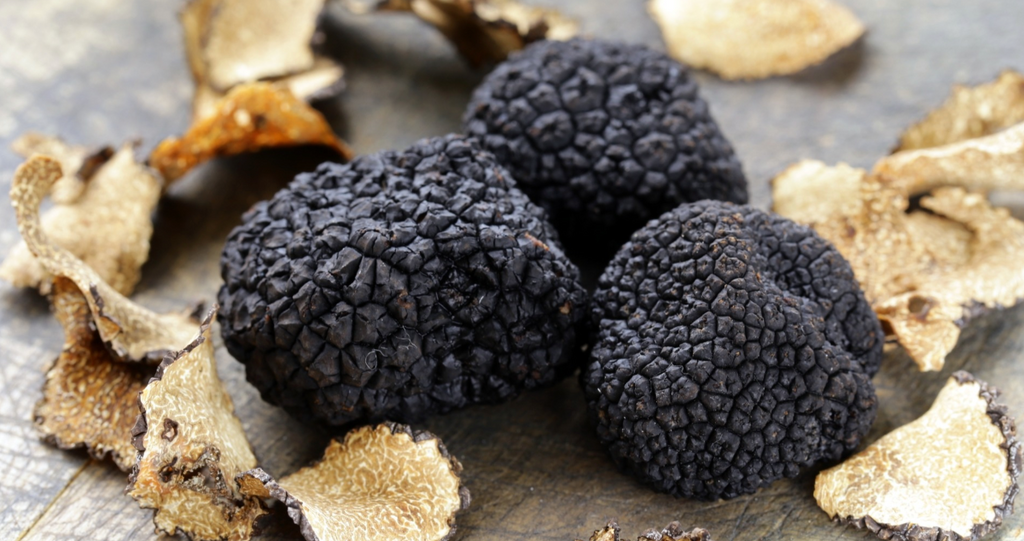
Where does Périgord Black Truffle grow?
Tuber melanosporum
Got a photo? Identify mushrooms instantly with the Mushby app
Open the appPérigord Black Truffle grows in specific habitats. Knowing where to look and when is the difference between an empty basket and a successful forage.
Where to find Périgord Black Truffle
France
Historically and presently, the Périgord region (Dordogne department) in southwestern France is the most famous for Tuber melanosporum. Other significant regions include Provence, Languedoc-Roussillon, and the Vaucluse.
Italy
Central and Southern Italy, particularly Umbria and Marche, are important production areas for Tuber melanosporum.
Spain
Regions such as Teruel, Soria, and Castellón are leading producers of black truffles, especially in northeastern Spain.
Australia and New Zealand
Successfully cultivated in newer truffle orchards in temperate regions of Australia (e.g., Tasmania, Western Australia) and New Zealand.
Foraging tips
- Host Trees. Focus your search around the roots of established oak (Quercus spp.) and hazel (Corylus avellana) trees, as these are the primary hosts.
- Soil Conditions. Look for calcareous, stony, and well-drained soils. Truffles thrive in relatively high pH levels.
- Brûlé (Burned Area). Identify areas under host trees where vegetation growth is suppressed or absent. This 'burned' circle is a strong indicator of truffle presence.
- Trained Animals. Traditional truffle hunting methods employ trained dogs (e.g., Lagotto Romagnolo) or pigs, which are highly efficient at detecting the truffle's aroma underground.
- Seasonal Timing. Harvest season is primarily in winter, from late November to March in the Northern Hemisphere, when the truffles are mature and most aromatic.
- Depth. Truffles are typically found 5-30 cm deep in the soil, requiring careful excavation to avoid damage.
Quick Check
- Substrate:
- Calcareous soil, in mycorrhizal association with oak, hazel, beech, and linden trees.
- Fruiting:
- Subterranean, tuber-like ascocarp.
- Odor:
- Intense, complex, earthy, musky, garlicky, often with notes of damp forest floor, undergrowth, and a hint of sweetness. The aroma is highly characteristic and potent.
Explore Périgord Black Truffle
Identify mushrooms anywhere
Free on iOS, Android, and Web. Photo identification, full database, and your personal collection.