
How to identify Desert Truffle
Terfezia boudieri
Got a photo? Identify mushrooms instantly with the Mushby app
Open the appTo correctly identify Desert Truffle (Terfezia boudieri), check each of these features in order. Misidentification is the most common cause of mushroom poisoning, so cross-reference multiple sources.
Step-by-step identification
- 1
Cap
Shape, color, surface texture, and diameter.
Not applicable, as Terfezia boudieri is a hypogeous fungus and does not produce a cap in the traditional sense.
- 2
Gills
Attachment to stem, color, and spacing.
Not applicable, as Terfezia boudieri is an ascomycete and does not produce gills.
- 3
Stem
Length, shape, surface, and any ring.
Not applicable, as Terfezia boudieri is a hypogeous fungus and does not produce a stem.
- 4
Flesh
Color, texture, and bruising reaction.
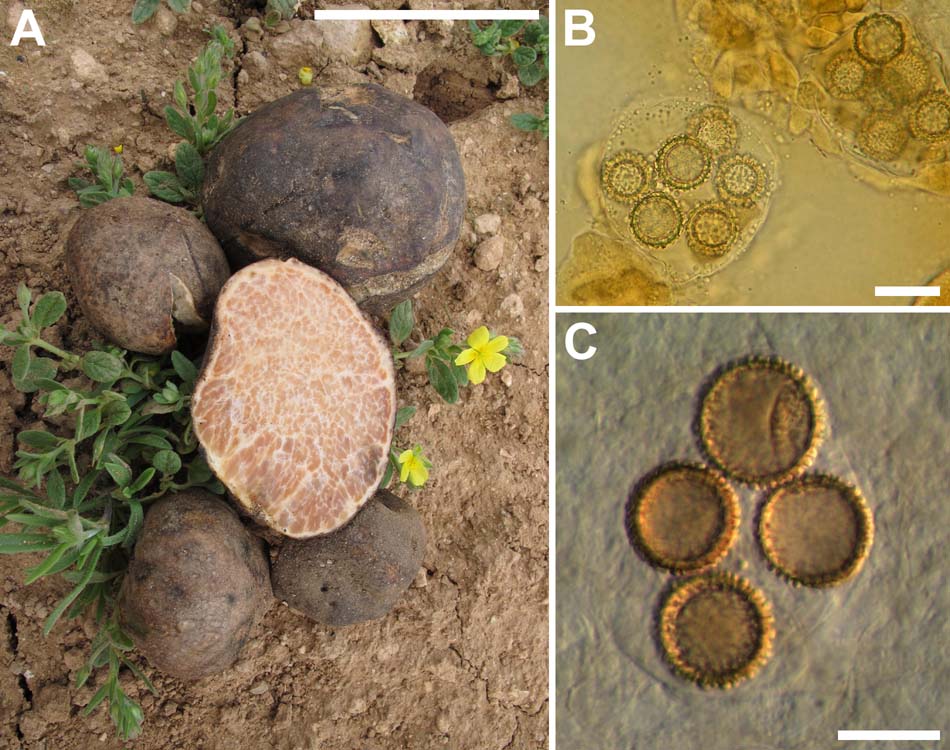
The gleba (internal fertile tissue) is firm and fleshy when young, becoming softer with age. It is initially whitish, then develops a marbled appearance with sterile, whitish veins interspersed with fertile, spore-bearing tissue that ranges from pinkish-brown to reddish-brown or purplish-brown. The marbling pattern is often intricate and distinctive.
- 5
Fruiting body
Overall growth pattern.
The fruiting body (ascocarp) is hypogeous, meaning it grows underground. It is irregularly tuberous to subglobose, often lobed or convoluted, ranging from 2 to 10 cm in diameter, though larger specimens can occur. The peridium (outer skin) is typically smooth to finely granular or slightly verrucose, varying in color from whitish to yellowish-brown, reddish-brown, or dark brown, often darkening with age or exposure.
- 6
Habitat
Where it grows and on what substrate.
Terfezia boudieri forms ectomycorrhizal associations, primarily with plants of the genus Helianthemum (rockroses), particularly H. guttatum and H. sessiliflorum. It thrives in sandy, calcareous, or loamy soils in arid and semi-arid environments, often in open areas with sparse vegetation. It is typically found in association with the roots of its host plants, often just below the soil surface or up to 15 cm deep.
Key Facts
- Cap surfaces
- Not applicable (hypogeous)
- Growth Form
- Hypogeous, solitary or in small clusters
- Spore Print
- Not applicable (spores are contained within asci in the gleba)
- Body color
- Whitish, yellowish-brown, reddish-brown, or dark brown
- Odor
- Mild, earthy, mushroomy
- Flesh bruises
- Does not bruise significantly
- Height
- Not applicable (hypogeous)
- Cap Diameter
- 2-10 cm (fruiting body diameter)
Fruit body characteristics
- Gill attachment: Not applicable
- Stem shape: Not applicable
- Stem surface: Not applicable
- Ring: Not applicable
- Stem cross-section: Not applicable
Explore Desert Truffle
Identify mushrooms anywhere
Free on iOS, Android, and Web. Photo identification, full database, and your personal collection.