
Got a photo? Identify mushrooms instantly with the Mushby app
Open the appDescription
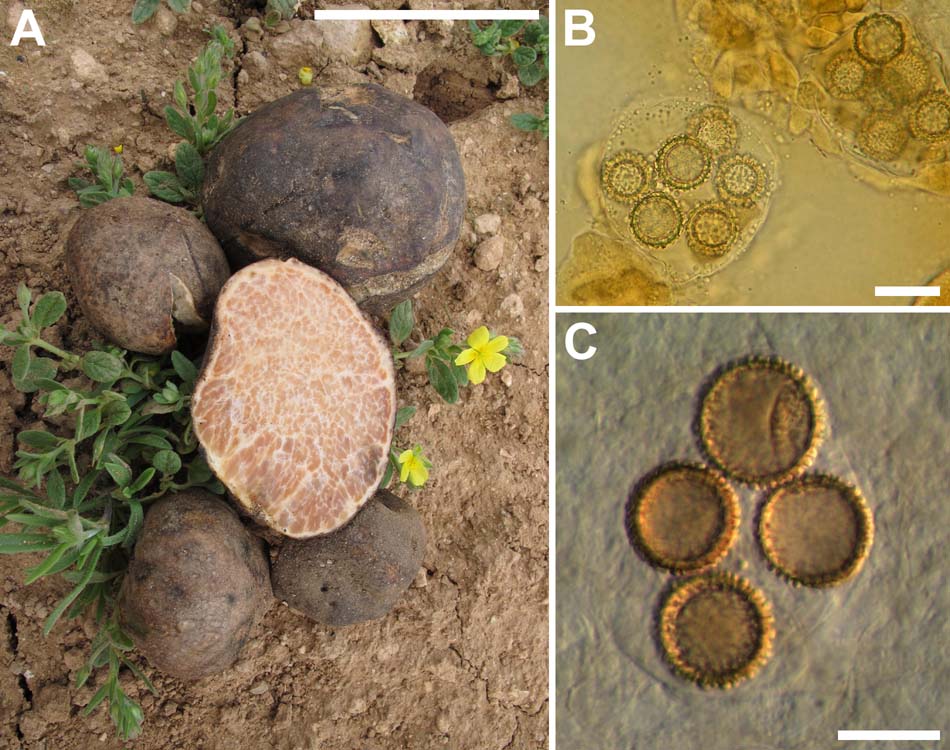
Terfezia boudieri is a hypogeous ascomycete, commonly known as a desert truffle. It is characterized by its subterranean growth, irregular tuberous shape, and a relatively smooth to slightly verrucose peridium. These truffles are highly prized in many arid and semi-arid regions for their culinary value and are often associated with specific host plants, particularly Helianthemum species. They are typically found partially or fully buried in sandy or calcareous soils.
How to Identify
- Cap
- Not applicable, as Terfezia boudieri is a hypogeous fungus and does not produce a cap in the traditional sense.
- Gills
- Not applicable, as Terfezia boudieri is an ascomycete and does not produce gills.
- Stem
- Not applicable, as Terfezia boudieri is a hypogeous fungus and does not produce a stem.
- Flesh
- The gleba (internal fertile tissue) is firm and fleshy when young, becoming softer with age. It is initially whitish, then develops a marbled appearance with sterile, whitish veins interspersed with fertile, spore-bearing tissue that ranges from pinkish-brown to reddish-brown or purplish-brown. The marbling pattern is often intricate and distinctive.
- Fruiting body
- The fruiting body (ascocarp) is hypogeous, meaning it grows underground. It is irregularly tuberous to subglobose, often lobed or convoluted, ranging from 2 to 10 cm in diameter, though larger specimens can occur. The peridium (outer skin) is typically smooth to finely granular or slightly verrucose, varying in color from whitish to yellowish-brown, reddish-brown, or dark brown, often darkening with age or exposure.
- Habitat
- Terfezia boudieri forms ectomycorrhizal associations, primarily with plants of the genus Helianthemum (rockroses), particularly H. guttatum and H. sessiliflorum. It thrives in sandy, calcareous, or loamy soils in arid and semi-arid environments, often in open areas with sparse vegetation. It is typically found in association with the roots of its host plants, often just below the soil surface or up to 15 cm deep.
Key Facts
- Cap surfaces: Not applicable (hypogeous)
- Growth Form: Hypogeous, solitary or in small clusters
- Spore Print: Not applicable (spores are contained within asci in the gleba)
- Body color: Whitish, yellowish-brown, reddish-brown, or dark brown
- Odor: Mild, earthy, mushroomy
- Flesh bruises: Does not bruise significantly
- Height: Not applicable (hypogeous)
- Cap Diameter: 2-10 cm (fruiting body diameter)
- Nutrient gathering: Ectomycorrhizal
Safe
SafeTerfezia boudieri is considered a choice edible mushroom. There are no known toxic look-alikes within the Terfezia genus that are commonly confused with it. However, as with any wild mushroom, proper identification is paramount. Allergic reactions are possible in sensitive individuals, though rare. Always cook desert truffles thoroughly; raw consumption is not recommended due to potential digestive upset.
Quick Check
- Odor: Mild, earthy, sometimes slightly nutty or mushroomy, less pungent than European true truffles.
- Fruiting: Hypogeous (underground)
- Substrate: Sandy, calcareous, or loamy soil, in association with Helianthemum species.
Where to Find
North Africa
Widespread across the deserts and semi-arid regions of Morocco, Algeria, Tunisia, Libya, and Egypt.
Middle East
Common in Saudi Arabia, Kuwait, Iraq, Syria, Jordan, and Israel.
Southern Europe
Found in parts of Spain (especially Andalusia), Portugal, and Cyprus, typically in areas with Mediterranean climate and suitable host plants.
Finding Tips
Host Plant Association
Always search near Helianthemum species. The presence of these 'truffle indicator plants' is crucial for locating Terfezia boudieri.
Soil Type
Focus on sandy, calcareous, or loamy soils. Avoid heavy clay soils.
Rainfall
Truffle production is highly dependent on adequate rainfall, typically occurring after significant autumn or winter rains. The season usually runs from late winter to early spring.
Cracks in Soil
Look for subtle cracks or mounds in the soil surface, which can indicate the presence of a truffle pushing up from below. Sometimes, small flies (truffle flies) may also be observed hovering over truffles.
Gentle Probing
Use a small stick or a specialized truffle tool to gently probe the soil around host plants. Be careful not to damage the truffles or the delicate mycorrhizal network.
Similar Species
White Desert Truffle
fungus
Also known as: Terfezia arenaria
Black Desert Truffle
fungus
Also known as: Terfezia claveryi
Picoa carthusiana
fungus
Also known as: Picoa truffle
Scientific Classification
- Phylum
- Ascomycota
- Class
- Pezizomycetes
- Order
- Pezizales
- Family
- Pezizaceae
- Genus
- Terfezia
Storage Information
- Max Temperature: 4°C
- Freezing duration: 6 months
- Min Temperature: 0°C
- Refrigeration: 1 week
How to Clean
Desert truffles are often covered in sand or soil. Brush off loose dirt with a soft brush. For more stubborn dirt, a damp cloth can be used. Avoid soaking them in water, as they can absorb water and lose flavor and texture. If necessary, a quick rinse under running water followed by immediate drying is acceptable. The peridium is edible and usually not peeled unless heavily damaged or very tough.
Explore Desert Truffle
Identify mushrooms anywhere
Free on iOS, Android, and Web. Photo identification, full database, and your personal collection.