
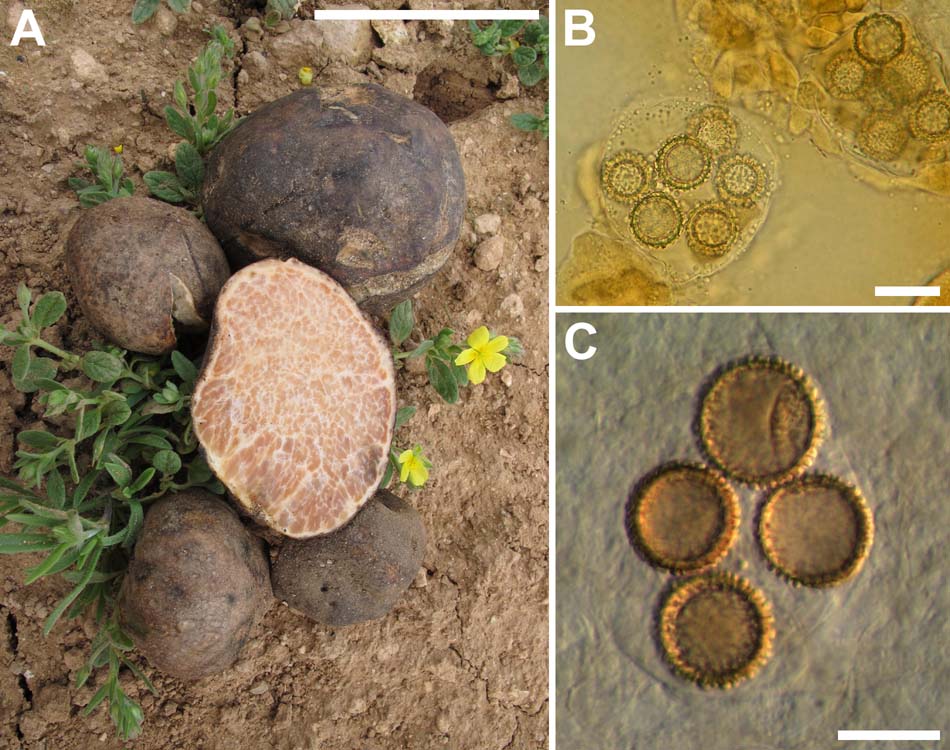
Where does Desert Truffle grow?
Terfezia boudieri
Got a photo? Identify mushrooms instantly with the Mushby app
Open the appDesert Truffle grows in specific habitats. Knowing where to look and when is the difference between an empty basket and a successful forage.
Where to find Desert Truffle
North Africa
Widespread across the deserts and semi-arid regions of Morocco, Algeria, Tunisia, Libya, and Egypt.
Middle East
Common in Saudi Arabia, Kuwait, Iraq, Syria, Jordan, and Israel.
Southern Europe
Found in parts of Spain (especially Andalusia), Portugal, and Cyprus, typically in areas with Mediterranean climate and suitable host plants.
Foraging tips
- Host Plant Association. Always search near Helianthemum species. The presence of these 'truffle indicator plants' is crucial for locating Terfezia boudieri.
- Soil Type. Focus on sandy, calcareous, or loamy soils. Avoid heavy clay soils.
- Rainfall. Truffle production is highly dependent on adequate rainfall, typically occurring after significant autumn or winter rains. The season usually runs from late winter to early spring.
- Cracks in Soil. Look for subtle cracks or mounds in the soil surface, which can indicate the presence of a truffle pushing up from below. Sometimes, small flies (truffle flies) may also be observed hovering over truffles.
- Gentle Probing. Use a small stick or a specialized truffle tool to gently probe the soil around host plants. Be careful not to damage the truffles or the delicate mycorrhizal network.
Quick Check
- Substrate:
- Sandy, calcareous, or loamy soil, in association with Helianthemum species.
- Fruiting:
- Hypogeous (underground)
- Odor:
- Mild, earthy, sometimes slightly nutty or mushroomy, less pungent than European true truffles.
Explore Desert Truffle
Identify mushrooms anywhere
Free on iOS, Android, and Web. Photo identification, full database, and your personal collection.