
How to identify White Russula
Russula delica
Got a photo? Identify mushrooms instantly with the Mushby app
Open the appTo correctly identify White Russula (Russula delica), check each of these features in order. Misidentification is the most common cause of mushroom poisoning, so cross-reference multiple sources.
Step-by-step identification
- 1
Cap
Shape, color, surface texture, and diameter.
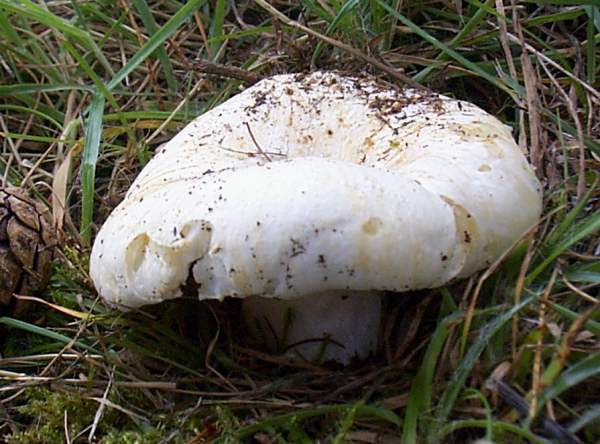
The cap is typically 5-15 cm (2-6 inches) in diameter, sometimes larger, initially convex, becoming broadly convex to flat, and eventually depressed in the center, often with a funnel-shaped depression in mature specimens. The margin is usually inrolled when young, expanding with age, and can be somewhat wavy. The surface is dry, unpolished, and often dull, sometimes with adhering soil or debris. It is typically white to cream, often staining yellowish-brown or rusty-brown with age or bruising.
- 2
Gills
Attachment to stem, color, and spacing.
The gills are deeply decurrent (running down the stem), crowded, thick, and brittle. They are initially white, becoming cream to pale yellow with age, and often develop rusty-brown spots or stains. They are not typically forking.
- 3
Stem
Length, shape, surface, and any ring.
The stem is 3-8 cm (1.2-3.2 inches) long and 1.5-3 cm (0.6-1.2 inches) thick, stout, solid, and cylindrical or tapering slightly towards the base. It is white, often staining yellowish or brownish with age or handling, and lacks a ring or volva. The surface is dry and unpolished.
- 4
Flesh
Color, texture, and bruising reaction.
The flesh is thick, firm, and brittle, white throughout, and does not change color when cut or bruised. It has a mild to slightly acrid or peppery taste when raw, and a faint, sometimes unpleasant, odor.
- 5
Fruiting body
Overall growth pattern.
The fruiting body is robust and fleshy, typically emerging from the soil partially buried, often covered in leaf litter or duff. It is entirely white to cream-colored when young, often developing yellowish or brownish stains with age or handling.
- 6
Habitat
Where it grows and on what substrate.
Russula delica is a mycorrhizal species, forming symbiotic relationships with a wide range of deciduous and coniferous trees. It is commonly found growing solitarily or scattered on the ground in mixed forests, broadleaf woodlands (especially with oak and beech), and conifer forests (pine, spruce, fir). It prefers well-drained, often mossy or leaf-littered soil.
Key Facts
- Cap surfaces
- Dry, unpolished, often dull, sometimes with adhering soil or debris.
- Growth Form
- Solitary to scattered.
- Spore Print
- White to cream.
- Body color
- White to cream, staining yellowish or brownish with age/handling.
- Odor
- Faint, sometimes slightly unpleasant.
- Flesh bruises
- Does not change color when cut or bruised.
- Height
- 3-8 cm (1.2-3.2 inches)
- Cap Diameter
- 5-15 cm (2-6 inches)
Fruit body characteristics
- Gill attachment: Deeply decurrent
- Stem shape: Cylindrical or slightly tapering towards the base
- Stem surface: Dry, unpolished
- Ring: Absent
- Stem cross-section: Solid
Explore White Russula
Identify mushrooms anywhere
Free on iOS, Android, and Web. Photo identification, full database, and your personal collection.