
Got a photo? Identify mushrooms instantly with the Mushby app
Open the appDescription
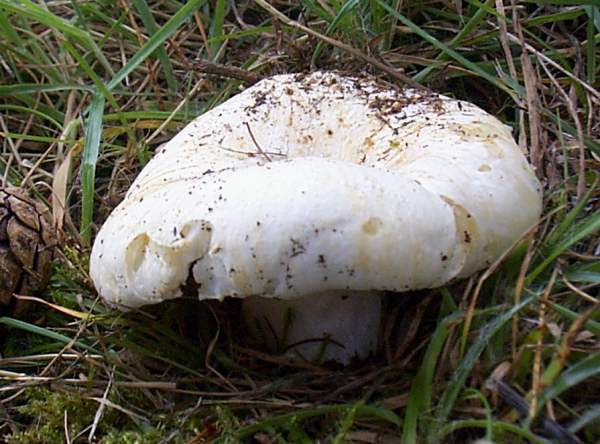
Russula delica is a robust, medium to large-sized mushroom characterized by its overall white to off-white coloration, deeply decurrent gills, and a lack of a milky latex (unlike Lactarius species). It is a mycorrhizal fungus, forming symbiotic relationships with various tree species, primarily hardwoods and conifers. Its common name, 'White Russula,' accurately reflects its dominant color. While generally considered edible after cooking, its taste can be somewhat acrid or peppery when raw, and it is often considered a mediocre edible due to its firm, somewhat brittle flesh and tendency to accumulate debris.
How to Identify
- Cap
- The cap is typically 5-15 cm (2-6 inches) in diameter, sometimes larger, initially convex, becoming broadly convex to flat, and eventually depressed in the center, often with a funnel-shaped depression in mature specimens. The margin is usually inrolled when young, expanding with age, and can be somewhat wavy. The surface is dry, unpolished, and often dull, sometimes with adhering soil or debris. It is typically white to cream, often staining yellowish-brown or rusty-brown with age or bruising.
- Gills
- The gills are deeply decurrent (running down the stem), crowded, thick, and brittle. They are initially white, becoming cream to pale yellow with age, and often develop rusty-brown spots or stains. They are not typically forking.
- Stem
- The stem is 3-8 cm (1.2-3.2 inches) long and 1.5-3 cm (0.6-1.2 inches) thick, stout, solid, and cylindrical or tapering slightly towards the base. It is white, often staining yellowish or brownish with age or handling, and lacks a ring or volva. The surface is dry and unpolished.
- Flesh
- The flesh is thick, firm, and brittle, white throughout, and does not change color when cut or bruised. It has a mild to slightly acrid or peppery taste when raw, and a faint, sometimes unpleasant, odor.
- Fruiting body
- The fruiting body is robust and fleshy, typically emerging from the soil partially buried, often covered in leaf litter or duff. It is entirely white to cream-colored when young, often developing yellowish or brownish stains with age or handling.
- Habitat
- Russula delica is a mycorrhizal species, forming symbiotic relationships with a wide range of deciduous and coniferous trees. It is commonly found growing solitarily or scattered on the ground in mixed forests, broadleaf woodlands (especially with oak and beech), and conifer forests (pine, spruce, fir). It prefers well-drained, often mossy or leaf-littered soil.
Key Facts
- Cap surfaces: Dry, unpolished, often dull, sometimes with adhering soil or debris.
- Growth Form: Solitary to scattered.
- Spore Print: White to cream.
- Body color: White to cream, staining yellowish or brownish with age/handling.
- Odor: Faint, sometimes slightly unpleasant.
- Flesh bruises: Does not change color when cut or bruised.
- Height: 3-8 cm (1.2-3.2 inches)
- Cap Diameter: 5-15 cm (2-6 inches)
- Nutrient gathering: Mycorrhizal
Safe
SafeRussula delica is generally considered edible after cooking. However, raw consumption is not recommended due to its potentially acrid or peppery taste, which can cause gastrointestinal upset in some individuals. It is not known to contain deadly toxins. The primary safety concern lies in misidentification with toxic look-alikes, particularly some species of Lactarius or other Russula species that can cause severe gastrointestinal distress.
Quick Check
- Odor: Faint, sometimes slightly unpleasant or fishy, but not distinctive.
- Fruiting: Summer to fall (July-October).
- Substrate: Terrestrial, on soil in mixed forests, broadleaf woodlands, and conifer forests.
Where to Find
North America
Widely distributed across temperate regions, particularly common in the eastern United States and Canada, and also found in the Pacific Northwest.
Europe
Common throughout Europe, from Scandinavia to the Mediterranean, in various forest types.
Asia
Reported from parts of Asia, including Japan and China, where suitable host trees are present.
Finding Tips
Seasonal Availability
Typically fruits from summer through fall (July to October), with peak abundance often in late summer and early autumn after periods of rain.
Preferred Habitat
Look for it in mixed forests, especially under oak, beech, pine, and spruce. It often grows partially buried in leaf litter or moss.
Distinguishing Features
Its deeply decurrent gills, lack of latex, and overall white coloration are key identifiers. Always check for the absence of milky latex to differentiate from Lactarius species.
Taste Test (Cautionary)
A small taste of the raw flesh (and spitting it out) can reveal a mild to slightly acrid or peppery taste, which is characteristic of many Russula species. However, this should not be relied upon as the sole identification method, especially for beginners, due to the risk of toxic look-alikes.
Similar Species
Peppery Milky
Lactarius
Also known as: Lactarius piperatus
Stiff Milky
Lactarius
Also known as: Lactarius vellereus
Compact Russula
Russula
Also known as: Russula compacta
Russula chloroides
Russula
Also known as: Green-gilled Russula
Scientific Classification
- Phylum
- Basidiomycota
- Class
- Agaricomycetes
- Order
- Russulales
- Family
- Russulaceae
- Genus
- Russula
Storage Information
- Max Temperature: 4°C
- Freezing duration: 6 months
- Min Temperature: 0°C
- Refrigeration: 5 days
How to Clean
Due to its tendency to grow partially buried and its often sticky cap surface, Russula delica can accumulate a lot of dirt and debris. Clean by gently brushing off soil with a soft brush or cloth. Avoid washing under running water if possible, as the flesh can absorb water and become soggy. If washing is necessary, do so quickly and pat dry immediately.
Explore White Russula
Identify mushrooms anywhere
Free on iOS, Android, and Web. Photo identification, full database, and your personal collection.