
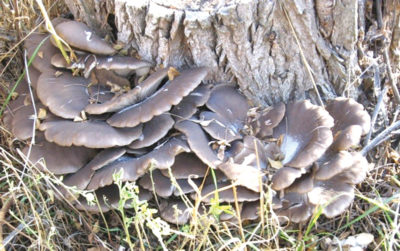
How to identify Giant Oyster Mushroom
Pleurotus giganteus
Got a photo? Identify mushrooms instantly with the Mushby app
Open the appTo correctly identify Giant Oyster Mushroom (Pleurotus giganteus), check each of these features in order. Misidentification is the most common cause of mushroom poisoning, so cross-reference multiple sources.
Step-by-step identification
- 1
Cap
Shape, color, surface texture, and diameter.
Typically 10-30 cm (4-12 inches) in diameter, but can reach up to 50 cm (20 inches) or more. The color ranges from whitish to cream, pale tan, or grayish-brown, often darker towards the center and paler at the margin. The surface is smooth, dry, and often somewhat wavy or lobed at the margin, which can be inrolled when young. Mature caps often become deeply depressed or funnel-shaped.
- 2
Gills
Attachment to stem, color, and spacing.
Decurrent, running far down the stem, crowded, and narrow. They are white to cream-colored, sometimes developing a yellowish tint with age. They often anastomose (form cross-connections) near the stem.
- 3
Stem
Length, shape, surface, and any ring.
Central to eccentric, stout, and solid, typically 5-15 cm (2-6 inches) long and 2-6 cm (0.8-2.4 inches) thick. It is white to off-white, often tapering towards the base, and can be somewhat hairy or scaly near the base, especially when growing terrestrially. It is often deeply embedded in the substrate.
- 4
Flesh
Color, texture, and bruising reaction.
Thick, firm, and white, with a somewhat fibrous texture. It does not change color when cut or bruised.
- 5
Fruiting body
Overall growth pattern.
Large, robust, and often gregarious, forming impressive clusters. The overall shape can be broadly fan-shaped, spatulate, or deeply infundibuliform (funnel-shaped) when mature.
- 6
Habitat
Where it grows and on what substrate.
Saprotrophic, growing on decaying wood, often buried wood, or directly on the ground in rich soil. It is found in tropical and subtropical forests, particularly in Asia (e.g., India, Southeast Asia) and sometimes in parts of Africa and Australia. It can also be cultivated.
Key Facts
- Cap surfaces
- Smooth, dry, sometimes wavy or lobed
- Growth Form
- Gregarious, often clustered
- Spore Print
- White to lilac-gray
- Body color
- Whitish, cream, pale tan, grayish-brown
- Odor
- Mild, pleasant, mushroomy
- Flesh bruises
- No significant bruising or color change
- Height
- 5-15 cm (stem), up to 50 cm (cap diameter)
- Cap Diameter
- 10-30 cm, occasionally up to 50 cm
Fruit body characteristics
- Gill attachment: Decurrent
- Stem shape: Cylindrical to tapering towards the base, stout
- Stem surface: Smooth to somewhat hairy or scaly near the base
- Ring: Absent
- Stem cross-section: Solid
Explore Giant Oyster Mushroom
Identify mushrooms anywhere
Free on iOS, Android, and Web. Photo identification, full database, and your personal collection.