
Got a photo? Identify mushrooms instantly with the Mushby app
Open the appDescription
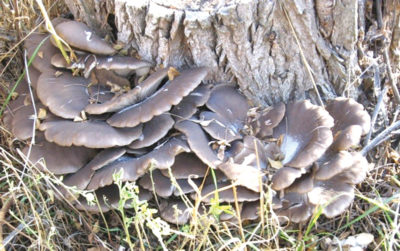
Pleurotus giganteus is a large, edible gilled mushroom belonging to the family Pleurotaceae. It is characterized by its massive size, often growing in impressive clusters, and its distinctive funnel-shaped or oyster-shell-shaped caps. Unlike many other Pleurotus species that grow on wood, P. giganteus is typically found growing terrestrially or on buried wood, often in tropical and subtropical regions. Its robust texture and mild flavor make it a popular culinary mushroom in areas where it is cultivated or foraged.
How to Identify
- Cap
- Typically 10-30 cm (4-12 inches) in diameter, but can reach up to 50 cm (20 inches) or more. The color ranges from whitish to cream, pale tan, or grayish-brown, often darker towards the center and paler at the margin. The surface is smooth, dry, and often somewhat wavy or lobed at the margin, which can be inrolled when young. Mature caps often become deeply depressed or funnel-shaped.
- Gills
- Decurrent, running far down the stem, crowded, and narrow. They are white to cream-colored, sometimes developing a yellowish tint with age. They often anastomose (form cross-connections) near the stem.
- Stem
- Central to eccentric, stout, and solid, typically 5-15 cm (2-6 inches) long and 2-6 cm (0.8-2.4 inches) thick. It is white to off-white, often tapering towards the base, and can be somewhat hairy or scaly near the base, especially when growing terrestrially. It is often deeply embedded in the substrate.
- Flesh
- Thick, firm, and white, with a somewhat fibrous texture. It does not change color when cut or bruised.
- Fruiting body
- Large, robust, and often gregarious, forming impressive clusters. The overall shape can be broadly fan-shaped, spatulate, or deeply infundibuliform (funnel-shaped) when mature.
- Habitat
- Saprotrophic, growing on decaying wood, often buried wood, or directly on the ground in rich soil. It is found in tropical and subtropical forests, particularly in Asia (e.g., India, Southeast Asia) and sometimes in parts of Africa and Australia. It can also be cultivated.
Key Facts
- Cap surfaces: Smooth, dry, sometimes wavy or lobed
- Growth Form: Gregarious, often clustered
- Spore Print: White to lilac-gray
- Body color: Whitish, cream, pale tan, grayish-brown
- Odor: Mild, pleasant, mushroomy
- Flesh bruises: No significant bruising or color change
- Height: 5-15 cm (stem), up to 50 cm (cap diameter)
- Cap Diameter: 10-30 cm, occasionally up to 50 cm
- Nutrient gathering: Saprotrophic
Safe
SafePleurotus giganteus is widely considered edible and is a popular culinary mushroom. There are no known toxic look-alikes that are easily confused with it, especially given its large size and distinctive growth habit. However, as with all wild-foraged mushrooms, proper identification by an experienced mycologist is crucial. Some individuals may experience mild gastrointestinal upset if consuming raw or undercooked mushrooms, or if they have a specific allergy to fungal proteins. Always cook mushrooms thoroughly.
Quick Check
- Odor: Mild, pleasant, mushroomy
- Fruiting: Often in large clusters, sometimes solitary
- Substrate: Terrestrial, on buried wood, or directly on rich soil
Where to Find
Tropical and Subtropical Forests
Primarily found in regions with warm, humid climates, such as Southeast Asia (e.g., India, Thailand, Malaysia), parts of Africa, and Australia. It prefers areas with abundant decaying woody debris or rich organic soil.
Cultivation Facilities
Due to its culinary value, P. giganteus is increasingly cultivated on various substrates, including agricultural waste products like straw, sawdust, and cotton waste, in controlled environments globally.
Finding Tips
Look for Large Clusters
P. giganteus often grows in impressive, multi-capped clusters, making them relatively easy to spot. Look for large, pale masses emerging from the ground or buried wood.
Check for Decaying Wood
While it appears to grow terrestrially, it is typically associated with buried decaying wood. Inspect areas with rich organic soil near fallen logs or stumps.
Observe Gill Attachment
The deeply decurrent gills are a key identifying feature. They run far down the stem, distinguishing it from some other large terrestrial fungi.
Consider the Season
In its native tropical and subtropical ranges, it can fruit year-round, especially during rainy seasons. In cultivated settings, it can be found consistently.
Similar Species
King Oyster Mushroom
Pleurotus
Also known as: Eryngii, French Horn Mushroom
Oyster Mushroom
Pleurotus
Also known as: Pearl Oyster Mushroom, Tree Oyster Mushroom
Phoenix Oyster Mushroom
Pleurotus
Also known as: Indian Oyster, Lung Oyster
Scientific Classification
- Phylum
- Basidiomycota
- Class
- Agaricomycetes
- Order
- Agaricales
- Family
- Pleurotaceae
- Genus
- Pleurotus
Storage Information
- Max Temperature: 4°C
- Freezing duration: 6 months
- Min Temperature: 0°C
- Refrigeration: 7 days
How to Clean
Gently brush off any soil or debris with a soft brush or damp cloth. Avoid washing under running water unless absolutely necessary, as mushrooms can absorb water and become soggy. If washing is required, do so quickly and pat dry immediately.
Explore Giant Oyster Mushroom
Identify mushrooms anywhere
Free on iOS, Android, and Web. Photo identification, full database, and your personal collection.