
How to identify Stinkhorn
Phallaceae
Got a photo? Identify mushrooms instantly with the Mushby app
Open the appTo correctly identify Stinkhorn (Phallaceae), check each of these features in order. Misidentification is the most common cause of mushroom poisoning, so cross-reference multiple sources.
Step-by-step identification
- 1
Cap
Shape, color, surface texture, and diameter.
In species like Phallus impudicus, the cap (pileus) is conical or bell-shaped, 2-5 cm tall, reticulated (pitted and ridged), and covered with a dark olive-brown to black, slimy gleba. In other genera, a distinct cap may not be present, with the gleba covering other parts of the structure.
- 2
Gills
Attachment to stem, color, and spacing.
Stinkhorns do not possess gills. Spores are produced in a gleba.
- 3
Stem
Length, shape, surface, and any ring.
The stem (stipe) is typically cylindrical, hollow, spongy, and white to yellowish, emerging from a cup-like volva at the base. It can range from 5-20 cm in height and 1-4 cm in diameter, depending on the species.
- 4
Flesh
Color, texture, and bruising reaction.
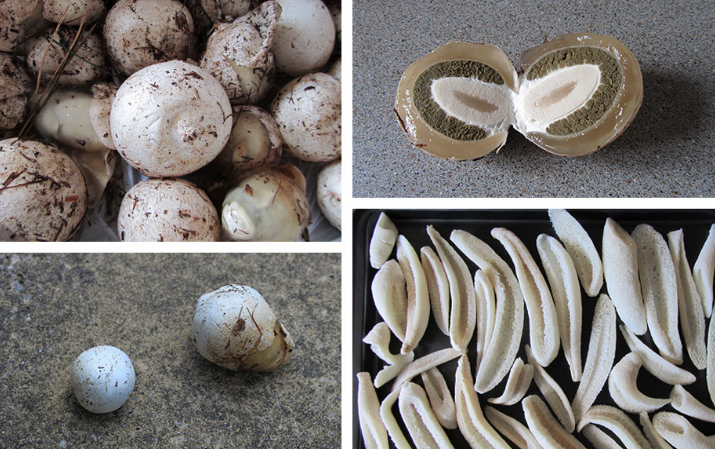
The flesh of the mature fruiting body (stipe) is spongy and hollow. The 'egg' stage contains a firm, gelatinous layer surrounding the developing mushroom.
- 5
Fruiting body
Overall growth pattern.
Emerges from a subterranean 'egg' (volva) which is white to off-white, gelatinous internally. The mature fruiting body varies significantly by genus and species within Phallaceae. Common forms include a cylindrical stalk topped with a conical, reticulated cap (e.g., Phallus impudicus) or a cage-like structure (e.g., Clathrus ruber). The most defining feature is the gleba, a dark olive-brown to black, slimy, and foul-smelling spore mass covering part of the fruiting body.
- 6
Habitat
Where it grows and on what substrate.
Saprobic, growing on decaying wood, leaf litter, wood chips, or rich soil. Often found in gardens, lawns, disturbed areas, woodlands, and forests.
Key Facts
- Cap surfaces
- Reticulated (pitted and ridged) and covered with a slimy gleba in species like Phallus impudicus; absent or different in other genera.
- Growth Form
- Solitary or scattered, emerging from a subterranean 'egg'.
- Spore Print
- Olive-brown to black (from the gleba).
- Body color
- White to yellowish stipe, dark olive-brown to black gleba, white to off-white 'egg'.
- Odor
- Foul, putrid, carrion-like, attracting insects.
- Flesh bruises
- Does not bruise significantly.
- Height
- 5-20 cm (mature stipe).
- Cap Diameter
- 2-5 cm (for species with a distinct cap like Phallus impudicus).
Fruit body characteristics
- Gill attachment: Not applicable (gills absent).
- Stem shape: Cylindrical, hollow, spongy.
- Stem surface: Smooth to slightly wrinkled.
- Ring: Absent.
- Stem cross-section: Hollow.
Explore Stinkhorn
Identify mushrooms anywhere
Free on iOS, Android, and Web. Photo identification, full database, and your personal collection.