
Got a photo? Identify mushrooms instantly with the Mushby app
Open the appDescription
Stinkhorns (family Phallaceae) are a distinctive group of gasteromycetes known for their often phallic shapes and foul-smelling, spore-bearing gleba. They typically emerge from an 'egg' stage, which is a subterranean or partially subterranean volva. The mature fruiting body can vary greatly in form, from simple columns to elaborate lattice-like structures, but all share the characteristic of producing a slimy, malodorous gleba that attracts insects for spore dispersal.
How to Identify
- Cap
- In species like Phallus impudicus, the cap (pileus) is conical or bell-shaped, 2-5 cm tall, reticulated (pitted and ridged), and covered with a dark olive-brown to black, slimy gleba. In other genera, a distinct cap may not be present, with the gleba covering other parts of the structure.
- Gills
- Stinkhorns do not possess gills. Spores are produced in a gleba.
- Stem
- The stem (stipe) is typically cylindrical, hollow, spongy, and white to yellowish, emerging from a cup-like volva at the base. It can range from 5-20 cm in height and 1-4 cm in diameter, depending on the species.
- Flesh
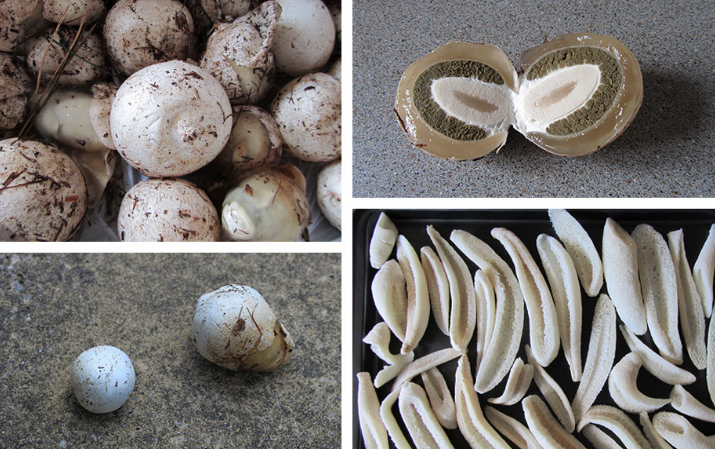
- The flesh of the mature fruiting body (stipe) is spongy and hollow. The 'egg' stage contains a firm, gelatinous layer surrounding the developing mushroom.
- Fruiting body
- Emerges from a subterranean 'egg' (volva) which is white to off-white, gelatinous internally. The mature fruiting body varies significantly by genus and species within Phallaceae. Common forms include a cylindrical stalk topped with a conical, reticulated cap (e.g., Phallus impudicus) or a cage-like structure (e.g., Clathrus ruber). The most defining feature is the gleba, a dark olive-brown to black, slimy, and foul-smelling spore mass covering part of the fruiting body.
- Habitat
- Saprobic, growing on decaying wood, leaf litter, wood chips, or rich soil. Often found in gardens, lawns, disturbed areas, woodlands, and forests.
Key Facts
- Cap surfaces: Reticulated (pitted and ridged) and covered with a slimy gleba in species like Phallus impudicus; absent or different in other genera.
- Growth Form: Solitary or scattered, emerging from a subterranean 'egg'.
- Spore Print: Olive-brown to black (from the gleba).
- Body color: White to yellowish stipe, dark olive-brown to black gleba, white to off-white 'egg'.
- Odor: Foul, putrid, carrion-like, attracting insects.
- Flesh bruises: Does not bruise significantly.
- Height: 5-20 cm (mature stipe).
- Cap Diameter: 2-5 cm (for species with a distinct cap like Phallus impudicus).
- Nutrient gathering: Saprobic (decomposer).
Safe
SafeMost stinkhorn species are not considered toxic, but their foul odor and slimy texture make them unpalatable when mature. The 'egg' stage of some species (e.g., Phallus impudicus) is considered edible by some, but caution is advised. There are no known significant toxins in Phallaceae, but consumption of mature specimens can cause gastrointestinal upset due to the gleba.
Quick Check
- Odor: Strongly putrid, carrion-like, or fecal, especially when mature.
- Fruiting: Emerges from a white 'egg' stage, often phallic or cage-like when mature, covered in a dark, slimy gleba.
- Substrate: Decaying wood, wood chips, leaf litter, rich soil.
Where to Find
Gardens and Lawns
Commonly found in mulched garden beds, lawns, and areas with wood chips due to their saprobic nature.
Woodlands and Forests
Can be found in deciduous and coniferous forests, growing on decaying organic matter.
Disturbed Areas
Often colonize disturbed ground, roadsides, and areas with rich, organic soil.
Finding Tips
Follow Your Nose
The strong, putrid odor of mature stinkhorns is often the first indicator of their presence. They can be smelled from a considerable distance.
Look for 'Eggs'
Before they erupt, stinkhorns exist as subterranean or partially buried 'eggs'. These white, rubbery spheres can be found in leaf litter or soil.
Check Mulched Areas
Wood chip mulch is a prime habitat for many stinkhorn species, as they thrive on decaying wood.
Seasonal Timing
Most stinkhorns fruit from late spring through autumn, especially after periods of rain.
Similar Species
Dog Stinkhorn
Mutinus caninus
Also known as: Dog's Nose Stinkhorn
Lattice Stinkhorn
Clathrus ruber
Also known as: Basket Stinkhorn
Stinky Squid
Pseudocolus fusiformis
Also known as: Octopus Stinkhorn
Scientific Classification
- Phylum
- Basidiomycota
- Class
- Agaricomycetes
- Order
- Phallales
- Family
- Phallaceae
- Genus
- Varies (e.g., Phallus, Mutinus, Clathrus, Lysurus)
Storage Information
- Max Temperature: 4°C
- Freezing duration: 6 months
- Min Temperature: 0°C
- Refrigeration: 3 days
How to Clean
For culinary use (only the 'egg' stage of certain species), gently brush off any soil or debris. The gelatinous outer layer of the 'egg' can be peeled away, leaving the firm inner core. Do not wash mature stinkhorns due to their slimy gleba and strong odor.
Explore Stinkhorn
Identify mushrooms anywhere
Free on iOS, Android, and Web. Photo identification, full database, and your personal collection.