
Got a photo? Identify mushrooms instantly with the Mushby app
Open the appDescription
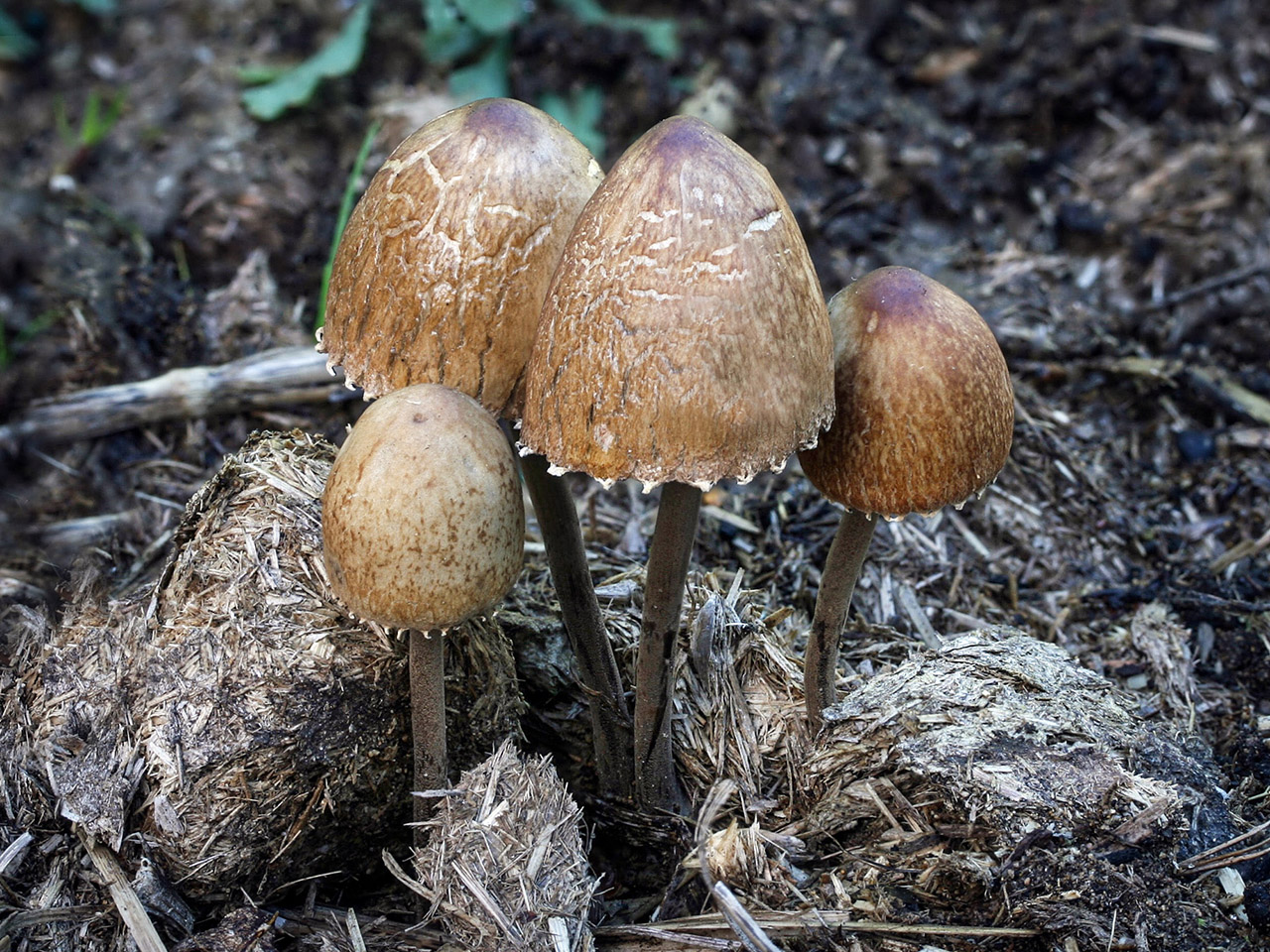
Panaeolus papilionaceus, commonly known as the Dung Bell, is a widespread and common species of mushroom found growing on dung. It is characterized by its bell-shaped cap, often with a slight papilla, and its dark, mottled gills. While not considered psychoactive, it is often confused with other psychoactive species of Panaeolus, making accurate identification crucial.
How to Identify
- Cap
- 1-4 cm in diameter, campanulate (bell-shaped) to convex, often with a distinct papilla (nipple-like projection) in the center. The margin can be slightly incurved when young, becoming straight or slightly upturned with age, sometimes with remnants of a partial veil. Color varies from grayish-brown to yellowish-brown, often paler towards the margin, and can be hygrophanous, fading to a lighter tan or buff when dry. The surface is smooth, sometimes finely striate when moist.
- Gills
- Adnate to adnexed, close, broad, and often mottled due to the uneven ripening of spores. Initially grayish, becoming dark brown to black with age as spores mature. The gill edges are often paler.
- Stem
- 3-10 cm long, 1-4 mm thick, slender, cylindrical, often slightly tapering upwards. Color is whitish to grayish-brown, often darker towards the base. The surface is smooth or finely pruinose (powdery) at the apex. It is hollow and fragile, without a ring, though a temporary fibrillose zone may be present from the partial veil.
- Flesh
- Thin, fragile, whitish to grayish, without a distinctive odor or taste.
- Fruiting body
- Small to medium-sized agaric, typically growing gregariously or scattered.
- Habitat
- Saprobic, growing directly on dung (especially horse, cow, and sheep dung) or on heavily manured soil. It is a common species in pastures, fields, and gardens.
Key Facts
- Cap surfaces: Smooth, sometimes finely striate when moist
- Growth Form: Gregarious or scattered
- Spore Print: Jet black
- Body color: Grayish-brown to yellowish-brown
- Odor: Indistinct
- Flesh bruises: No significant bruising reaction
- Height: 3-10 cm
- Cap Diameter: 1-4 cm
- Nutrient gathering: Saprobic
Safe
SafePanaeolus papilionaceus is generally considered non-toxic, but it is not recommended for consumption due to its lack of culinary value and the high risk of confusion with psychoactive Panaeolus species. While it does not contain psilocybin, some sources suggest it may contain trace amounts of other indole compounds, though this is not well-established. The primary danger lies in misidentification with species like Panaeolus cinctulus or Panaeolus cyanescens, which are hallucinogenic. Therefore, it should be treated with extreme caution and never consumed.
Quick Check
- Odor: Indistinct
- Fruiting: Spring to Autumn
- Substrate: Dung (coprophilous)
Where to Find
Pastures and Fields
Commonly found in grassy areas where livestock graze, particularly on horse or cow dung.
Manured Gardens
Can appear in gardens or cultivated areas that have been fertilized with animal manure.
Roadsides
Occasionally found on dung along roadsides or trails.
Finding Tips
Check Dung
Focus your search on fresh or aged animal dung, especially from herbivores like horses and cows.
Look for Bell Shape
Identify the characteristic bell-shaped cap, often with a central papilla.
Observe Gill Mottling
Note the distinctive mottled appearance of the gills, which is a key feature of Panaeolus species.
Seasonal Timing
Search during warmer, moist periods from spring through autumn, as these conditions favor its growth.
Similar Species
Mottled Gilled Panaeolus
Panaeolus
Also known as: Panaeolus sphinctrinus
Panaeolus foenisecii
Panaeolus
Also known as: Haymaker's Mushroom
Panaeolus cinctulus
Panaeolus
Also known as: Banded Mottlegill
Panaeolus cyanescens
Panaeolus
Also known as: Blue Meanie
Scientific Classification
- Phylum
- Basidiomycota
- Class
- Agaricomycetes
- Order
- Agaricales
- Family
- Psathyrellaceae
- Genus
- Panaeolus
Storage Information
- Max Temperature: Not applicable
- Freezing duration: Not applicable
- Min Temperature: Not applicable
- Refrigeration: Not applicable
How to Clean
Not applicable. This mushroom is not recommended for consumption.
Explore Dung Bell
Identify mushrooms anywhere
Free on iOS, Android, and Web. Photo identification, full database, and your personal collection.