
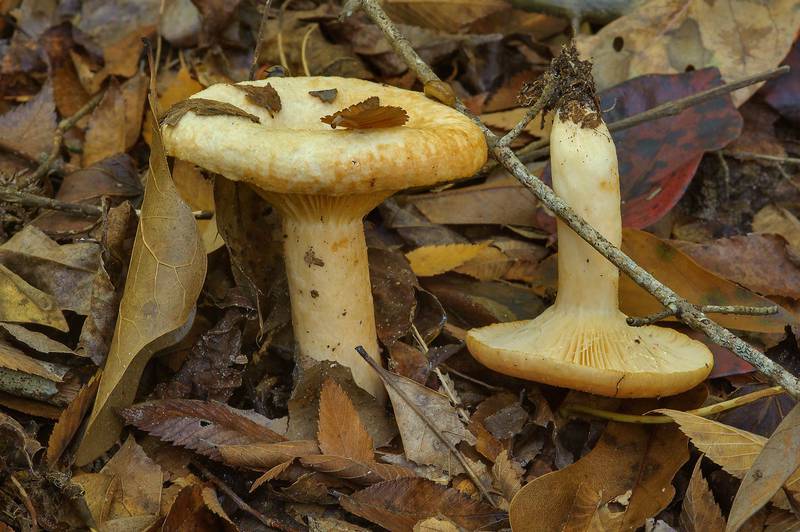
How to identify Milkcap
Lactarius
Got a photo? Identify mushrooms instantly with the Mushby app
Open the appTo correctly identify Milkcap (Lactarius), check each of these features in order. Misidentification is the most common cause of mushroom poisoning, so cross-reference multiple sources.
Step-by-step identification
- 1
Cap
Shape, color, surface texture, and diameter.
Caps vary greatly in size (2-20 cm), shape (convex, plano-convex, depressed, infundibuliform), color (white, yellow, orange, brown, green, purple), and surface texture (smooth, sticky, hairy, scaly, zoned). Many species have a central depression or umbo. The margin can be inrolled, straight, or wavy.
- 2
Gills
Attachment to stem, color, and spacing.
Adnate, decurrent, or subdecurrent, often crowded, and typically brittle. Gill color varies from white to cream, yellow, orange, or brownish, and can change with age or bruising. The latex is most readily observed by breaking a gill.
- 3
Stem
Length, shape, surface, and any ring.
Cylindrical, often tapering towards the base or apex, sometimes hollow or chambered. Surface can be smooth, pruinose, or scrobiculate (pitted). Color often matches the cap or is paler. Typically central, but can be eccentric.
- 4
Flesh
Color, texture, and bruising reaction.
Brittle, granular, and often breaks cleanly, similar to Russula. When cut or broken, it exudes a milky latex. The color of the flesh and the latex, and any color changes upon exposure to air, are important diagnostic features.
- 5
Fruiting body
Overall growth pattern.
Typically agaricoid (mushroom-shaped) with a cap, gills, and central or eccentric stem. The most defining characteristic is the production of latex when injured.
- 6
Habitat
Where it grows and on what substrate.
Ectomycorrhizal, forming symbiotic relationships with various trees (conifers and hardwoods) and shrubs. Found growing on the ground in forests, woodlands, and sometimes in parks or gardens, usually solitary or scattered, occasionally gregarious.
Key Facts
- Cap surfaces
- Smooth, sticky, dry, hairy, scaly, zoned, or pitted.
- Growth Form
- Solitary, scattered, or gregarious.
- Spore Print
- White to cream or pale yellow.
- Body color
- Highly variable across the genus, ranging from white, yellow, orange, red, brown, green, to purple.
- Odor
- Variable; mild, fruity, fishy, fenugreek-like, or indistinct.
- Flesh bruises
- Some species show color changes in the flesh or latex upon bruising or exposure to air (e.g., L. indigo turns green, L. deliciosus turns green).
- Height
- Typically 3-15 cm, but can vary from 2 cm to over 20 cm.
- Cap Diameter
- Typically 2-20 cm, with some species having smaller or larger caps.
Fruit body characteristics
- Gill attachment: Adnate, decurrent, or subdecurrent.
- Stem shape: Cylindrical, tapering towards base or apex, sometimes clavate.
- Stem surface: Smooth, pruinose, scrobiculate (pitted), or dry.
- Ring: Absent.
- Stem cross-section: Solid, stuffed, or hollow/chambered.
Explore Milkcap
Identify mushrooms anywhere
Free on iOS, Android, and Web. Photo identification, full database, and your personal collection.