
How to identify Artist's Conk
Ganoderma adspersum
Got a photo? Identify mushrooms instantly with the Mushby app
Open the appTo correctly identify Artist's Conk (Ganoderma adspersum), check each of these features in order. Misidentification is the most common cause of mushroom poisoning, so cross-reference multiple sources.
Step-by-step identification
- 1
Cap
Shape, color, surface texture, and diameter.
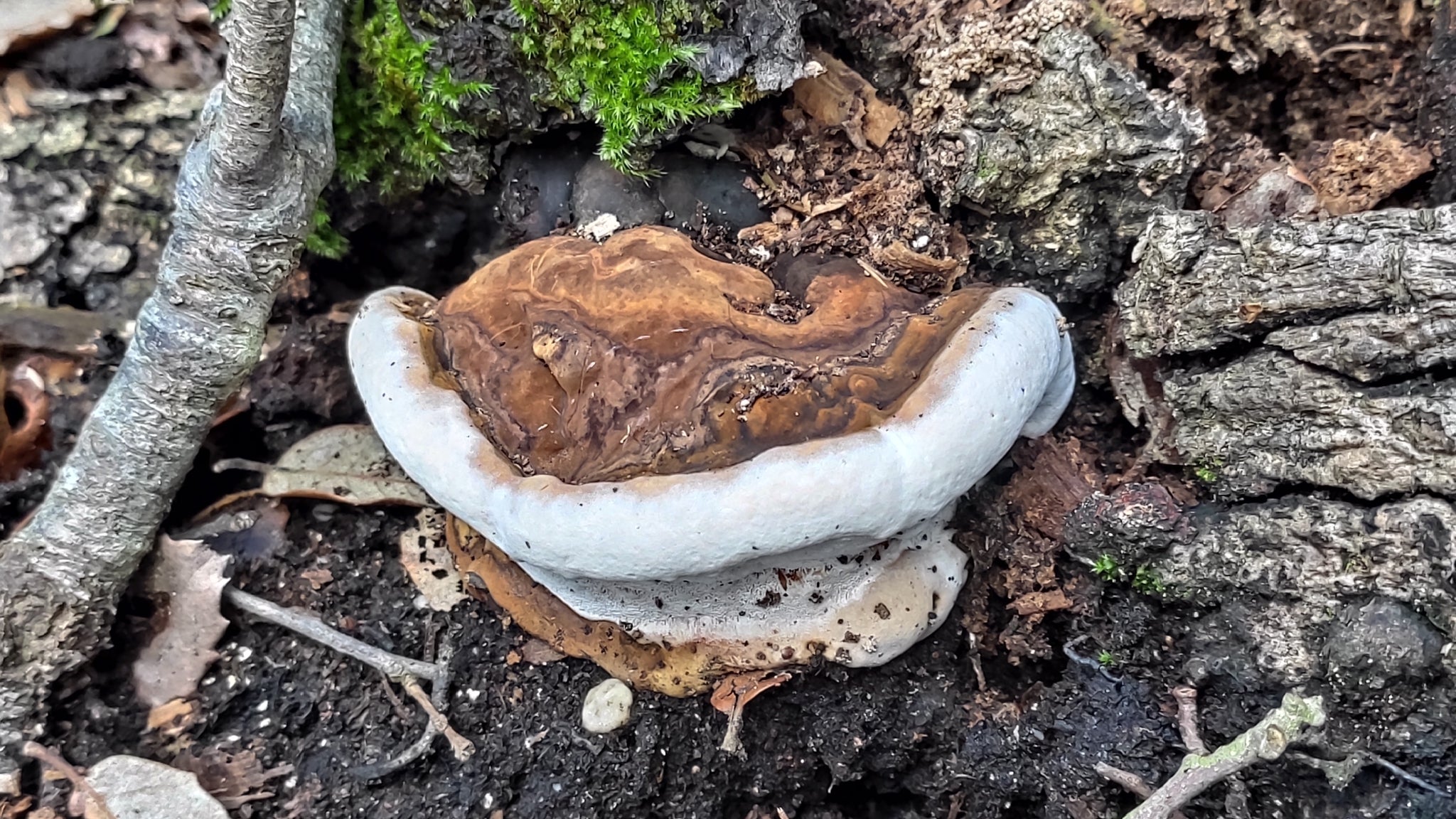
The upper surface (pileus) is dull to somewhat shiny, often lacking a prominent 'varnished' appearance compared to other Ganoderma species (though some regional variations can show some varnish). The color ranges from gray-brown to dark gray or blackish, often with concentric growth zones (zonate) and radial furrows or lumps. The margin (edge) is typically thick, rounded, and often lighter in color, usually whitish to yellowish-brown, especially in actively growing areas. It can be quite lumpy and irregular.
- 2
Gills
Attachment to stem, color, and spacing.
Ganoderma adspersum, being a polypore, does not have gills but rather a pore surface. The pore surface is creamy white to buff, becoming grayish or brownish with age. It is remarkable for instantly bruising dark brown or black when touched or scratched, making it a popular medium for 'drawing' by artists. The pores are very minute, 4-6 per millimeter, with thin dissepiments (walls between pores). The tube layer (below the pore surface) is brown, layering indistinctly in older specimens, up to 1-2 cm thick.
- 3
Stem
Length, shape, surface, and any ring.
This species is sessile, meaning it lacks a true stem (stipe). It grows directly attached to the host substrate.
- 4
Flesh
Color, texture, and bruising reaction.
The flesh is very tough, corky to woody, and fibrous. It is uniformly brown, often a reddish-brown or cinnamon-brown color, without significant marbling or changes in color upon exposure to air.
- 5
Fruiting body
Overall growth pattern.
The fruiting body is a large, perennial, sessile (lacking a stalk) bracket fungus, typically hoof-shaped to ungulate or triquetrous (triangular in cross-section). It grows directly out from the host tree or wood. The entire fruiting body can range from 10 to 60 cm (4 to 24 inches) across and often extends outward 5 to 20 cm (2 to 8 inches) from the substrate, with a thickness of 5 to 15 cm (2 to 6 inches) at the point of attachment. Younger specimens may be lighter in color, becoming darker and woodier with age. The weighty nature is notable.
- 6
Habitat
Where it grows and on what substrate.
Typically found solitary or in small groups, growing saprobically on dead logs, stumps, or fallen branches of deciduous trees, and also as a parasite on the base of living deciduous trees, causing a white rot. Favored hosts include oak, beech, maple, and other hardwoods. Less commonly found on conifers.
Key Facts
- Cap surfaces
- Dull to somewhat shiny, often lumpy or radially furrowed, gray-brown to blackish, margin often whitish/yellowish.
- Growth Form
- Sessile, solitary or in small overlapping groups.
- Spore Print
- Brown to reddish-brown.
- Body color
- Upper surface dull gray to blackish-brown; pore surface creamy white, bruising dark brown/black; flesh brown.
- Odor
- Mild, indistinct.
- Flesh bruises
- Not applicable to flesh; pore surface bruises instantly dark brown/black.
- Height
- Not applicable (sessile); thickness up to 15 cm (6 inches).
- Cap Diameter
- 10-60 cm (4-24 inches) across.
Fruit body characteristics
- Gill attachment: Not applicable (polypore, no gills).
- Stem shape: Not applicable (sessile).
- Stem surface: Not applicable (sessile).
- Ring: Absent.
- Stem cross-section: Not applicable (sessile).
Explore Artist's Conk
Identify mushrooms anywhere
Free on iOS, Android, and Web. Photo identification, full database, and your personal collection.