
Got a photo? Identify mushrooms instantly with the Mushby app
Open the appDescription
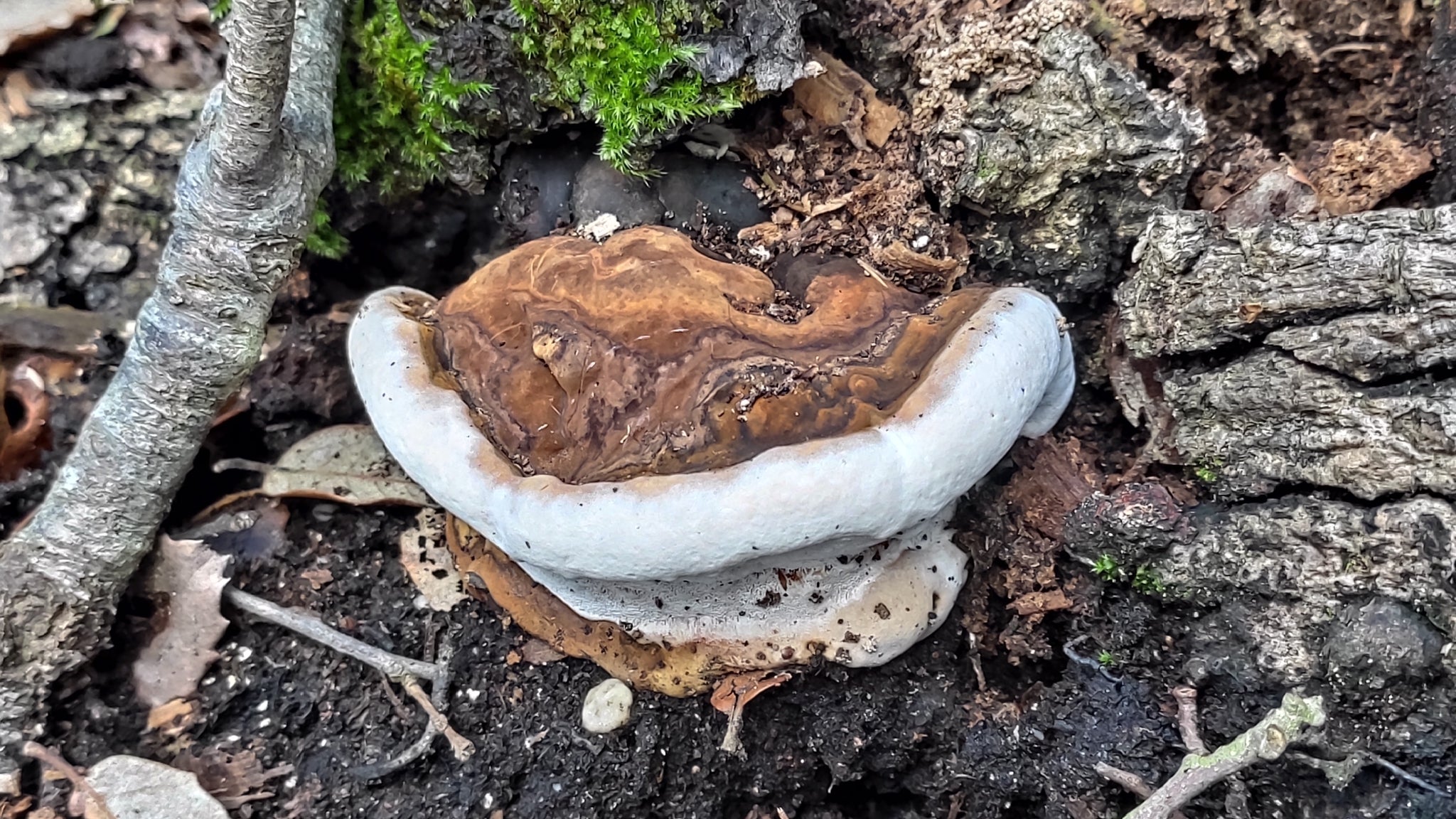
Ganoderma adspersum, commonly known as the Artist's Conk, is a large, perennial, woody polypore fungus belonging to the genus Ganoderma. It is characterized by its dull to somewhat shiny, often lumpy or radially furrowed upper surface and a distinct, creamy white pore surface that darkens instantly when bruised or 'drawn' upon. This species is saprobic and parasitic, primarily found growing on the base of living deciduous trees, or on dead stumps and logs. Its robust nature allows it to persist for many years, adding new layers of growth annually, forming a large, hoof-shaped conk.
How to Identify
- Cap
- The upper surface (pileus) is dull to somewhat shiny, often lacking a prominent 'varnished' appearance compared to other Ganoderma species (though some regional variations can show some varnish). The color ranges from gray-brown to dark gray or blackish, often with concentric growth zones (zonate) and radial furrows or lumps. The margin (edge) is typically thick, rounded, and often lighter in color, usually whitish to yellowish-brown, especially in actively growing areas. It can be quite lumpy and irregular.
- Gills
- Ganoderma adspersum, being a polypore, does not have gills but rather a pore surface. The pore surface is creamy white to buff, becoming grayish or brownish with age. It is remarkable for instantly bruising dark brown or black when touched or scratched, making it a popular medium for 'drawing' by artists. The pores are very minute, 4-6 per millimeter, with thin dissepiments (walls between pores). The tube layer (below the pore surface) is brown, layering indistinctly in older specimens, up to 1-2 cm thick.
- Stem
- This species is sessile, meaning it lacks a true stem (stipe). It grows directly attached to the host substrate.
- Flesh
- The flesh is very tough, corky to woody, and fibrous. It is uniformly brown, often a reddish-brown or cinnamon-brown color, without significant marbling or changes in color upon exposure to air.
- Fruiting body
- The fruiting body is a large, perennial, sessile (lacking a stalk) bracket fungus, typically hoof-shaped to ungulate or triquetrous (triangular in cross-section). It grows directly out from the host tree or wood. The entire fruiting body can range from 10 to 60 cm (4 to 24 inches) across and often extends outward 5 to 20 cm (2 to 8 inches) from the substrate, with a thickness of 5 to 15 cm (2 to 6 inches) at the point of attachment. Younger specimens may be lighter in color, becoming darker and woodier with age. The weighty nature is notable.
- Habitat
- Typically found solitary or in small groups, growing saprobically on dead logs, stumps, or fallen branches of deciduous trees, and also as a parasite on the base of living deciduous trees, causing a white rot. Favored hosts include oak, beech, maple, and other hardwoods. Less commonly found on conifers.
Key Facts
- Cap surfaces: Dull to somewhat shiny, often lumpy or radially furrowed, gray-brown to blackish, margin often whitish/yellowish.
- Growth Form: Sessile, solitary or in small overlapping groups.
- Spore Print: Brown to reddish-brown.
- Body color: Upper surface dull gray to blackish-brown; pore surface creamy white, bruising dark brown/black; flesh brown.
- Odor: Mild, indistinct.
- Flesh bruises: Not applicable to flesh; pore surface bruises instantly dark brown/black.
- Height: Not applicable (sessile); thickness up to 15 cm (6 inches).
- Cap Diameter: 10-60 cm (4-24 inches) across.
- Nutrient gathering: Saprobic (on dead wood) and parasitic (on living trees), causing white rot.
Safe
SafeGanoderma adspersum is considered inedible due to its extremely tough, woody texture. It is not known to be toxic, but its consistency makes it unsuitable for consumption. There are no reported cases of poisoning from ingesting this mushroom. However, like any wild mushroom, individual sensitivities can occur, and caution should always be exercised.
Quick Check
- Odor: Mild, faintly fungoid to somewhat reminiscent of licorice, not distinctive.
- Fruiting: Perennial, hoof-shaped to ungulate bracket, growing directly on wood.
- Substrate: Deciduous trees (living or dead), rarely conifers.
Where to Find
North America
Widely distributed throughout temperate regions of North America, particularly in the eastern United States and Canada where deciduous forests are prevalent.
Europe
Common across much of Europe, from the United Kingdom to continental Europe, thriving in similar deciduous forest ecosystems.
Asia
Also reported in parts of Asia, though its distribution might overlap with other closely related Ganoderma species which can be difficult to distinguish without microscopic examination or genetic analysis.
Finding Tips
Look for Hardwoods
Focus your search in deciduous forests, particularly those with older oak, maple, beech, or birch trees, as these are preferred hosts for Ganoderma adspersum. Check around the base of living trees and on fallen logs or stumps.
Examine Tree Bases
Artist's Conk frequently grows at the base of living trees, often near the ground level or slightly higher up. Look for the distinctive hoof-shaped brackets protruding from the bark.
Check Deadwood
Do not overlook deadwood. Large, fallen logs and stumps, especially of deciduous species, are prime locations for this saprobic fungus.
Year-Round Presence
While spore production is strongest in warmer months, the perennial fruiting bodies can be found year-round. They persist for many seasons, growing larger over time.
Pore Surface Test
To confirm identification, gently scratch or draw on the creamy white underside (pore surface). If it instantly bruises dark brown to black, it is a strong indicator of an Artist's Conk (Ganoderma species capable of this, including G. adspersum and G. applanatum).
Similar Species
Reishi Mushroom
Polypore fungus
Also known as: Lingzhi
Artist's Conk
Polypore fungus
Also known as: Ganoderma applanatum
Varnished Ganoderma
Polypore fungus
Also known as: Ganoderma lucidum
Hemlock Varnish Shelf
Polypore fungus
Also known as: Ganoderma tsugae
Scientific Classification
- Phylum
- Basidiomycota
- Class
- Agaricomycetes
- Order
- Polyporales
- Family
- Ganodermataceae
- Genus
- Ganoderma
Storage Information
- Max Temperature: N/A
- Freezing duration: N/A
- Min Temperature: N/A
- Refrigeration: N/A
How to Clean
Artist's Conk is not typically cleaned for culinary purposes as it is inedible. If collected for artistic purposes, a dry brush can be used to remove loose debris. Avoid wetting the pore surface if you intend to draw on it.
Explore Artist's Conk
Identify mushrooms anywhere
Free on iOS, Android, and Web. Photo identification, full database, and your personal collection.