
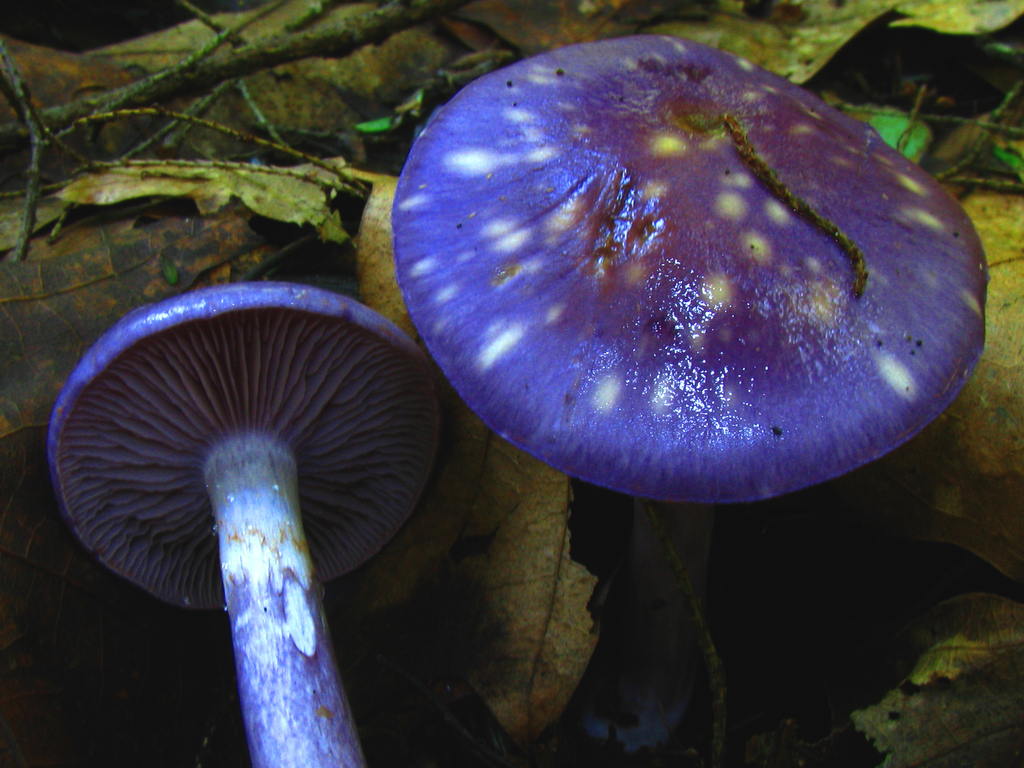
How to identify Blue-belted Cortinarius
Cortinarius collinitus
Got a photo? Identify mushrooms instantly with the Mushby app
Open the appTo correctly identify Blue-belted Cortinarius (Cortinarius collinitus), check each of these features in order. Misidentification is the most common cause of mushroom poisoning, so cross-reference multiple sources.
Step-by-step identification
- 1
Cap
Shape, color, surface texture, and diameter.
5-12 cm in diameter, convex to broadly umbonate, becoming flattened with age. The surface is distinctly viscid to slimy, especially when moist, with an even margin. Color ranges from yellow-brown to orange-brown or reddish-brown, often darker towards the center. It may be slightly striate at the margin when wet.
- 2
Gills
Attachment to stem, color, and spacing.
Adnexed to adnate, relatively crowded, and thick. They are initially pale grayish-blue to pallid, becoming cinnamon-brown to rusty-brown with the maturation of spores.
- 3
Stem
Length, shape, surface, and any ring.
6-15 cm long and 1-2.5 cm thick. Cylindrical to club-shaped, often tapering towards the base. The most striking feature is its thick covering of clear, colorless or bluish-tinged slime, especially when young, often obscuring a characteristic bluish subcortinal zone. Above the slimy zone, fine cortinal remnants may be visible, which are initially whitish blue. The universal veil forms rings of slime or glutinous sheaths on the stem.
- 4
Flesh
Color, texture, and bruising reaction.
Whitish to pale yellowish, firm, and rather thick in the cap. It does not change color when cut or bruised.
- 5
Fruiting body
Overall growth pattern.
The fruit body is agaricoid (gilled mushroom), robust, and typically slimy throughout, particularly the stem.
- 6
Habitat
Where it grows and on what substrate.
Mycorrhizal, primarily with conifers (especially spruce, pine, and fir), but also occasionally with hardwoods like birch. Grows solitarily or scattered in coniferous and mixed woods.
Key Facts
- Cap surfaces
- Viscid to slimy
- Growth Form
- Solitary to scattered
- Spore Print
- Rusty-brown
- Body color
- Cap: Yellow-brown to orange-brown; Gills: Pale becoming rusty-brown; Stem: Whitish to pale yellowish, often with bluish tints, covered in clear slime.
- Odor
- Indistinct
- Flesh bruises
- No significant bruising or color change.
- Height
- 6-15 cm
- Cap Diameter
- 5-12 cm
Fruit body characteristics
- Gill attachment: Adnexed to adnate
- Stem shape: Cylindrical to club-shaped, often tapering at the base
- Stem surface: Covered in thick, clear, gelatinous slime, often with a bluish zone superiorly, and sometimes with remnants of the cortina.
- Ring: No true ring, but a slimy glutinous sheath covers the stem, and cobweb-like cortinal remnants (often bluish) are present when young and connect the cap margin to the stem.
- Stem cross-section: Solid
Explore Blue-belted Cortinarius
Identify mushrooms anywhere
Free on iOS, Android, and Web. Photo identification, full database, and your personal collection.