
Got a photo? Identify mushrooms instantly with the Mushby app
Open the appDescription
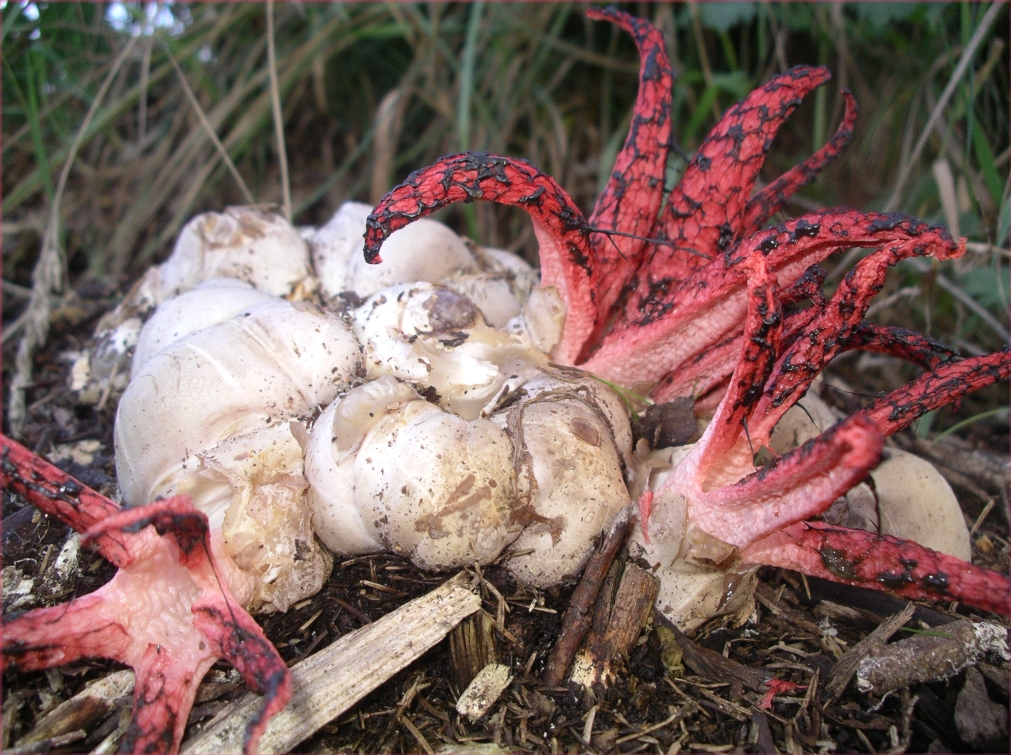
Clathrus archeri, commonly known as Devil's Fingers or Octopus Stinkhorn, is a fascinating and often startling fungus belonging to the stinkhorn group. It is characterized by its dramatic emergence from an egg-like structure, developing into several radiating red arms that are covered in a dark, spore-bearing gleba with a putrid odor. This odor attracts insects which then aid in spore dispersal. Originally native to Australia, New Zealand, Tasmania, and some islands in the South Pacific, it has become an invasive species in Europe and parts of North America due to human activity, primarily through the movement of soil and plants.
How to Identify
- Cap
- Not applicable; this species does not have a distinct cap in the traditional sense. The gleba (spore-bearing tissue) covers the inner surfaces of the radiating arms.
- Gills
- Not applicable; this is a gasteromycete and does not produce gills. Spores are produced on the surface of the gleba.
- Stem
- Not applicable; there is no traditional stem. The arms emerge directly from the ruptured volva (remnant of the 'egg').
- Flesh
- The 'flesh' of the arms is spongy, fragile, and hollow. The immature 'egg' contains a firm, white, gelatinous inner layer that transitions to a reddish or pinkish color as it matures.
- Fruiting body
- Initially, it appears as a whitish, gelatinous egg, 3-6 cm in diameter, often buried or partially buried in the substrate, with faint pinkish or reddish tints. As it matures, the egg ruptures, revealing 4-7 (occasionally more) slender, bright red to reddish-orange arms that radiate outwards. These arms are connected at their base and sometimes at the tip when young, but typically separate and become free as they mature. Each arm is 4-10 cm long and 1-2 cm thick, often tapering towards the tip. The inner surface of the arms is covered in a dark olive-brown to blackish-green, slimy, gelatinous gleba which produces the characteristic foul odor. The outer surface of the arms is typically paler and finely wrinkled. The arms are hollow, porous, and brittle.
- Habitat
- Saprobic, growing on decaying wood debris, leaf litter, wood chips, and sometimes in grassy areas or disturbed soil. It prefers moist, warm, and somewhat sheltered environments. Often found in gardens, mulched areas, woodlands, and urban parks.
Key Facts
- Cap surfaces: Not applicable (gleba covers inner arm surfaces)
- Growth Form: Solitary to scattered, emerging from an egg-like volva
- Spore Print: Blackish-green to dark olive-brown (from the gleba)
- Body color: White/pinkish (egg), bright red to reddish-orange (arms)
- Odor: Strongly fetid, resembling decaying meat
- Flesh bruises: Does not typically bruise in a distinct color change
- Height: Arms typically 4-10 cm long, 'egg' 3-6 cm diameter
- Cap Diameter: Not applicable
- Nutrient gathering: Saprobic
Safe
SafeClathrus archeri is considered edible in its 'egg' stage, but it is not commonly consumed due to its rarity and repulsive odor upon maturity. The 'egg' has a mild, radish-like flavor when raw. Once the arms emerge and the gleba develops, the strong, foul odor makes it highly unpalatable and unappetizing. There are no known toxins associated with this species, but its consumption is generally discouraged due to its unpleasant characteristics and potential for mild gastrointestinal upset if eaten mature or in large quantities. Always exercise extreme caution and certainty with mushroom identification before consumption. Never consume any wild mushroom unless 100% sure of its identification and edibility.
Quick Check
- Odor: Putrid, carrion-like, offensive (especially when mature)
- Fruiting: Starts as a 'witch's egg', then ruptures into 4-7 bright red, finger-like arms covered in dark gleba.
- Substrate: Decaying wood, leaf litter, disturbed soil, mulch
Where to Find
Gardens and Mulched Areas
Often found in cultivated areas where wood chips or mulch have been used, providing ample decaying organic matter.
Woodlands and Forest Edges
Can be found in deciduous and mixed forests, particularly on the edges or in areas with disturbed soil and decaying woody debris.
Parks and Urban Green Spaces
Due to its invasive nature and preference for disturbed sites, it frequently appears in urban parks and other managed green spaces.
Finding Tips
Look for the 'Egg' Stage
Before the arms emerge, search for white to pinkish-red, gelatinous egg-like structures partially buried in the substrate. These are less conspicuous but indicate the presence of the fungus.
Follow the Odor
When mature, the putrid, carrion-like odor is a strong indicator of its presence, especially on still, warm days.
Check Decaying Wood Substrates
Focus your search on areas with decomposing wood, leaf litter, and wood chip mulch, as these are its preferred habitats.
Seasonal Awareness
While it can fruit throughout the warmer months, late summer and autumn are often peak times for observation, especially after periods of rain.
Similar Species
Stinkhorn
Fungus
Also known as: Phallus impudicus
Elegant Stinkhorn
Fungus
Also known as: Mutinus elegans
Columned Stinkhorn
Fungus
Also known as: Clathrus columnatus
Scientific Classification
- Phylum
- Basidiomycota
- Class
- Agaricomycetes
- Order
- Phallales
- Family
- Phallaceae
- Genus
- Clathrus
Storage Information
- Max Temperature: Not Applicable
- Freezing duration: Not Applicable
- Min Temperature: Not Applicable
- Refrigeration: Not Applicable
How to Clean
Not applicable as this species is generally not collected for culinary purposes. If handled, gloves are recommended due to the strong odor and slimy gleba. Any remnants on hands or tools can be washed with soap and water.
Explore Stinkhorn
Identify mushrooms anywhere
Free on iOS, Android, and Web. Photo identification, full database, and your personal collection.