
How to identify Summer Bolete
Boletus aestivalis
Got a photo? Identify mushrooms instantly with the Mushby app
Open the appTo correctly identify Summer Bolete (Boletus aestivalis), check each of these features in order. Misidentification is the most common cause of mushroom poisoning, so cross-reference multiple sources.
Step-by-step identification
- 1
Cap
Shape, color, surface texture, and diameter.
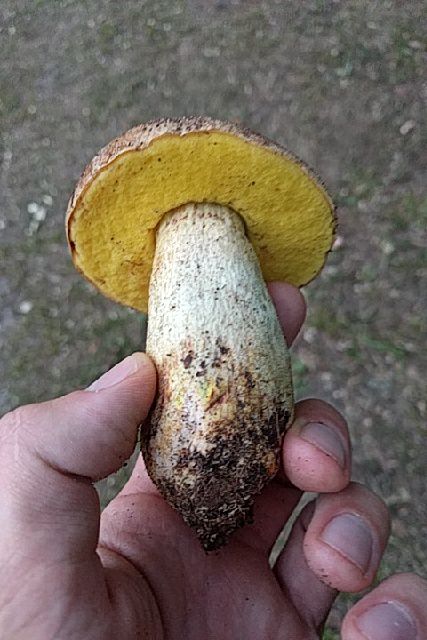
The cap measures 6-20 cm (2.4-7.9 in) in diameter, occasionally larger. It is initially hemispherical, expanding to convex and then plano-convex in maturity. The color ranges from various shades of brown: pale coffee brown, yellowish-brown, ochre, or hazel-brown, often paler at the margin. A key distinguishing feature is its velvety surface, which frequently cracks into an intricate network, especially in dry weather, revealing paler flesh beneath. These cracks are particularly prominent in mature specimens. The cap cuticle is dry and not viscid, even when wet.
- 2
Gills
Attachment to stem, color, and spacing.
Spore-bearing surface consists of tubes and pores. The tubes are initially whitish, becoming yellow-green to olive-green with age. The pores are small, circular, and concolorous with the tubes, not bruising blue when touched. This is a crucial differentiating feature from many blue-staining boletes.
- 3
Stem
Length, shape, surface, and any ring.
The stem is robust, typically 5-15 cm (2-6 in) long and 2-6 cm (0.8-2.4 in) thick. It is usually bulbous or club-shaped when young, becoming more cylindrical or slightly clavate with age. The color is often paler than the cap, whitish or brownish. The entire surface is covered by a fine, whitish to pale brown reticulation (net-like pattern) that extends from the apex almost to the base, a very important diagnostic character.
- 4
Flesh
Color, texture, and bruising reaction.
The flesh is thick, firm, and white, remaining white or very subtly discoloring upon cutting, but not bruising blue. It has a mild, nutty, mushroomy taste and a pleasant, often intense, fungal odor.
- 5
Fruiting body
Overall growth pattern.
The fruit body of Boletus aestivalis is robust and fleshy, typical of a 'cep' type mushroom.
- 6
Habitat
Where it grows and on what substrate.
This mushroom is mycorrhizal, forming symbiotic relationships with a variety of broadleaf trees, predominantly oak (Quercus spp.), but also beech (Fagus sylvatica), hornbeam (Carpinus betulus), and chestnut (Castanea sativa). It typically grows terrestrially in deciduous and mixed woodlands, preferring well-drained, often calcareous soils.
Key Facts
- Cap surfaces
- Velvety, often cracked, dry
- Growth Form
- Solitary or scattered
- Spore Print
- Olive-brown
- Body color
- Brownish cap, whitish to brownish stem with pale reticulation, white flesh
- Odor
- Mild, pleasant, fungal
- Flesh bruises
- Does not bruise blue or only very subtly discolors
- Height
- 5-15 cm (2-6 in)
- Cap Diameter
- 6-20 cm (2.4-7.9 in)
Fruit body characteristics
- Gill attachment: Adnexed (referring to tubes, not gills)
- Stem shape: Bulbous to club-shaped when young, becoming cylindrical or clavate
- Stem surface: Covered with a prominent white to pale brown reticulation (net-like pattern)
- Ring: Absent
- Stem cross-section: Solid
Explore Summer Bolete
Identify mushrooms anywhere
Free on iOS, Android, and Web. Photo identification, full database, and your personal collection.