
Got a photo? Identify mushrooms instantly with the Mushby app
Open the appDescription
Boletus aestivalis, commonly known as the Summer Bolete, is a prized edible mushroom belonging to the Boletaceae family. It is closely related to the better-known Porcini mushroom (Boletus edulis) and is highly valued for its excellent culinary qualities. The species was first described by Jean-Jacques Paulet in 1793 as Boletus aestivalis and later reclassified by Elias Magnus Fries in 1838. It is characterized by its velvety, often cracked cap, reticulated stem, and a mild, pleasant aroma and taste.
How to Identify
- Cap
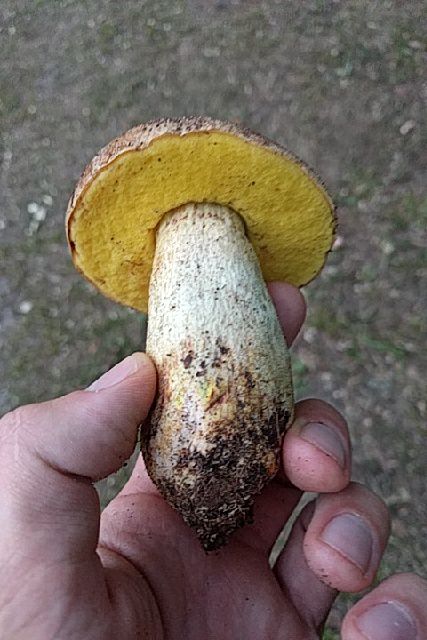
- The cap measures 6-20 cm (2.4-7.9 in) in diameter, occasionally larger. It is initially hemispherical, expanding to convex and then plano-convex in maturity. The color ranges from various shades of brown: pale coffee brown, yellowish-brown, ochre, or hazel-brown, often paler at the margin. A key distinguishing feature is its velvety surface, which frequently cracks into an intricate network, especially in dry weather, revealing paler flesh beneath. These cracks are particularly prominent in mature specimens. The cap cuticle is dry and not viscid, even when wet.
- Gills
- Spore-bearing surface consists of tubes and pores. The tubes are initially whitish, becoming yellow-green to olive-green with age. The pores are small, circular, and concolorous with the tubes, not bruising blue when touched. This is a crucial differentiating feature from many blue-staining boletes.
- Stem
- The stem is robust, typically 5-15 cm (2-6 in) long and 2-6 cm (0.8-2.4 in) thick. It is usually bulbous or club-shaped when young, becoming more cylindrical or slightly clavate with age. The color is often paler than the cap, whitish or brownish. The entire surface is covered by a fine, whitish to pale brown reticulation (net-like pattern) that extends from the apex almost to the base, a very important diagnostic character.
- Flesh
- The flesh is thick, firm, and white, remaining white or very subtly discoloring upon cutting, but not bruising blue. It has a mild, nutty, mushroomy taste and a pleasant, often intense, fungal odor.
- Fruiting body
- The fruit body of Boletus aestivalis is robust and fleshy, typical of a 'cep' type mushroom.
- Habitat
- This mushroom is mycorrhizal, forming symbiotic relationships with a variety of broadleaf trees, predominantly oak (Quercus spp.), but also beech (Fagus sylvatica), hornbeam (Carpinus betulus), and chestnut (Castanea sativa). It typically grows terrestrially in deciduous and mixed woodlands, preferring well-drained, often calcareous soils.
Key Facts
- Cap surfaces: Velvety, often cracked, dry
- Growth Form: Solitary or scattered
- Spore Print: Olive-brown
- Body color: Brownish cap, whitish to brownish stem with pale reticulation, white flesh
- Odor: Mild, pleasant, fungal
- Flesh bruises: Does not bruise blue or only very subtly discolors
- Height: 5-15 cm (2-6 in)
- Cap Diameter: 6-20 cm (2.4-7.9 in)
- Nutrient gathering: Ectomycorrhizal
Safe
SafeBoletus aestivalis is considered an excellent edible mushroom. However, consuming raw boletes can cause gastrointestinal upset in some individuals; therefore, it should always be thoroughly cooked. It is crucial to distinguish it from potentially toxic or bitter lookalikes. People with known mushroom allergies or sensitive digestive systems should consume it in moderation the first time. There are no known toxins in Boletus aestivalis itself.
Quick Check
- Odor: Pleasant, mild, mushroomy
- Fruiting: Early summer to early autumn, peaking in summer
- Substrate: Terrestrial, mycorrhizal with broadleaf trees
Where to Find
Deciduous Woodlands
Commonly found under oak, beech, hornbeam, and sweet chestnut trees.
Mixed Woodlands
Can also occur in mixed forests where preferred host trees are present.
Well-drained Soils
Prefers chalky or sandy, well-drained soils, often appearing on slopes or woodland edges.
Finding Tips
Seasonality
As its common name suggests, the Summer Bolete fruits primarily in summer, starting from late May or early June and continuing through August and sometimes into September, earlier than Boletus edulis. It thrives in warm, humid conditions following summer rains.
Geographic Distribution
Widespread throughout Europe, particularly in central and southern regions. It is also reported from parts of North America (where it may be represented by a closely related species or complex) and Asia, though its distribution is primarily Palearctic.
Ecological Role
It is an ectomycorrhizal fungus, essential for the nutrient uptake and health of its host trees. Its fruiting bodies contribute to nutrient cycling in forest ecosystems.
Foraging Tips
Look for cracked caps, especially during dry spells in summer. The prominent reticulation on the stem is a key identifier. Always collect young, firm specimens. Avoid old, soft, or insect-ridden mushrooms. Be absolutely certain of identification to avoid toxic lookalikes. It is considered an excellent edible, highly prized by foragers.
Similar Species
Porcini
Boletus
Also known as: Penny Bun, King Bolete
Bay Bolete
Imleria
Also known as: Bay-brown Bolete
Bitter Bolete
Tylopilus
Also known as: Bitter Scaber Stalk
Scientific Classification
- Phylum
- Basidiomycota
- Class
- Agaricomycetes
- Order
- Boletales
- Family
- Boletaceae
- Genus
- Boletus
Storage Information
- Max Temperature: 4°C
- Freezing duration: 6 months
- Min Temperature: 0°C
- Refrigeration: 5 days
How to Clean
Gently brush off any soil or debris with a soft brush or cloth. If necessary, a slightly damp cloth can be used for persistent dirt, but avoid washing or soaking the mushroom in water as it absorbs liquid readily and can become slimy. Trim off any insect-damaged or overly soft parts of the stem and cap.
Explore Summer Bolete
Identify mushrooms anywhere
Free on iOS, Android, and Web. Photo identification, full database, and your personal collection.