
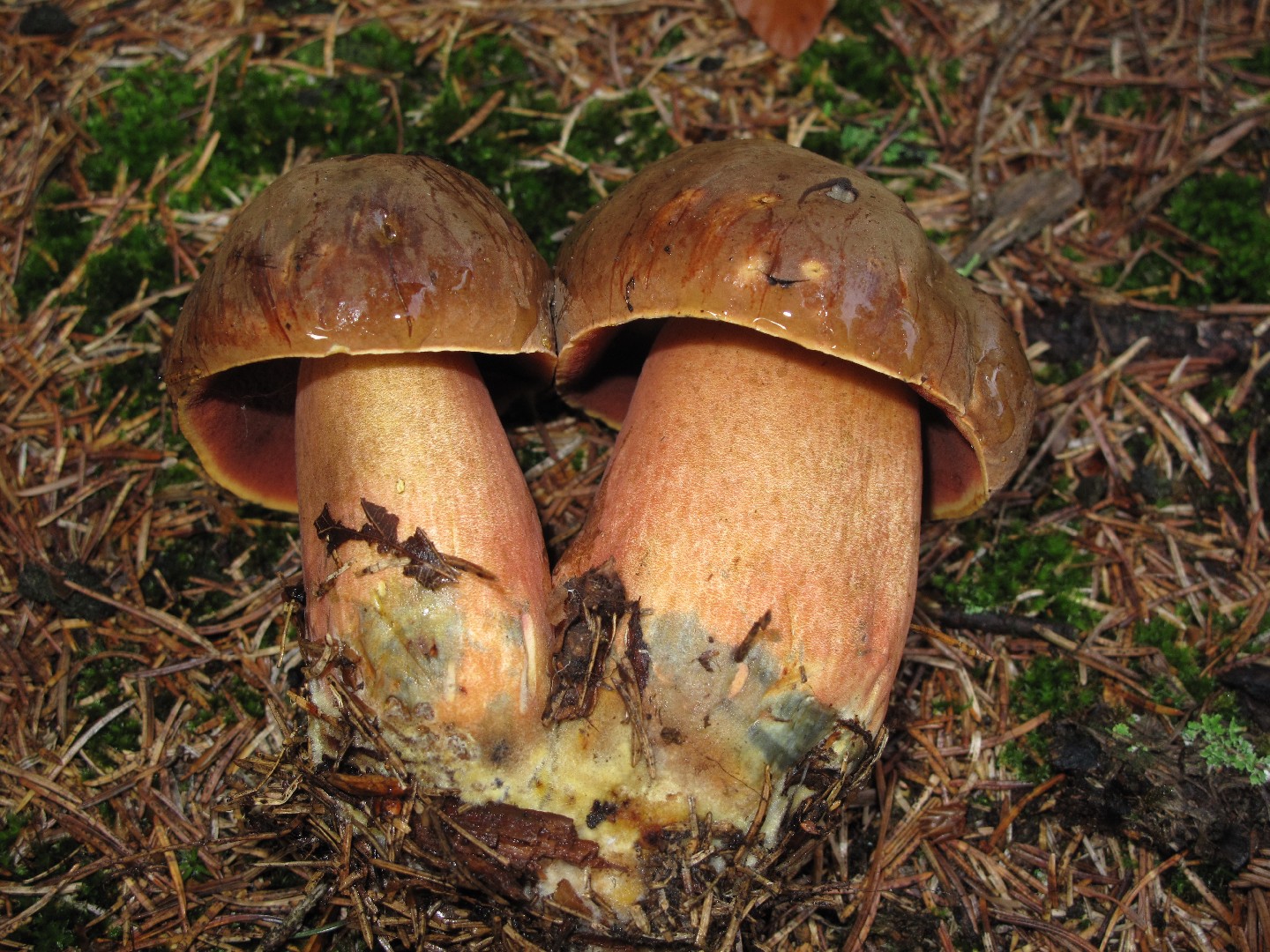
How to identify Unidentified Bolete
Boletaceae
Got a photo? Identify mushrooms instantly with the Mushby app
Open the appTo correctly identify Unidentified Bolete (Boletaceae), check each of these features in order. Misidentification is the most common cause of mushroom poisoning, so cross-reference multiple sources.
Step-by-step identification
- 1
Cap
Shape, color, surface texture, and diameter.
Variable in size (2-30 cm or more), shape (convex to flat), color (white, yellow, red, brown, black), and surface texture (smooth, velvety, sticky, scaly, cracked). The margin can be inrolled, decurved, or straight.
- 2
Gills
Attachment to stem, color, and spacing.
Absent. Instead, boletes have a porous hymenophore. The pore surface can be white, yellow, orange, red, or brown, and the pores themselves can be small and round or larger and angular. The tubes are typically adnate to depressed.
- 3
Stem
Length, shape, surface, and any ring.
Variable in size (3-20 cm tall, 1-8 cm thick), shape (cylindrical, club-shaped, bulbous, tapered), and surface (smooth, reticulate/netted, scabrous/scaly, punctate/dotted). Color can be uniform with the cap or contrasting, often with a basal mycelium of a distinct color.
- 4
Flesh
Color, texture, and bruising reaction.
Thick, firm, and often white or yellowish, but can be red, pink, or blue. Many species exhibit a color change (bluing, reddening) when cut or bruised, which can be an important identification feature.
- 5
Fruiting body
Overall growth pattern.
Typically robust and fleshy, with a distinct cap and central or eccentric stem. The most defining feature is the hymenophore, which consists of tubes terminating in pores, rather than gills.
- 6
Habitat
Where it grows and on what substrate.
Mycorrhizal, forming symbiotic relationships with trees (conifers or hardwoods). Found growing on the ground in forests, woodlands, and sometimes parks or gardens where host trees are present. Rarely found on wood.
Key Facts
- Cap surfaces
- Smooth, velvety, sticky, scaly, cracked, dry, or moist.
- Growth Form
- Solitary to scattered or gregarious.
- Spore Print
- Olive-brown, yellowish-brown, reddish-brown, pinkish-brown, or purplish-brown.
- Body color
- Highly variable across species, encompassing almost the entire spectrum of mushroom colors.
- Odor
- Variable, from mild to strong, sometimes distinctive (e.g., fruity, earthy, unpleasant).
- Flesh bruises
- Often stains blue, red, or brown when cut or bruised; some do not stain.
- Height
- 3-20 cm
- Cap Diameter
- 2-30 cm
Fruit body characteristics
- Gill attachment: Pores, not gills; tubes are typically adnate to depressed.
- Stem shape: Cylindrical, club-shaped, bulbous, tapered, often robust.
- Stem surface: Smooth, reticulate (netted), scabrous (scaly), punctate (dotted), or fibrillose.
- Ring: Absent in most species, but a few may have a rudimentary or evanescent ring.
- Stem cross-section: Solid, rarely hollow.
Explore Unidentified Bolete
Identify mushrooms anywhere
Free on iOS, Android, and Web. Photo identification, full database, and your personal collection.