
How to identify Scaly Earthfan
Thelephora terrestris
Got a photo? Identify mushrooms instantly with the Mushby app
Open the appTo correctly identify Scaly Earthfan (Thelephora terrestris), check each of these features in order. Misidentification is the most common cause of mushroom poisoning, so cross-reference multiple sources.
Step-by-step identification
- 1
Cap
Shape, color, surface texture, and diameter.
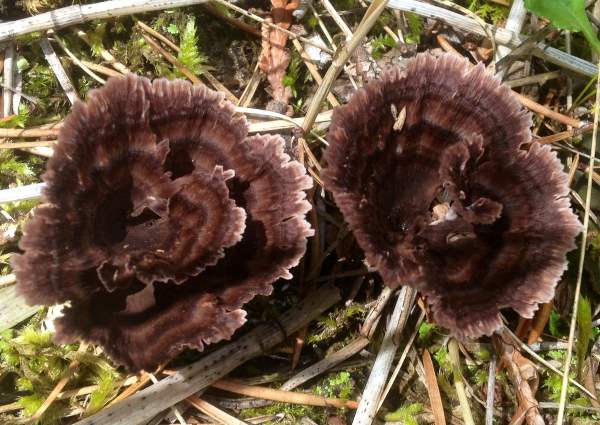
The upper surface of the cap or lobes is typically dark brown to reddish-brown, often with concentric zones of lighter and darker shades. It is characteristically scaly, fibrous, or velvety, especially towards the base, becoming smoother towards the margin. The margin is usually thin, wavy, and often lighter in color, sometimes whitish or yellowish, and can be finely fimbriate (fringed).
- 2
Gills
Attachment to stem, color, and spacing.
The underside (hymenial surface) is smooth to slightly wrinkled or convoluted, lacking true gills. It is typically paler than the upper surface, ranging from whitish to grayish-brown or purplish-brown, often with a pruinose (powdery) appearance due to the spores. When young, it may be whitish, darkening with age.
- 3
Stem
Length, shape, surface, and any ring.
A true stem is usually absent. The fruiting body is sessile or attached directly to the substrate by a broad base. In some forms, particularly when growing on soil, a rudimentary, tough, fibrous stipe-like structure may be present, often covered in debris or mycelial threads.
- 4
Flesh
Color, texture, and bruising reaction.
The flesh is thin, tough, leathery, and fibrous. It is typically brownish, concolorous with the cap surface, and does not change color when bruised or cut.
- 5
Fruiting body
Overall growth pattern.
The fruiting body is highly variable in shape, ranging from fan-shaped, shell-like, or bracket-like to rosette-like or even somewhat coral-like when growing in clusters. It can be solitary or, more commonly, imbricate (overlapping) or fused, forming extensive mats. The individual caps or lobes typically measure 2-10 cm across and up to 5 cm high.
- 6
Habitat
Where it grows and on what substrate.
Thelephora terrestris is primarily found growing on the ground, often among mosses, conifer needles, or woody debris, particularly in coniferous forests. It can also be found growing on the base of conifer trunks, stumps, or buried wood. It forms ectomycorrhizal associations, predominantly with conifers such as pines (Pinus spp.), spruces (Picea spp.), and firs (Abies spp.).
Key Facts
- Cap surfaces
- Scaly, fibrous, velvety, concentrically zoned, dark brown to reddish-brown.
- Growth Form
- Fan-shaped, shell-like, rosette-like, imbricate, or fused mats.
- Spore Print
- Brown to purplish-brown.
- Body color
- Dark brown to reddish-brown on top, paler (whitish to grayish-brown) underneath.
- Odor
- Mild, earthy, or indistinct.
- Flesh bruises
- Does not bruise.
- Height
- Up to 5 cm (individual lobes).
- Cap Diameter
- 2-10 cm (individual lobes).
Fruit body characteristics
- Gill attachment: Absent (hymenial surface smooth to wrinkled).
- Stem shape: Absent or rudimentary, tough, fibrous base.
- Stem surface: Absent or covered in debris/mycelium.
- Ring: Absent.
- Stem cross-section: Absent.
Explore Scaly Earthfan
Identify mushrooms anywhere
Free on iOS, Android, and Web. Photo identification, full database, and your personal collection.