
Got a photo? Identify mushrooms instantly with the Mushby app
Open the appDescription
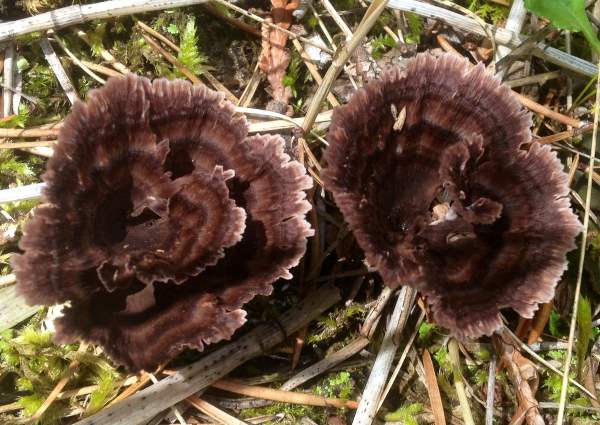
Thelephora terrestris, commonly known as the Scaly Earthfan or Earthfan, is a widespread and easily recognizable fungus belonging to the family Thelephoraceae. It is characterized by its fan-shaped to rosette-like fruiting bodies, often with a scaly or fibrous upper surface and a spore-bearing underside that is typically smooth or slightly wrinkled. This species is a significant ectomycorrhizal associate, primarily with conifers, and plays an important ecological role in forest ecosystems.
How to Identify
- Cap
- The upper surface of the cap or lobes is typically dark brown to reddish-brown, often with concentric zones of lighter and darker shades. It is characteristically scaly, fibrous, or velvety, especially towards the base, becoming smoother towards the margin. The margin is usually thin, wavy, and often lighter in color, sometimes whitish or yellowish, and can be finely fimbriate (fringed).
- Gills
- The underside (hymenial surface) is smooth to slightly wrinkled or convoluted, lacking true gills. It is typically paler than the upper surface, ranging from whitish to grayish-brown or purplish-brown, often with a pruinose (powdery) appearance due to the spores. When young, it may be whitish, darkening with age.
- Stem
- A true stem is usually absent. The fruiting body is sessile or attached directly to the substrate by a broad base. In some forms, particularly when growing on soil, a rudimentary, tough, fibrous stipe-like structure may be present, often covered in debris or mycelial threads.
- Flesh
- The flesh is thin, tough, leathery, and fibrous. It is typically brownish, concolorous with the cap surface, and does not change color when bruised or cut.
- Fruiting body
- The fruiting body is highly variable in shape, ranging from fan-shaped, shell-like, or bracket-like to rosette-like or even somewhat coral-like when growing in clusters. It can be solitary or, more commonly, imbricate (overlapping) or fused, forming extensive mats. The individual caps or lobes typically measure 2-10 cm across and up to 5 cm high.
- Habitat
- Thelephora terrestris is primarily found growing on the ground, often among mosses, conifer needles, or woody debris, particularly in coniferous forests. It can also be found growing on the base of conifer trunks, stumps, or buried wood. It forms ectomycorrhizal associations, predominantly with conifers such as pines (Pinus spp.), spruces (Picea spp.), and firs (Abies spp.).
Key Facts
- Cap surfaces: Scaly, fibrous, velvety, concentrically zoned, dark brown to reddish-brown.
- Growth Form: Fan-shaped, shell-like, rosette-like, imbricate, or fused mats.
- Spore Print: Brown to purplish-brown.
- Body color: Dark brown to reddish-brown on top, paler (whitish to grayish-brown) underneath.
- Odor: Mild, earthy, or indistinct.
- Flesh bruises: Does not bruise.
- Height: Up to 5 cm (individual lobes).
- Cap Diameter: 2-10 cm (individual lobes).
- Nutrient gathering: Ectomycorrhizal with conifers.
Safe
SafeThelephora terrestris is generally considered non-toxic but is not edible due to its tough, leathery texture and lack of culinary appeal. There are no known reports of toxicity from ingestion, but it offers no gastronomic value. As with any wild mushroom, proper identification is crucial to avoid confusion with potentially toxic species, though no dangerously poisonous look-alikes are commonly associated with T. terrestris.
Quick Check
- Odor: Mild, earthy, or indistinct; sometimes described as slightly unpleasant or 'fungoid'.
- Fruiting: Late summer to late autumn, sometimes earlier in moist conditions.
- Substrate: Soil, conifer needle litter, woody debris, base of conifer trunks.
Where to Find
Coniferous Forests
Abundant in coniferous and mixed coniferous-deciduous forests across temperate and boreal regions.
Forest Edges and Disturbed Areas
Can be found in disturbed areas, clearings, and along forest edges where conifers are present.
Nurseries and Plantations
Common in conifer nurseries and plantations, often associated with young trees.
Finding Tips
Look for Conifers
Always search in areas dominated by coniferous trees, as it forms mycorrhizal relationships with them.
Check the Ground and Base of Trees
Scan the forest floor, especially among needle litter, moss, and at the base of conifer trunks.
Seasonal Timing
While it can be found throughout the growing season, it is most prevalent from late summer through autumn.
Observe Growth Habits
Note its variable growth forms – solitary fans, overlapping clusters, or extensive mats.
Similar Species
Thelephora palmata
fungus
Also known as: Stinking Earthfan
Thelephora caryophyllea
fungus
Also known as: Clove Earthfan
Thelephora anthocephala
fungus
Also known as: Flower Earthfan
Scientific Classification
- Phylum
- Basidiomycota
- Class
- Agaricomycetes
- Order
- Thelephorales
- Family
- Thelephoraceae
- Genus
- Thelephora
Storage Information
- Max Temperature: Not applicable
- Freezing duration: Not applicable
- Min Temperature: Not applicable
- Refrigeration: Not applicable
How to Clean
Not applicable, as this species is not considered edible. If handled for identification purposes, simply brush off any adhering debris.
Explore Scaly Earthfan
Identify mushrooms anywhere
Free on iOS, Android, and Web. Photo identification, full database, and your personal collection.