
How to identify Purple-gilled Russula
Russula cyanoxantha
Got a photo? Identify mushrooms instantly with the Mushby app
Open the appTo correctly identify Purple-gilled Russula (Russula cyanoxantha), check each of these features in order. Misidentification is the most common cause of mushroom poisoning, so cross-reference multiple sources.
Step-by-step identification
- 1
Cap
Shape, color, surface texture, and diameter.
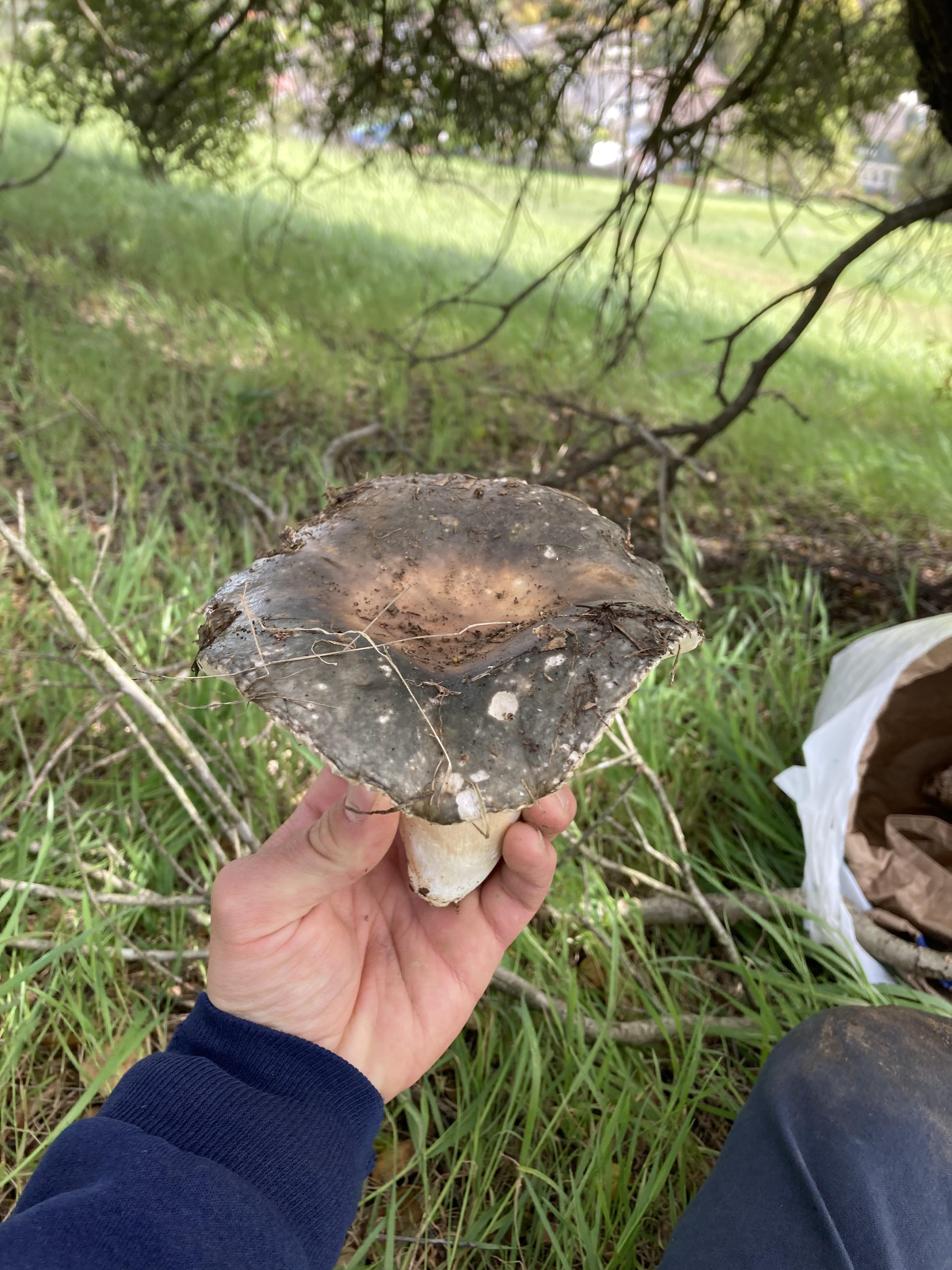
The cap is typically 5-15 cm (2-6 inches) in diameter, initially convex, becoming flattened or slightly depressed with age. The color is highly variable, ranging from purplish, lilac, violet, olive-green, grayish-green, or brownish, often with shades of blue or purple. The cuticle (cap skin) is often sticky or greasy in wet weather, peeling about one-third to halfway to the center. It often has darker blotches or streaks.
- 2
Gills
Attachment to stem, color, and spacing.
The gills are adnexed to almost free, crowded, and white to cream-colored, often with a bluish or purplish sheen, especially when young. A crucial identifying feature is their flexibility; unlike most Russula species, the gills of R. cyanoxantha are greasy to the touch and do not snap or break easily when bent or rubbed.
- 3
Stem
Length, shape, surface, and any ring.
The stem is 4-12 cm (1.5-5 inches) long and 1-3 cm (0.4-1.2 inches) thick, cylindrical or slightly club-shaped, solid, and white. It is smooth and lacks a ring or volva. It can sometimes have a faint purplish blush.
- 4
Flesh
Color, texture, and bruising reaction.
The flesh is white, firm, and brittle, but not as crumbly as some other Russula species. It does not change color when cut or bruised. It has a mild, pleasant, nutty taste and no distinctive odor.
- 5
Fruiting body
Overall growth pattern.
The fruiting body is a typical agaric (gilled mushroom) with a cap, gills, and a central stem. It is robust and medium to large in size.
- 6
Habitat
Where it grows and on what substrate.
Russula cyanoxantha is a mycorrhizal fungus, forming symbiotic relationships with various deciduous and coniferous trees. It is commonly found growing on the ground in broadleaf woodlands, particularly under oak (Quercus), beech (Fagus), and birch (Betula), but also occasionally under conifers.
Key Facts
- Cap surfaces
- Smooth, often sticky or greasy when wet, cuticle peeling up to halfway.
- Growth Form
- Solitary or scattered
- Spore Print
- White
- Body color
- Cap highly variable (purplish, greenish, brownish, lilac); gills white to cream with purplish sheen; stem white.
- Odor
- Mild, pleasant
- Flesh bruises
- Does not bruise or change color
- Height
- 4-12 cm (1.5-5 inches)
- Cap Diameter
- 5-15 cm (2-6 inches)
Fruit body characteristics
- Gill attachment: Adnexed to almost free
- Stem shape: Cylindrical or slightly club-shaped
- Stem surface: Smooth
- Ring: Absent
- Stem cross-section: Solid
Explore Purple-gilled Russula
Identify mushrooms anywhere
Free on iOS, Android, and Web. Photo identification, full database, and your personal collection.