
Got a photo? Identify mushrooms instantly with the Mushby app
Open the appDescription
Russula cyanoxantha, commonly known as the Purple-gilled Russula or Charcoal Burner, is a widespread and common edible mushroom belonging to the large genus Russula. It is characterized by its variable cap coloration, which can range from purplish to greenish or brownish, and its distinctive flexible, greasy-feeling gills that do not break easily when rubbed, unlike many other Russula species. This flexibility is a key diagnostic feature. The flesh is firm and white, and it has a mild, nutty taste.
How to Identify
- Cap
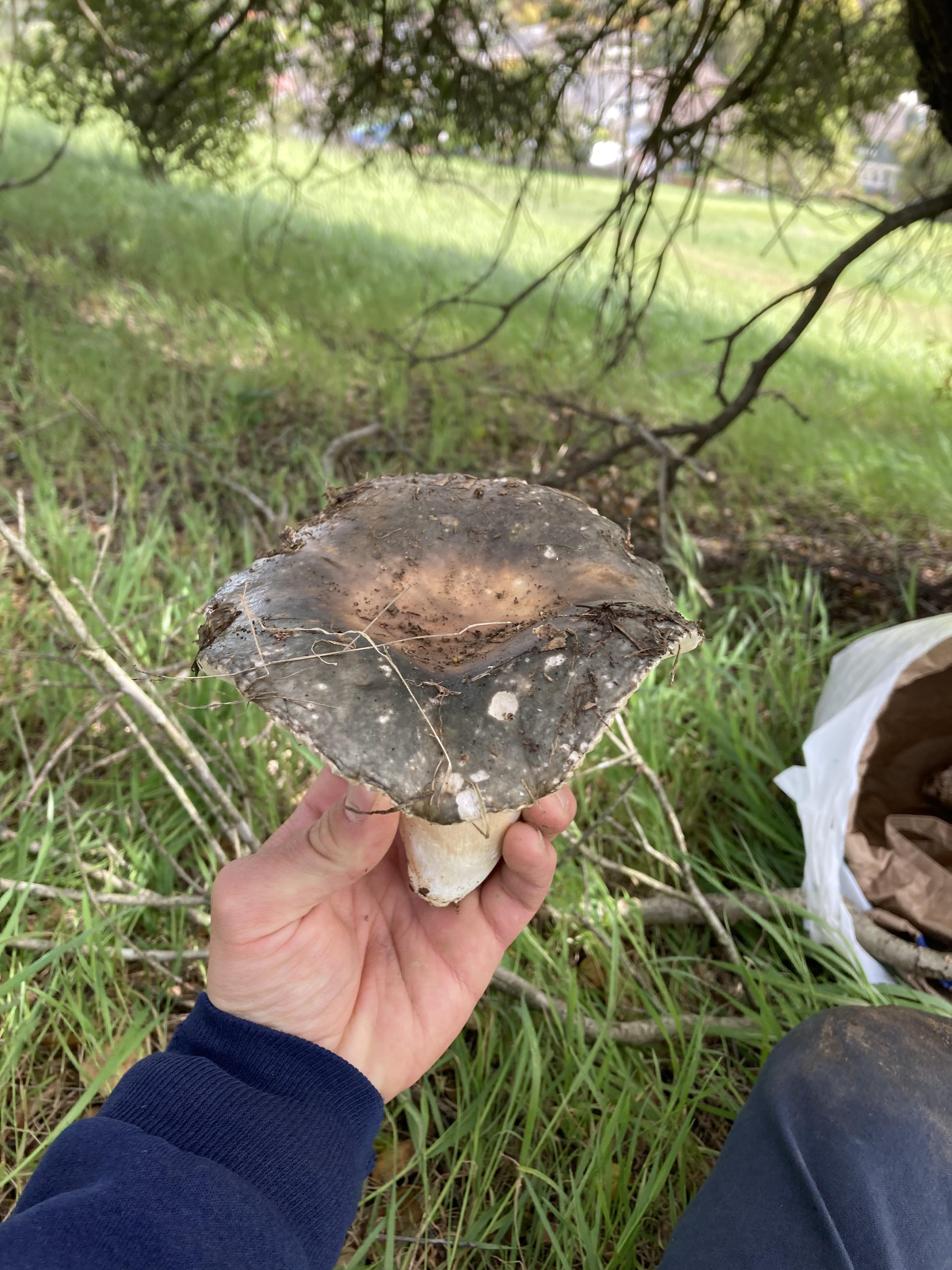
- The cap is typically 5-15 cm (2-6 inches) in diameter, initially convex, becoming flattened or slightly depressed with age. The color is highly variable, ranging from purplish, lilac, violet, olive-green, grayish-green, or brownish, often with shades of blue or purple. The cuticle (cap skin) is often sticky or greasy in wet weather, peeling about one-third to halfway to the center. It often has darker blotches or streaks.
- Gills
- The gills are adnexed to almost free, crowded, and white to cream-colored, often with a bluish or purplish sheen, especially when young. A crucial identifying feature is their flexibility; unlike most Russula species, the gills of R. cyanoxantha are greasy to the touch and do not snap or break easily when bent or rubbed.
- Stem
- The stem is 4-12 cm (1.5-5 inches) long and 1-3 cm (0.4-1.2 inches) thick, cylindrical or slightly club-shaped, solid, and white. It is smooth and lacks a ring or volva. It can sometimes have a faint purplish blush.
- Flesh
- The flesh is white, firm, and brittle, but not as crumbly as some other Russula species. It does not change color when cut or bruised. It has a mild, pleasant, nutty taste and no distinctive odor.
- Fruiting body
- The fruiting body is a typical agaric (gilled mushroom) with a cap, gills, and a central stem. It is robust and medium to large in size.
- Habitat
- Russula cyanoxantha is a mycorrhizal fungus, forming symbiotic relationships with various deciduous and coniferous trees. It is commonly found growing on the ground in broadleaf woodlands, particularly under oak (Quercus), beech (Fagus), and birch (Betula), but also occasionally under conifers.
Key Facts
- Cap surfaces: Smooth, often sticky or greasy when wet, cuticle peeling up to halfway.
- Growth Form: Solitary or scattered
- Spore Print: White
- Body color: Cap highly variable (purplish, greenish, brownish, lilac); gills white to cream with purplish sheen; stem white.
- Odor: Mild, pleasant
- Flesh bruises: Does not bruise or change color
- Height: 4-12 cm (1.5-5 inches)
- Cap Diameter: 5-15 cm (2-6 inches)
- Nutrient gathering: Mycorrhizal
Safe
SafeRussula cyanoxantha is considered an excellent edible mushroom. However, it is crucial to correctly identify it, as some other Russula species are acrid and can cause gastrointestinal upset if consumed raw or undercooked. Always cook mushrooms thoroughly. Never consume any wild mushroom unless 100% certain of its identification by an experienced mycologist. When trying any new mushroom, consume a small amount first to ensure no individual allergic reactions.
Quick Check
- Odor: Mild, not distinctive
- Fruiting: Summer to autumn (July-October)
- Substrate: Ground, mycorrhizal with broadleaf trees (oak, beech, birch)
Where to Find
Europe
Widespread and common across temperate Europe.
North America
Found in various regions, particularly in eastern North America.
Asia
Reported in parts of Asia, including Japan and China.
Finding Tips
Habitat Preference
Look for it in broadleaf woodlands, especially under oak, beech, and birch trees. It can also be found in mixed forests.
Seasonal Availability
Fruiting bodies typically appear from summer to autumn, usually from July to October, depending on local climate and rainfall.
Gill Test
Always perform the 'gill flexibility test' to confirm identification. Gently rub or bend the gills; if they are flexible and greasy-feeling rather than brittle, it strongly suggests R. cyanoxantha.
Cap Color Variability
Be aware of the wide range of cap colors. Don't rely solely on color for identification. Focus on the gill characteristics and other morphological features.
Similar Species
Green Brittlegill
Russula
Also known as: Russula virescens
Geranium Scented Russula
Russula
Also known as: Russula fellea
Sickener
Russula
Also known as: Russula emetica
Scientific Classification
- Phylum
- Basidiomycota
- Class
- Agaricomycetes
- Order
- Russulales
- Family
- Russulaceae
- Genus
- Russula
Storage Information
- Max Temperature: 4°C
- Freezing duration: 6 months
- Min Temperature: 0°C
- Refrigeration: 5 days
How to Clean
Gently brush off any dirt or debris with a soft brush or damp cloth. Avoid washing under running water, as mushrooms can absorb excess moisture. Trim off any damaged or insect-ridden parts of the stem.
Explore Purple-gilled Russula
Identify mushrooms anywhere
Free on iOS, Android, and Web. Photo identification, full database, and your personal collection.