
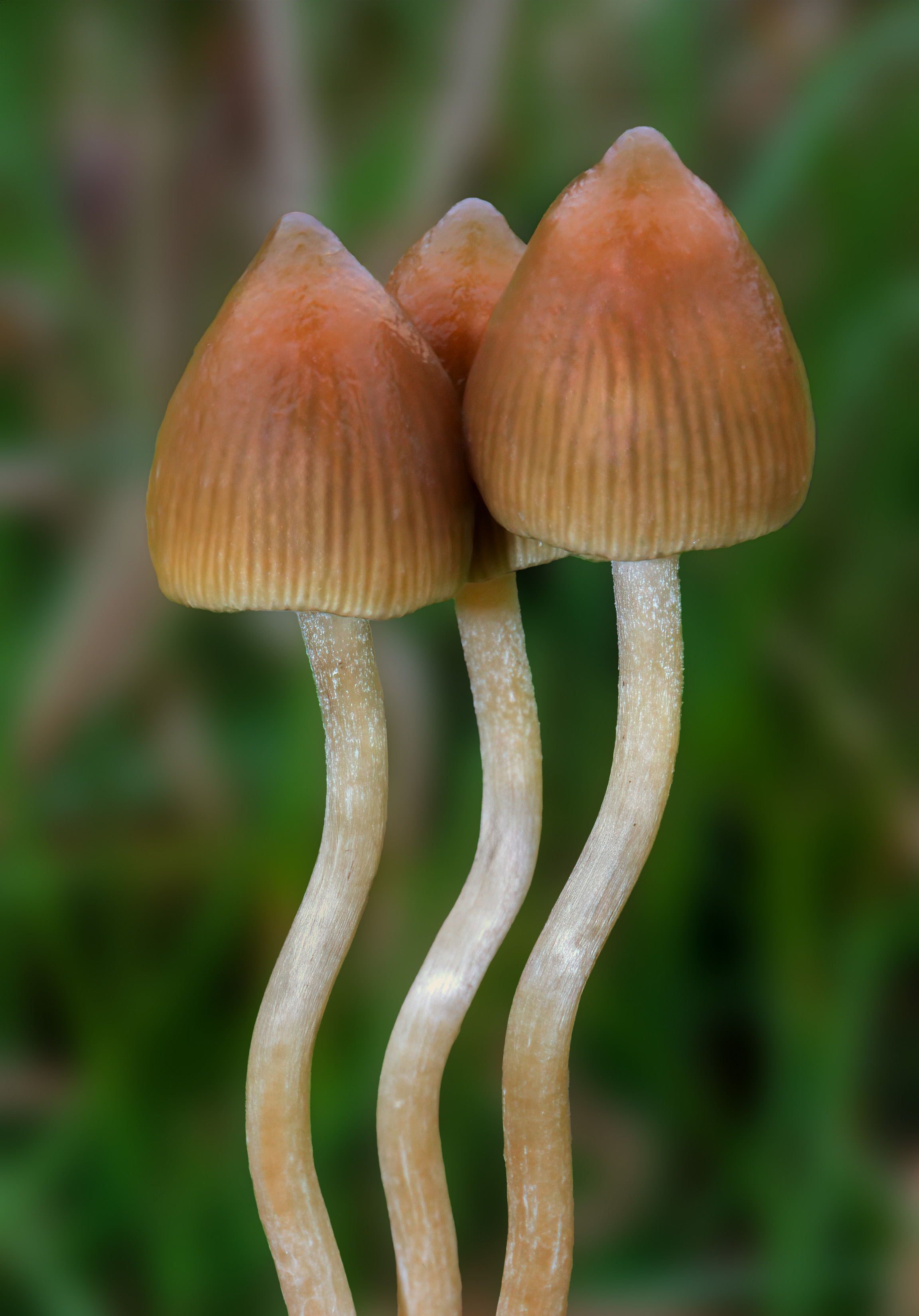
How to identify Liberty Cap
Psilocybe semilanceata
Got a photo? Identify mushrooms instantly with the Mushby app
Open the appTo correctly identify Liberty Cap (Psilocybe semilanceata), check each of these features in order. Misidentification is the most common cause of mushroom poisoning, so cross-reference multiple sources.
Step-by-step identification
- 1
Cap
Shape, color, surface texture, and diameter.
2-25 mm in diameter, conical to bell-shaped, often with a distinct, pointed papilla at the apex. The margin is often incurved when young, becoming straight with age, sometimes slightly striate (grooved) when moist. Color varies from pale yellow-brown to dark chestnut brown when moist, fading to a pale buff or yellowish-brown when dry (hygrophanous). The surface is smooth, viscid (slimy) when moist due to a separable gelatinous pellicle.
- 2
Gills
Attachment to stem, color, and spacing.
Adnate to adnexed, sometimes nearly free, crowded, narrow. Color starts pale brown, becoming purplish-brown to dark purplish-black with a whitish edge as spores mature.
- 3
Stem
Length, shape, surface, and any ring.
40-100 mm long and 1-3 mm thick, slender, flexible, and often wavy or contorted. Color is whitish to yellowish-brown, often darker towards the base, and can bruise bluish, particularly when handled. The surface is smooth, and it lacks a ring (annulus). The base is often slightly enlarged and can be covered with fine white mycelial hairs.
- 4
Flesh
Color, texture, and bruising reaction.
Thin, fragile, whitish to pale brownish, often bruising bluish, especially at the base of the stem, due to oxidation of psilocin.
- 5
Fruiting body
Overall growth pattern.
Small, slender, and delicate, typically growing solitarily or in small scattered groups.
- 6
Habitat
Where it grows and on what substrate.
Saprobic, growing in rich, acidic soil in grasslands, pastures, meadows, and lawns, especially in areas that have been fertilized by animal droppings (sheep, cattle, horses), but not directly on dung. Prefers disturbed ground and often found among grasses and mosses. It is commonly found at higher altitudes in mountainous regions.
Key Facts
- Cap surfaces
- Smooth, viscid when moist, often striate at margin when wet
- Growth Form
- Solitary to scattered
- Spore Print
- Dark purplish-brown to black
- Body color
- Cap: Yellow-brown to chestnut brown (moist), fading to pale buff (dry). Stem: Whitish to yellowish-brown.
- Odor
- Farinaceous or indistinct
- Flesh bruises
- Bluish, especially at the base of the stem
- Height
- 4-10 cm
- Cap Diameter
- 0.2-2.5 cm
Fruit body characteristics
- Gill attachment: Adnate to adnexed, sometimes nearly free
- Stem shape: Cylindrical, often wavy or contorted
- Stem surface: Smooth, sometimes with fine fibrils, no ring
- Ring: Absent
- Stem cross-section: Hollow
Explore Liberty Cap
Identify mushrooms anywhere
Free on iOS, Android, and Web. Photo identification, full database, and your personal collection.