
Got a photo? Identify mushrooms instantly with the Mushby app
Open the appDescription
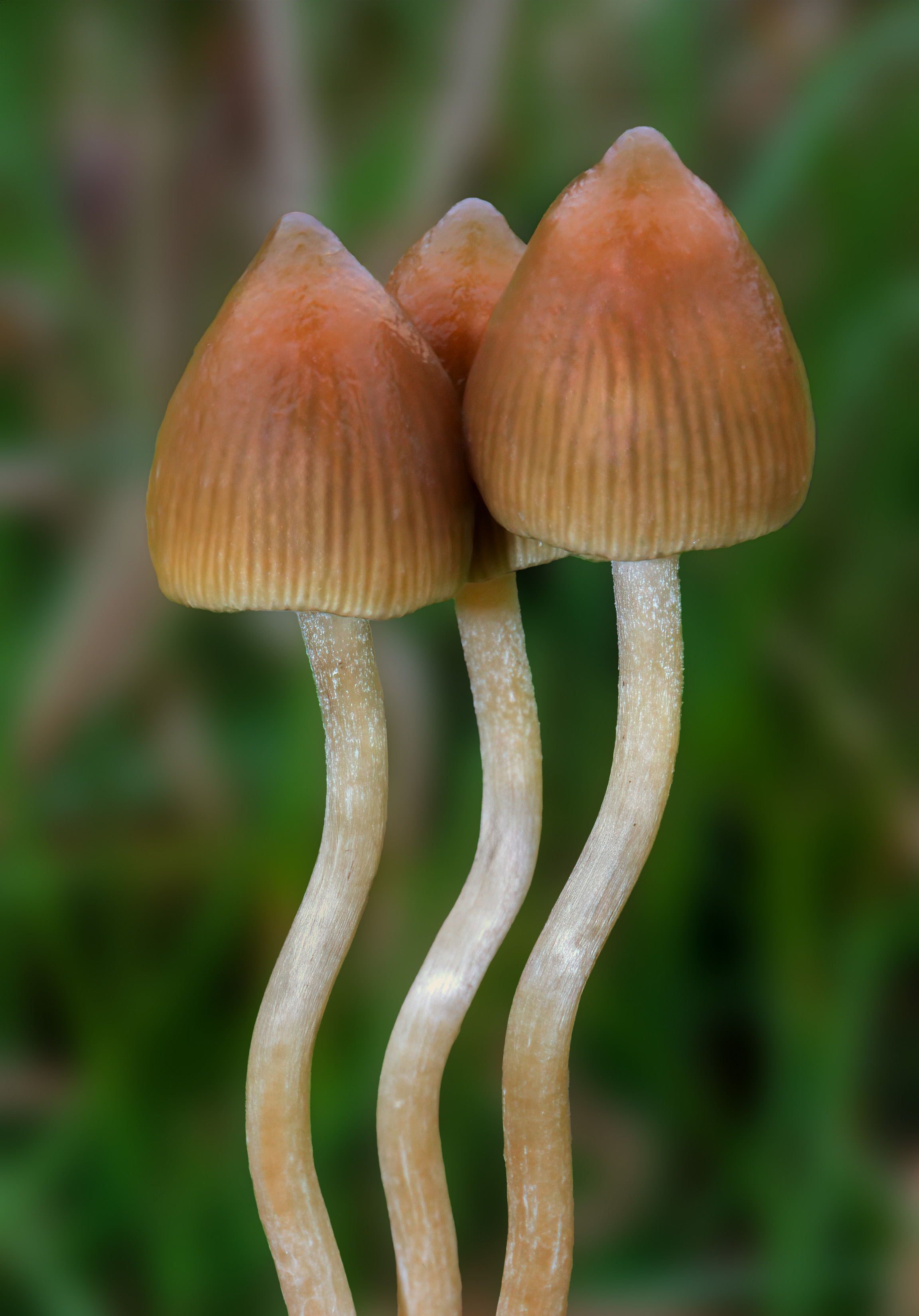
Psilocybe semilanceata, commonly known as the Liberty Cap, is a species of psychedelic mushroom. It is one of the most well-known psilocybin-containing mushrooms and is recognized by its distinctive conical to bell-shaped cap, often with a prominent papilla (nipple-like protrusion) at the apex. The mushroom is small, slender, and typically grows in grasslands, pastures, and meadows, particularly in areas grazed by sheep or cattle, though it does not grow directly on dung. Its psychoactive properties are due to the presence of psilocybin, psilocin, and baeocystin. It is widely distributed in temperate regions of the Northern Hemisphere and has also been introduced to parts of the Southern Hemisphere.
How to Identify
- Cap
- 2-25 mm in diameter, conical to bell-shaped, often with a distinct, pointed papilla at the apex. The margin is often incurved when young, becoming straight with age, sometimes slightly striate (grooved) when moist. Color varies from pale yellow-brown to dark chestnut brown when moist, fading to a pale buff or yellowish-brown when dry (hygrophanous). The surface is smooth, viscid (slimy) when moist due to a separable gelatinous pellicle.
- Gills
- Adnate to adnexed, sometimes nearly free, crowded, narrow. Color starts pale brown, becoming purplish-brown to dark purplish-black with a whitish edge as spores mature.
- Stem
- 40-100 mm long and 1-3 mm thick, slender, flexible, and often wavy or contorted. Color is whitish to yellowish-brown, often darker towards the base, and can bruise bluish, particularly when handled. The surface is smooth, and it lacks a ring (annulus). The base is often slightly enlarged and can be covered with fine white mycelial hairs.
- Flesh
- Thin, fragile, whitish to pale brownish, often bruising bluish, especially at the base of the stem, due to oxidation of psilocin.
- Fruiting body
- Small, slender, and delicate, typically growing solitarily or in small scattered groups.
- Habitat
- Saprobic, growing in rich, acidic soil in grasslands, pastures, meadows, and lawns, especially in areas that have been fertilized by animal droppings (sheep, cattle, horses), but not directly on dung. Prefers disturbed ground and often found among grasses and mosses. It is commonly found at higher altitudes in mountainous regions.
Key Facts
- Cap surfaces: Smooth, viscid when moist, often striate at margin when wet
- Growth Form: Solitary to scattered
- Spore Print: Dark purplish-brown to black
- Body color: Cap: Yellow-brown to chestnut brown (moist), fading to pale buff (dry). Stem: Whitish to yellowish-brown.
- Odor: Farinaceous or indistinct
- Flesh bruises: Bluish, especially at the base of the stem
- Height: 4-10 cm
- Cap Diameter: 0.2-2.5 cm
- Nutrient gathering: Saprobic
Toxic
DeadlyPsilocybe semilanceata contains psychoactive compounds psilocybin, psilocin, and baeocystin. Consumption leads to hallucinogenic effects, altered perception, mood changes, and other psychological and physiological effects. While not acutely toxic in terms of organ damage at typical doses, the psychological effects can be profound and potentially distressing, especially for individuals with pre-existing mental health conditions or in uncontrolled settings. It is illegal to possess, cultivate, or distribute in many countries. Misidentification with deadly toxic species like Galerina marginata is a significant risk.
Quick Check
- Odor: Farinaceous (mealy) or indistinct
- Fruiting: Late summer to late autumn
- Substrate: Grasslands, pastures, meadows (not directly on dung)
Where to Find
Europe
Widespread across temperate regions, particularly in the UK, Ireland, Scandinavia, and Central Europe.
North America
Common in the Pacific Northwest (Oregon, Washington, British Columbia) and parts of the Northeast (e.g., New England, New York).
Australia and New Zealand
Introduced and established in certain regions, often in pastures.
South America
Reported in some temperate areas, though less common than in the Northern Hemisphere.
Finding Tips
Timing
Typically fruits from late summer through late autumn (August to November in the Northern Hemisphere), after periods of rain and cooler temperatures. Peak season is often September and October.
Habitat Specifics
Look in undisturbed, unfertilized (or naturally fertilized by grazing animals) grasslands, especially those with long grass, moss, and good drainage. Avoid areas treated with pesticides or herbicides. Often found on north-facing slopes or in shaded areas where moisture is retained.
Weather Conditions
Thrives after cool, wet weather. A few days of rain followed by mild temperatures are ideal.
Elevation
Can be found from sea level to high altitudes, but often more abundant in upland pastures.
Distinguishing Features
Always check for the distinct papilla on the cap, the separable gelatinous pellicle (which can be peeled off), the purplish-brown to blackish spore print, and the blue bruising reaction, especially at the stem base. The slender, flexible stem is also a key characteristic.
Similar Species
Panaeolus foenisecii
Panaeolus
Also known as: Mower's Mushroom, Haymaker
Galerina marginata
Galerina
Also known as: Deadly Galerina, Funeral Bell
Mycena spp.
Mycena
Also known as: Bonnet mushrooms
Conocybe spp.
Conocybe
Also known as: Dunce caps
Scientific Classification
- Phylum
- Basidiomycota
- Class
- Agaricomycetes
- Order
- Agaricales
- Family
- Hymenogastraceae
- Genus
- Psilocybe
Explore Liberty Cap
Identify mushrooms anywhere
Free on iOS, Android, and Web. Photo identification, full database, and your personal collection.