
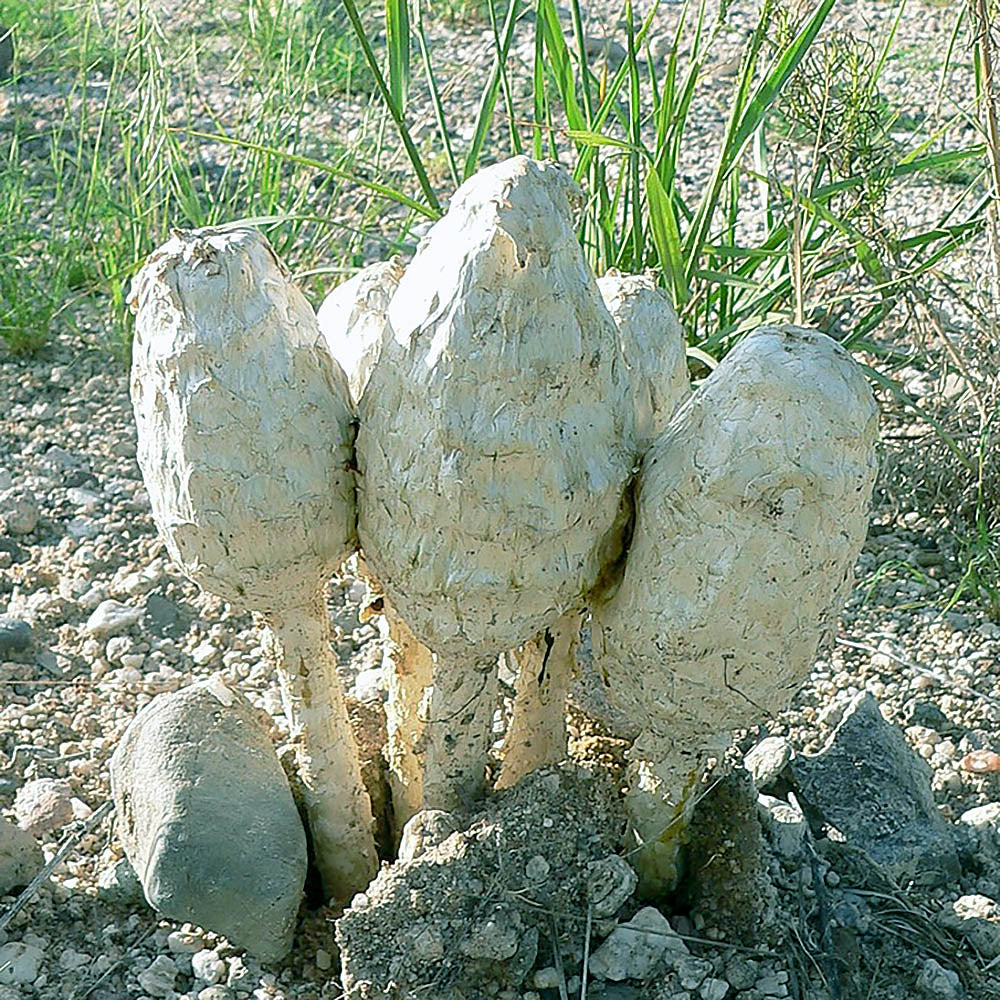
How to identify Desert Shaggy Mane
Podaxis pistillaris
Got a photo? Identify mushrooms instantly with the Mushby app
Open the appTo correctly identify Desert Shaggy Mane (Podaxis pistillaris), check each of these features in order. Misidentification is the most common cause of mushroom poisoning, so cross-reference multiple sources.
Step-by-step identification
- 1
Cap
Shape, color, surface texture, and diameter.
The 'cap' or peridium is ovoid to cylindrical, 3-10 cm tall and 2-5 cm wide. Its outer surface (exoperidium) is initially white to yellowish, often becoming shaggy or scaly with age, eventually peeling away to reveal the inner peridium. The inner peridium (endoperidium) is thin and papery, enclosing the gleba. As it matures, the gleba dries and becomes a dark brown, powdery mass of spores.
- 2
Gills
Attachment to stem, color, and spacing.
Absent, as this is a gasteroid fungus. Spores are produced within the gleba.
- 3
Stem
Length, shape, surface, and any ring.
The stalk (stipe) is central, solid, fibrous, and woody, typically 5-20 cm long and 1-3 cm thick. It is usually white to yellowish, often with a slightly shaggy or scaly surface, and tapers slightly towards the base. It is persistent and often remains standing after the gleba has dispersed.
- 4
Flesh
Color, texture, and bruising reaction.
The gleba (spore mass) is initially white and firm, then turns yellowish, olive, and finally dark brown to black and powdery as it matures. The stalk is fibrous and woody.
- 5
Fruiting body
Overall growth pattern.
The fruiting body is club-shaped to cylindrical, typically 5-20 cm tall, occasionally reaching 30 cm. It consists of a distinct stalk (stipe) and a cap-like head (peridium) that contains the spore mass.
- 6
Habitat
Where it grows and on what substrate.
Terrestrial, growing solitarily or in scattered groups on sandy or disturbed soils in arid and semi-arid regions, deserts, grasslands, and open woodlands. It is often found in association with various grasses and shrubs.
Key Facts
- Cap surfaces
- Shaggy, scaly, or smooth, peeling with age.
- Growth Form
- Solitary or scattered.
- Spore Print
- Dark brown to black (powdery).
- Body color
- White to yellowish, becoming brown to black with age.
- Odor
- Mild, earthy.
- Flesh bruises
- Does not bruise.
- Height
- 5-20 cm (up to 30 cm)
- Cap Diameter
- 2-5 cm
Fruit body characteristics
- Gill attachment: N/A (gasteroid)
- Stem shape: Cylindrical to slightly tapering.
- Stem surface: Fibrous, sometimes shaggy or scaly.
- Ring: Absent.
- Stem cross-section: Solid, fibrous.
Explore Desert Shaggy Mane
Identify mushrooms anywhere
Free on iOS, Android, and Web. Photo identification, full database, and your personal collection.