
Got a photo? Identify mushrooms instantly with the Mushby app
Open the appDescription
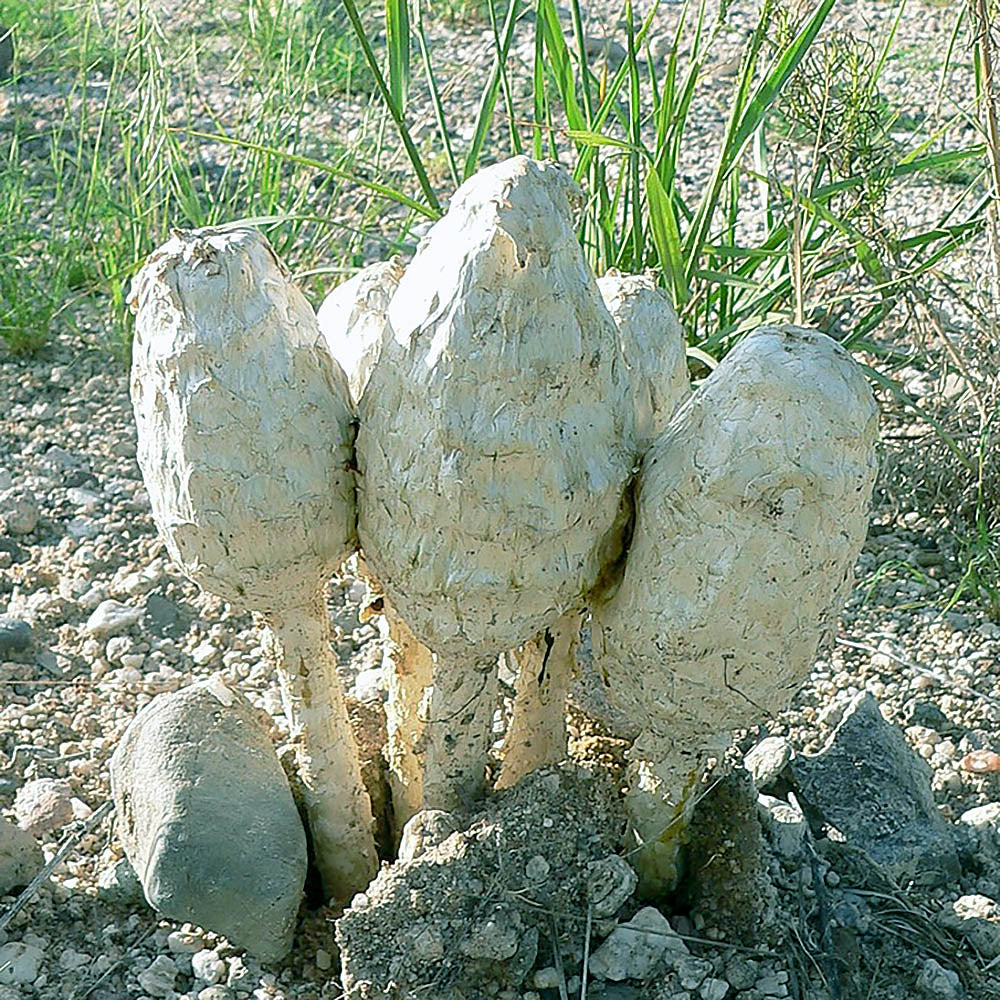
Podaxis pistillaris, commonly known as the Desert Shaggy Mane or Stalked Puffball, is a distinctive gasteroid fungus characterized by its elongated, stalked fruiting body that resembles a club or a shaggy-capped mushroom. Unlike typical mushrooms, it does not release spores from gills but rather from a powdery mass (gleba) enclosed within its cap-like structure. It is well-adapted to arid and semi-arid environments globally.
How to Identify
- Cap
- The 'cap' or peridium is ovoid to cylindrical, 3-10 cm tall and 2-5 cm wide. Its outer surface (exoperidium) is initially white to yellowish, often becoming shaggy or scaly with age, eventually peeling away to reveal the inner peridium. The inner peridium (endoperidium) is thin and papery, enclosing the gleba. As it matures, the gleba dries and becomes a dark brown, powdery mass of spores.
- Gills
- Absent, as this is a gasteroid fungus. Spores are produced within the gleba.
- Stem
- The stalk (stipe) is central, solid, fibrous, and woody, typically 5-20 cm long and 1-3 cm thick. It is usually white to yellowish, often with a slightly shaggy or scaly surface, and tapers slightly towards the base. It is persistent and often remains standing after the gleba has dispersed.
- Flesh
- The gleba (spore mass) is initially white and firm, then turns yellowish, olive, and finally dark brown to black and powdery as it matures. The stalk is fibrous and woody.
- Fruiting body
- The fruiting body is club-shaped to cylindrical, typically 5-20 cm tall, occasionally reaching 30 cm. It consists of a distinct stalk (stipe) and a cap-like head (peridium) that contains the spore mass.
- Habitat
- Terrestrial, growing solitarily or in scattered groups on sandy or disturbed soils in arid and semi-arid regions, deserts, grasslands, and open woodlands. It is often found in association with various grasses and shrubs.
Key Facts
- Cap surfaces: Shaggy, scaly, or smooth, peeling with age.
- Growth Form: Solitary or scattered.
- Spore Print: Dark brown to black (powdery).
- Body color: White to yellowish, becoming brown to black with age.
- Odor: Mild, earthy.
- Flesh bruises: Does not bruise.
- Height: 5-20 cm (up to 30 cm)
- Cap Diameter: 2-5 cm
- Nutrient gathering: Saprobic, decomposing organic matter in soil.
Safe
SafePodaxis pistillaris is generally considered edible when young and the gleba is still white and firm. However, its edibility is often debated, and some sources report it as having a poor taste or being indigestible for some individuals. There are no known toxic look-alikes that are morphologically similar enough to cause confusion. The primary safety concern is consuming mature specimens where the gleba has turned dark and powdery, as this stage is unpalatable and can cause digestive upset.
Quick Check
- Odor: Mild, earthy, or indistinct.
- Fruiting: Club-shaped, stalked, with a powdery spore mass inside the 'cap'.
- Substrate: Sandy or disturbed soil in arid regions.
Where to Find
Deserts and Semi-Arid Regions
Commonly found in the deserts of North America (e.g., Sonoran, Mojave), Australia, Africa, Asia, and the Middle East. It thrives in sandy soils and areas with sparse vegetation.
Grasslands and Open Woodlands
Can also be found in drier grasslands and open woodland areas, particularly where soil is sandy or disturbed.
Finding Tips
Seasonal Availability
Typically fruits after rainfall events, often in spring, summer, or fall, depending on the specific desert climate. In some regions, it can be found year-round if conditions are favorable.
Look for Disturbed Ground
Often appears in areas of disturbed soil, such as roadsides, trails, or recently cleared land.
Check Under Shrubs
While it grows in open areas, it can sometimes be found partially sheltered by desert shrubs.
Similar Species
None
fungus
Also known as: No closely similar species in morphology and habitat
Scientific Classification
- Phylum
- Basidiomycota
- Class
- Agaricomycetes
- Order
- Agaricales
- Family
- Agaricaceae
- Genus
- Podaxis
Storage Information
- Max Temperature: 4°C
- Freezing duration: 6 months
- Min Temperature: 0°C
- Refrigeration: 3 days
How to Clean
Due to its fibrous and often sandy nature, cleaning can be challenging. If collected for consumption (with extreme caution, see edibility), the outer peridium can be carefully peeled away. The inner gleba, if still white and firm, can be wiped clean with a dry cloth or soft brush. Avoid washing with water, as it can become waterlogged and lose texture.
Explore Desert Shaggy Mane
Identify mushrooms anywhere
Free on iOS, Android, and Web. Photo identification, full database, and your personal collection.