
Got a photo? Identify mushrooms instantly with the Mushby app
Open the appDescription
A common and widely distributed saprobic mushroom, the Fawn Pluteus is recognized by its pink spore print, free gills, and lack of a volva or ring on the stem. It grows on decaying wood and is often found in forests and wooded areas.
How to Identify
- Cap
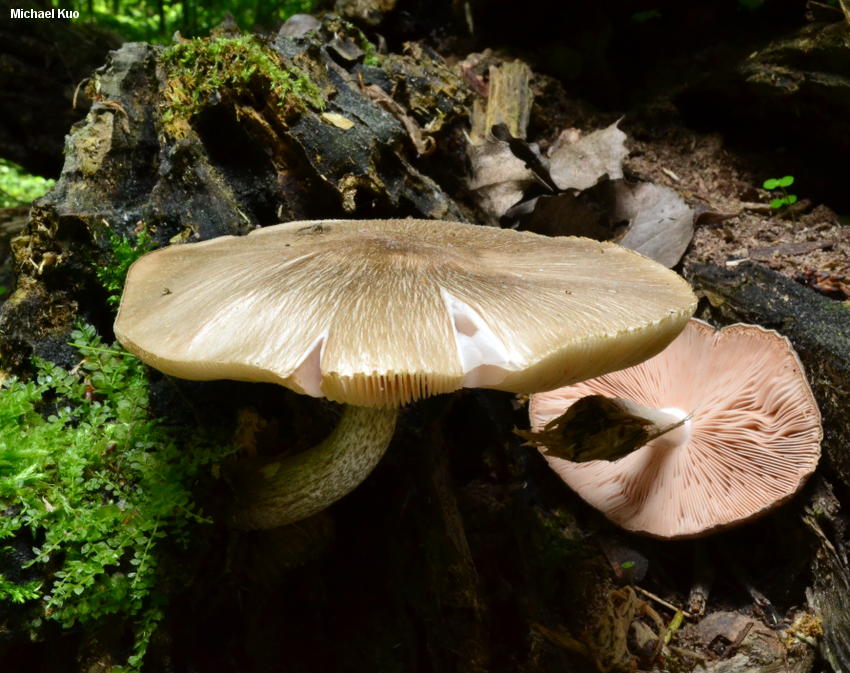
- The cap is typically 5-10 cm in diameter, convex to flattened, and often has a slight umbo (a raised bump in the center). The color ranges from tan to brown, resembling the color of a fawn (hence the name). The surface can be smooth or slightly wrinkled.
- Gills
- The gills are free from the stem, crowded, and start out white, eventually turning pink as the spores mature. This pink spore print is a key identifying feature.
- Stem
- The stem is typically 5-10 cm long and 1-2 cm thick, cylindrical, and white to light brown. It lacks a ring or volva.
- Flesh
- The flesh is white and does not change color when cut or bruised.
- Fruiting body
- The fruiting body of Pluteus cervinus is a typical mushroom shape, with a cap and stem. The size can vary, but it's generally a medium-sized mushroom.
- Habitat
- Pluteus cervinus is a saprobe, meaning it feeds on decaying organic matter. It is typically found growing on dead wood, such as logs, stumps, and wood debris, in forests and wooded areas. It can be found alone, in groups, or clustered together.
Key Facts
- Cap surfaces: Smooth to slightly wrinkled
- Growth Form: Saprobic
- Spore Print: Pink
- Body color: Tan to brown
- Odor: Mild
- Flesh bruises: No
- Height: 5-10 cm
- Cap Diameter: 5-10 cm
- Nutrient gathering: Saprobic
Safe
SafePluteus cervinus is generally considered edible, but it is not highly regarded due to its mild taste and potential for confusion with toxic species. It is important to properly identify any mushroom before consumption.
Quick Check
- Odor: Mild, sometimes radish-like
- Fruiting: Solitary or in small groups
- Substrate: Decaying wood
Where to Find
Forests
Common in deciduous and coniferous forests.
Wooded Areas
Found in areas with decaying wood, such as parks and gardens.
Finding Tips
Check Decaying Wood
Look for the mushroom growing directly on or near dead logs, stumps, and wood debris.
Look for Pink Gills
Examine the gills to see if they have a pinkish hue, which indicates a mature specimen with spores.
Similar Species
Pluteus americanus
gilled mushroom
Also known as: American Pluteus
Volvariella species
gilled mushroom
Also known as: Sheath mushrooms
Scientific Classification
- Phylum
- Basidiomycota
- Class
- Agaricomycetes
- Order
- Agaricales
- Family
- Pluteaceae
- Genus
- Pluteus
Storage Information
- Max Temperature: 4
- Freezing duration: N/A
- Min Temperature: 2
- Refrigeration: 3-5 days
How to Clean
Gently brush off any dirt or debris from the cap and stem. Avoid washing unless necessary, as mushrooms can absorb water and become soggy.
Explore Fawn Pluteus
Identify mushrooms anywhere
Free on iOS, Android, and Web. Photo identification, full database, and your personal collection.