
Got a photo? Identify mushrooms instantly with the Mushby app
Open the appDescription
Phellinus igniarius, commonly known as the False Tinder Conk, is a widespread and perennial bracket fungus belonging to the family Hymenochaetaceae. It is a significant white-rot pathogen of hardwoods, causing a white heart rot in living trees. Its fruiting bodies are hard, woody, and hoof-shaped, growing directly on the trunks of various deciduous trees. The species name 'igniarius' refers to its historical use as tinder for starting fires, though it is less effective than Fomes fomentarius (True Tinder Conk).
How to Identify
- Cap
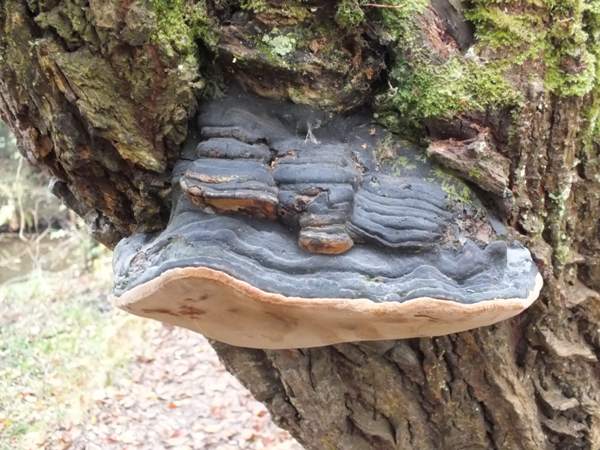
- The 'cap' is the upper surface of the perennial fruiting body. It is convex to hoof-shaped, often flattened at the base where it attaches to the tree. Color ranges from dark gray to black, sometimes with a brownish tinge, especially towards the margin. The surface is typically dull, rough, and concentrically furrowed or zoned, often developing deep cracks with age. The margin is blunt, rounded, and typically lighter in color, often grayish-brown or reddish-brown.
- Gills
- Phellinus igniarius is a polypore, meaning it has pores on its underside instead of gills. The pore surface is flat, grayish-brown to brown, becoming darker with age. The pores are very small, typically 4-6 per millimeter, circular to angular. The tubes are stratified, forming distinct layers corresponding to annual growth, and are the same color as the context.
- Stem
- Absent (sessile). The fruiting body is directly attached to the host tree.
- Flesh
- The context (flesh) is very hard, woody, and fibrous. It is dark reddish-brown to rusty brown, lacking distinct zones. It does not change color when cut or bruised. The pore layer is stratified, meaning new layers of pores are added each year, visible as distinct layers when the conk is cut in cross-section.
- Fruiting body
- Perennial, sessile, hoof-shaped to ungulate (horse-hoof shaped), very hard and woody. Can grow quite large, up to 30 cm (12 inches) across and 20 cm (8 inches) thick. The upper surface is typically concentrically zoned, dark gray to black, often cracked with age, and may be covered with algae or moss. The margin is usually blunt and lighter in color, often brownish or grayish-brown.
- Habitat
- Saprobic and parasitic on living and dead deciduous trees, particularly birch (Betula spp.), aspen (Populus tremuloides), willow (Salix spp.), oak (Quercus spp.), and beech (Fagus spp.). It causes a white heart rot in the host wood. Typically found growing singly or in small groups on the trunks of standing trees or fallen logs.
Key Facts
- Cap surfaces: Dark gray to black, concentrically zoned and furrowed, often cracked with age.
- Growth Form: Sessile, ungulate (hoof-shaped) bracket.
- Spore Print: White to pale yellow (spores are hyaline, smooth, broadly ellipsoid).
- Body color: Upper surface dark gray to black; pore surface grayish-brown; context dark reddish-brown.
- Odor: Mild, earthy.
- Flesh bruises: Does not bruise or change color.
- Height: Up to 20 cm (8 inches) thick.
- Cap Diameter: Up to 30 cm (12 inches) across.
- Nutrient gathering: Parasitic and saprobic, causing white heart rot in hardwoods.
Safe
SafePhellinus igniarius is considered non-toxic but is inedible due to its extremely tough, woody texture. It has no culinary value. There are no known toxins associated with this species, but it should not be consumed.
Quick Check
- Odor: Mildly fungoid or earthy, not distinctive.
- Fruiting: Perennial, hoof-shaped, woody bracket.
- Substrate: Living or dead deciduous trees, causing white heart rot.
Where to Find
North America
Widespread across temperate and boreal forests, particularly common in the northern United States and Canada.
Europe
Common throughout Europe, especially in deciduous woodlands.
Asia
Found in temperate regions of Asia, including Russia, China, and Japan.
Finding Tips
Host Tree Identification
Focus your search on deciduous trees, especially birch, aspen, willow, and oak. It rarely grows on conifers.
Look for Older Trees
Phellinus igniarius often infects older or stressed trees, so examine mature woodlands.
Check Trunks and Large Branches
The conks typically grow directly on the main trunk or large branches, often at varying heights.
Year-Round Presence
As a perennial fungus, its fruiting bodies can be found year-round, though they may be more noticeable in winter when deciduous trees have lost their leaves.
Similar Species
True Tinder Conk
Bracket Fungus
Also known as: Tinder Fungus, Hoof Fungus
Artist's Conk
Bracket Fungus
Also known as: Artist's Bracket
Red-banded Polypore
Bracket Fungus
Also known as: Red-belted Conk
Scientific Classification
- Phylum
- Basidiomycota
- Class
- Agaricomycetes
- Order
- Hymenochaetales
- Family
- Hymenochaetaceae
- Genus
- Phellinus
Storage Information
- Max Temperature: Not applicable for consumption.
- Freezing duration: Not applicable for consumption.
- Min Temperature: Not applicable for consumption.
- Refrigeration: Not applicable for consumption.
How to Clean
Not applicable, as this mushroom is not consumed. If collected for craft or tinder purposes, simply brush off any loose debris, moss, or dirt. No washing is required or recommended due to its woody texture.
Explore False Tinder Conk
Identify mushrooms anywhere
Free on iOS, Android, and Web. Photo identification, full database, and your personal collection.