
Got a photo? Identify mushrooms instantly with the Mushby app
Open the appDescription
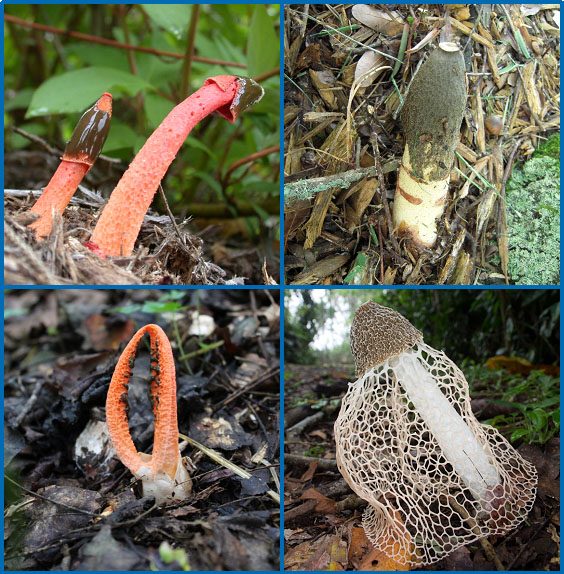
Phallus rubicundus is a species of fungus in the stinkhorn family (Phallaceae). It is characterized by its vibrant red to orange color, a reticulate (net-like) cap covered in a foul-smelling, olive-brown gleba, and a hollow, spongy stipe. It emerges from an 'egg' stage, which is a whitish, gelatinous volva. The strong, putrid odor of the gleba attracts insects, primarily flies, which aid in spore dispersal.
How to Identify
- Cap
- Conical to campanulate, 2-4 cm tall, covered by a slimy, olive-brown to dark brown gleba when young. The gleba is highly odorous and attracts insects. After the gleba is removed by insects, the cap reveals a reticulate (net-like or honeycomb-like) surface, typically reddish-orange, matching the stipe color.
- Gills
- Absent. Spores are embedded in the gleba.
- Stem
- Stipe (stem) is 8-20 cm tall and 1-2.5 cm thick, cylindrical, hollow, spongy, and brittle. It is typically bright red to orange, tapering slightly towards the apex. It arises from a cup-like volva (remnant of the 'egg' peridium) at the base, which is whitish and often stained with gleba.
- Flesh
- The 'egg' stage contains a firm, gelatinous layer surrounding the developing stipe and cap. The mature stipe is hollow, spongy, and brittle.
- Fruiting body
- Initially an 'egg' stage, 2-4 cm in diameter, whitish to pale brown, subglobose to ovoid, partially buried in the substrate. As it matures, the outer peridium ruptures, and the stipe rapidly elongates, pushing the cap upwards.
- Habitat
- Saprobic, growing on decaying wood, leaf litter, wood chips, garden mulch, and disturbed soils. Often found in gardens, lawns, cultivated areas, and woodlands.
Key Facts
- Cap surfaces: Reticulate (net-like) after gleba removal, covered in slimy, olive-brown gleba when young.
- Growth Form: Emerges from an 'egg' stage, then rapidly elongates into a columnar structure.
- Spore Print: Olive-brown (spores are embedded in the gleba).
- Body color: Bright red to orange stipe and reticulate cap; whitish volva; olive-brown gleba.
- Odor: Foul, putrid, carrion-like.
- Flesh bruises: Does not bruise.
- Height: 8-20 cm
- Cap Diameter: 2-4 cm (height of cap)
- Nutrient gathering: Saprobic
Safe
SafePhallus rubicundus is generally considered non-toxic, but its edibility is highly debated and not recommended. The 'egg' stage is sometimes consumed in some cultures, but the mature fruiting body is universally considered unpalatable due to its foul odor and slimy gleba. There are no known toxins, but consumption of the mature form could lead to gastrointestinal upset due to its unpleasant nature.
Quick Check
- Odor: Strongly putrid, fetid, carrion-like, especially from the gleba.
- Fruiting: Solitary or scattered, emerging from a subterranean 'egg'.
- Substrate: Decaying wood, wood chips, leaf litter, garden mulch, disturbed soil.
Where to Find
Tropical and Subtropical Regions
Widely distributed in tropical and subtropical areas worldwide, including parts of North America (especially the southeastern US), Central and South America, Asia, Africa, and Australia.
Disturbed Habitats
Commonly found in human-modified environments such as gardens, mulched beds, lawns, parks, and agricultural fields.
Woodlands
Can also be found in natural woodland settings, particularly in areas with rich organic matter and decaying wood.
Finding Tips
Look for 'Eggs'
Keep an eye out for the whitish, partially buried 'egg' stage, especially after rain. These are often easier to spot before the mature stinkhorn emerges.
Follow Your Nose
The strong, putrid odor of the mature stinkhorn is a primary indicator of its presence. If you smell something foul and unidentifiable, investigate the area.
Check Mulched Areas
Gardens and landscaped areas with wood chip mulch are prime locations for Phallus rubicundus, as it thrives on decaying organic material.
Seasonal Availability
Typically fruits during warm, humid periods, often after heavy rains. In tropical regions, it can appear year-round; in temperate zones, it's more common in late summer and fall.
Similar Species
Elegant Stinkhorn
fungus
Also known as: Phallus indusiatus
Dog Stinkhorn
fungus
Also known as: Mutinus caninus
Stinky Squid
fungus
Also known as: Pseudocolus fusiformis
Scientific Classification
- Phylum
- Basidiomycota
- Class
- Agaricomycetes
- Order
- Phallales
- Family
- Phallaceae
- Genus
- Phallus
Storage Information
- Max Temperature: Not applicable
- Freezing duration: Not applicable
- Min Temperature: Not applicable
- Refrigeration: Not applicable
How to Clean
Not typically collected for culinary purposes due to its strong odor and texture. If one were to handle it, gentle brushing to remove debris would suffice. The gleba is extremely sticky and difficult to remove.
Explore Stinkhorn
Identify mushrooms anywhere
Free on iOS, Android, and Web. Photo identification, full database, and your personal collection.