
Got a photo? Identify mushrooms instantly with the Mushby app
Open the appDescription
Panaeolus foenisecii is a very common, widely distributed, small to medium-sized brown mushroom often found in lawns and grassy areas. While not considered highly toxic, it can cause mild gastrointestinal upset in some individuals.
How to Identify
- Cap
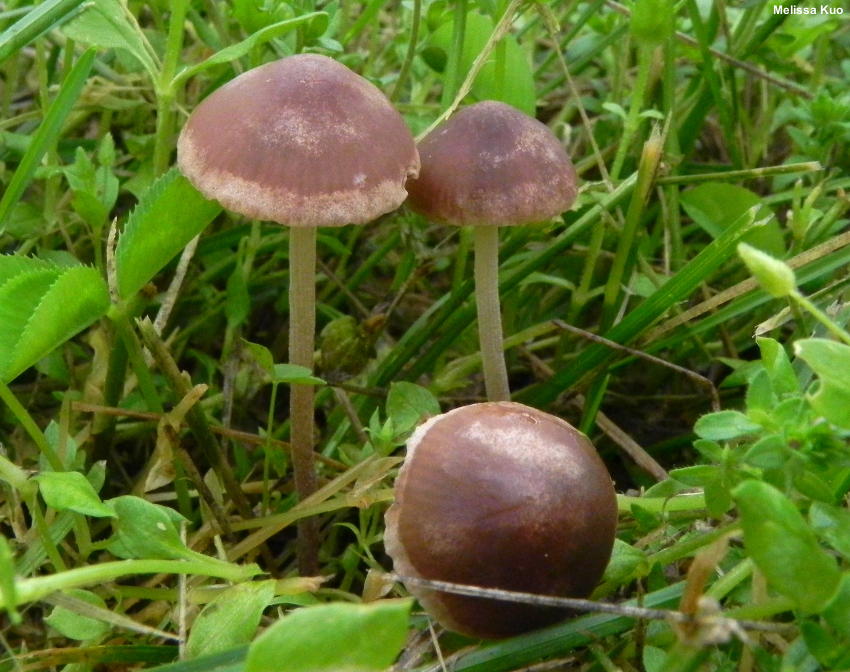
- The cap is hemispherical to convex, becoming more flattened with age. It is typically smooth and moist, with a color ranging from tan to brown, often fading to a lighter color as it dries. The cap margin may be slightly inrolled when young.
- Gills
- The gills are adnate to adnexed, close to crowded, and brownish in color. A key characteristic is that the gills are mottled, meaning they have dark spots or patches, especially as they mature. This mottling is due to uneven maturation of the spores.
- Stem
- The stem is slender, typically 3 to 7 cm long and 2 to 4 mm thick. It is usually straight and cylindrical, with a color similar to the cap or slightly lighter. The stem surface is smooth and lacks a ring or volva.
- Flesh
- The flesh is thin and brownish in color.
- Fruiting body
- The fruiting body is typically small, with a cap ranging from 1 to 3 cm in diameter. The overall appearance is that of a typical agaric mushroom.
- Habitat
- Panaeolus foenisecii is commonly found in lawns, meadows, pastures, and other grassy areas. It is saprotrophic, meaning it obtains nutrients from decaying organic matter. It often appears after rain or during periods of high humidity.
Key Facts
- Cap surfaces: Smooth, moist
- Growth Form: Solitary to gregarious
- Spore Print: Black
- Body color: Tan to brown
- Odor: Farinaceous or indistinct
- Flesh bruises: Does not typically bruise
- Height: 3-7 cm
- Cap Diameter: 1-3 cm
- Nutrient gathering: Saprotrophic
Toxic
Mild ToxicityPanaeolus foenisecii contains small amounts of psilocybin and psilocin, but the concentrations are generally too low to produce significant psychoactive effects. However, some individuals may experience mild gastrointestinal upset or anxiety. It is important to accurately identify this mushroom to avoid confusion with more potent psilocybin-containing species.
Quick Check
- Odor: Farinaceous (like flour) or indistinct
- Fruiting: Grows in lawns and grassy areas
- Substrate: Decaying grass and organic matter
Where to Find
Lawns and Gardens
Commonly found in well-fertilized lawns and gardens.
Meadows and Pastures
Often found in grassy meadows and pastures, especially after rainfall.
Finding Tips
Look After Rain
Search for them after periods of rain or high humidity, as this encourages fruiting.
Check Grassy Areas
Focus your search on grassy areas with rich soil and decaying organic matter.
Similar Species
Panaeolus cinctulus
mushroom
Also known as: Banded Mottlegill
Psilocybe semilanceata
mushroom
Also known as: Liberty Cap
Scientific Classification
- Phylum
- Basidiomycota
- Class
- Agaricomycetes
- Order
- Agaricales
- Family
- Bolbitiaceae
- Genus
- Panaeolus
Explore Haymaker's Fungi
Identify mushrooms anywhere
Free on iOS, Android, and Web. Photo identification, full database, and your personal collection.