
Got a photo? Identify mushrooms instantly with the Mushby app
Open the appDescription
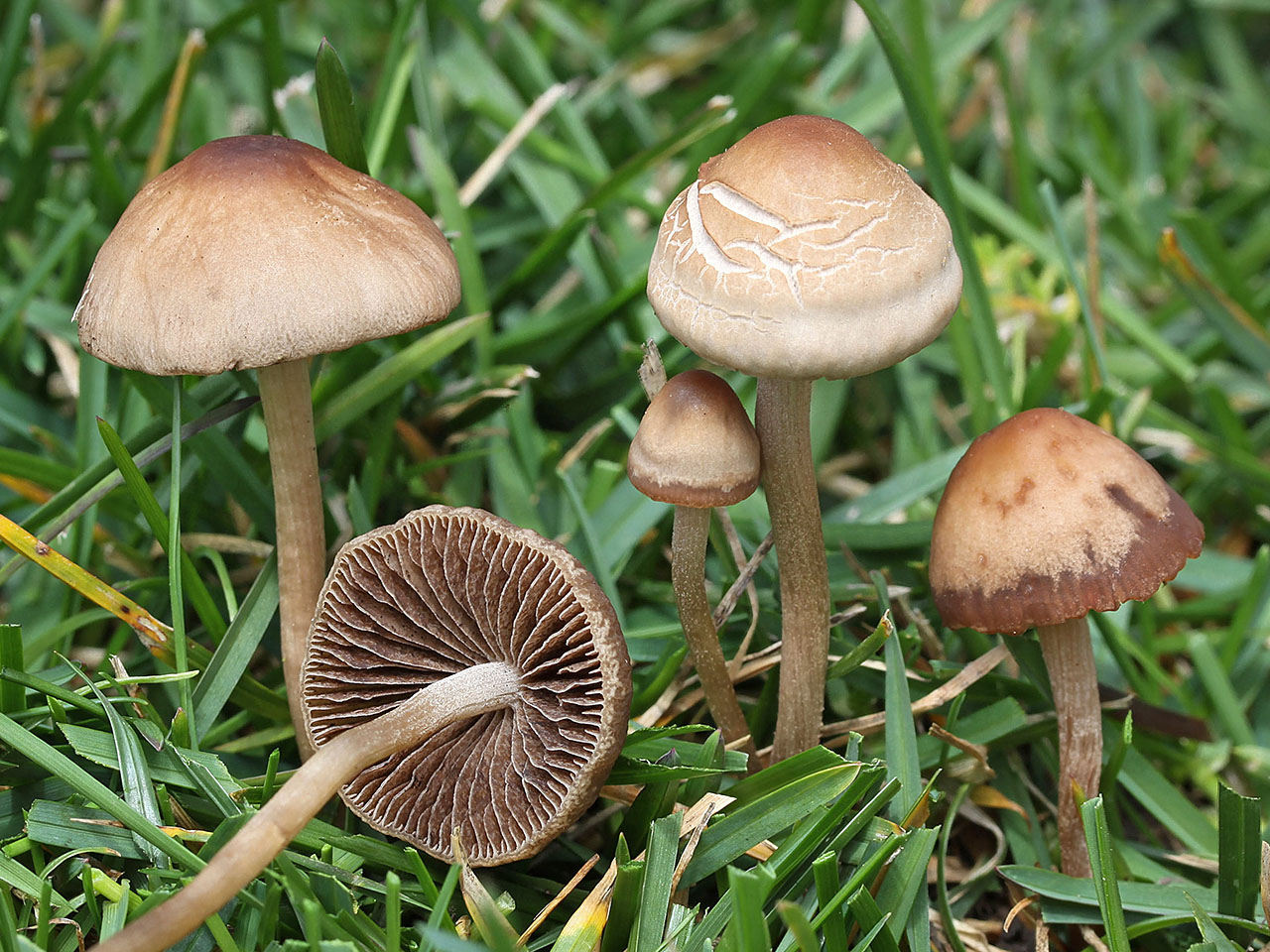
Panaeolina foenisecii, commonly known as the Brown Haycap or Mower's Mushroom, is a small, common, and widespread saprobic mushroom found in lawns, pastures, and grassy areas. It is characterized by its hygrophanous cap, which changes color significantly depending on moisture levels, and its dark brown, finely roughened spores. While often considered non-toxic, it is not recommended for consumption due to its small size, lack of culinary value, and potential for confusion with psychoactive species.
How to Identify
- Cap
- 1-3 cm in diameter, initially convex to bell-shaped, expanding to broadly convex or nearly flat with age, often retaining a slight umbo. The margin is often striate when moist. It is strongly hygrophanous; when moist, it is dark reddish-brown to sepia brown, fading to buff, tan, or pale yellowish-brown from the center outwards as it dries. The surface is smooth.
- Gills
- Adnate to adnexed, close to crowded, initially pale brown, becoming dark brown to purplish-brown with whitish edges due to the maturing spores. They often have a mottled appearance due to the uneven maturation of spores.
- Stem
- 3-8 cm long and 1-3 mm thick, slender, cylindrical, often slightly tapering upwards, sometimes with a slightly swollen base. It is concolorous with the cap or slightly paler, often pruinose (finely powdered) at the apex, becoming smooth below. It is hollow and fragile, without a ring.
- Flesh
- Thin, fragile, brownish, and unchanging when bruised or cut.
- Fruiting body
- Small, slender, and fragile, typically growing scattered or in small groups.
- Habitat
- Saprobic, growing on decaying grass, lawns, pastures, meadows, and other grassy areas, often in fertilized soil. It can also be found in gardens, parks, and along roadsides.
Key Facts
- Cap surfaces: Smooth, hygrophanous, changing color with moisture.
- Growth Form: Scattered to gregarious.
- Spore Print: Dark brown to purplish-brown.
- Body color: Cap: Dark reddish-brown to sepia brown (moist), fading to buff, tan, or pale yellowish-brown (dry). Gills: Pale brown becoming dark purplish-brown. Stem: Concolorous with cap or paler.
- Odor: Mild, indistinct.
- Flesh bruises: Does not bruise or stain.
- Height: 3-8 cm
- Cap Diameter: 1-3 cm
- Nutrient gathering: Saprobic
Safe
SafePanaeolina foenisecii is generally considered non-toxic, but it is not edible due to its small size and lack of culinary value. There have been reports of mild gastrointestinal upset in some individuals who have consumed it, possibly due to individual sensitivity or misidentification. Crucially, it is often mistaken for psychoactive species of Panaeolus and Psilocybe, which contain psilocybin and psilocin. Therefore, consumption is strongly discouraged.
Quick Check
- Odor: Mild, indistinct, sometimes slightly earthy or fungoid.
- Fruiting: Spring to late autumn, often appearing in flushes after rain.
- Substrate: Decaying grass, lawns, pastures, grassy areas, often in fertilized soil.
Where to Find
Lawns and Gardens
Commonly found in well-maintained lawns, gardens, and parks, especially after rain.
Pastures and Meadows
Abundant in grassy fields, pastures, and meadows, often in areas enriched by animal droppings, though it does not directly grow on dung.
Roadsides and Disturbed Areas
Can be found along roadsides and other disturbed grassy areas.
Finding Tips
Look in Grassy Areas
Focus your search on lawns, parks, pastures, and any area with short grass, especially after periods of rain.
Observe Hygrophanous Nature
Pay attention to the cap's color change as it dries. This is a key identifying feature. Moist caps are dark, dry caps are pale.
Check Spore Print
A dark brown to purplish-brown spore print is crucial for identification and differentiation from similar species.
Note Gill Mottling
The mottled appearance of the gills due to uneven spore maturation is a characteristic feature of Panaeolina and Panaeolus species.
Similar Species
Panaeolus cinctulus
mushroom
Also known as: Banded Mottlegill
Panaeolus olivaceus
mushroom
Also known as: Olive Mottlegill
Panaeolus papilionaceus
mushroom
Also known as: Panaeolus campanulatus
Psilocybe semilanceata
mushroom
Also known as: Liberty Cap
Galerina marginata
mushroom
Also known as: Funeral Bell
Scientific Classification
- Phylum
- Basidiomycota
- Class
- Agaricomycetes
- Order
- Agaricales
- Family
- Bolbitiaceae
- Genus
- Panaeolina
Storage Information
- Max Temperature: 4°C
- Freezing duration: Not applicable
- Min Temperature: 1°C
- Refrigeration: Not applicable
How to Clean
Not recommended for culinary use. If handled for identification, gently brush off any debris. Avoid washing as the fragile structure can be easily damaged.
Explore Brown Haycap
Identify mushrooms anywhere
Free on iOS, Android, and Web. Photo identification, full database, and your personal collection.