
How to identify Red-capped scaly polypore
Neolentinus lepideus
Got a photo? Identify mushrooms instantly with the Mushby app
Open the appTo correctly identify Red-capped scaly polypore (Neolentinus lepideus), check each of these features in order. Misidentification is the most common cause of mushroom poisoning, so cross-reference multiple sources.
Step-by-step identification
- 1
Cap
Shape, color, surface texture, and diameter.
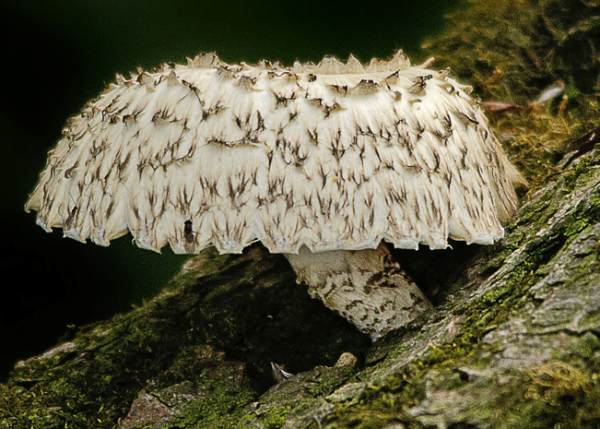
The cap is typically 5-20 cm (2-8 inches) in diameter, convex to flat, sometimes depressed in the center, and often irregular in shape. The color ranges from whitish to yellowish-brown, often with reddish-brown to dark brown scales, especially towards the center. The margin is usually inrolled when young, becoming wavy or lobed with age. The surface is dry and distinctly scaly.
- 2
Gills
Attachment to stem, color, and spacing.
The gills are decurrent (running down the stem), broad, and widely spaced. They are white to cream-colored, becoming yellowish with age. A key feature is that the gill edges are serrated or 'saw-toothed', which is characteristic of the genus Neolentinus. In older specimens, the gills can become somewhat labyrinthine or anastomosing, giving a pore-like appearance.
- 3
Stem
Length, shape, surface, and any ring.
The stem is 3-10 cm (1.2-4 inches) long and 1-3 cm (0.4-1.2 inches) thick, central or eccentric, tough, and fibrous. It is typically whitish to yellowish, often with scales similar to the cap, especially towards the base. It can be solid or hollow with age.
- 4
Flesh
Color, texture, and bruising reaction.
The flesh is tough, white, and fibrous, not changing color when bruised or cut. It has a mild, somewhat mealy or indistinct odor and taste.
- 5
Fruiting body
Overall growth pattern.
The fruiting body is tough, leathery, and often eccentric or centrally stemmed. It can grow quite large, sometimes solitary but often in scattered groups.
- 6
Habitat
Where it grows and on what substrate.
Saprobic, growing on dead or decaying coniferous wood, especially pine, spruce, and fir. It is commonly found on stumps, logs, fallen branches, and sometimes on structural timber like railroad ties, utility poles, and wooden bridges. It causes a brown rot.
Key Facts
- Cap surfaces
- Dry, scaly, often with reddish-brown to dark brown scales
- Growth Form
- Solitary to scattered groups
- Spore Print
- White
- Body color
- Whitish to yellowish-brown, with darker scales
- Odor
- Mild, mealy
- Flesh bruises
- No color change
- Height
- 3-10 cm (1.2-4 inches)
- Cap Diameter
- 5-20 cm (2-8 inches)
Fruit body characteristics
- Gill attachment: Decurrent
- Stem shape: Cylindrical, often tapering towards the base
- Stem surface: Whitish to yellowish, often scaly, fibrous
- Ring: Absent
- Stem cross-section: Solid to hollow with age
Explore Red-capped scaly polypore
Identify mushrooms anywhere
Free on iOS, Android, and Web. Photo identification, full database, and your personal collection.