
Got a photo? Identify mushrooms instantly with the Mushby app
Open the appDescription
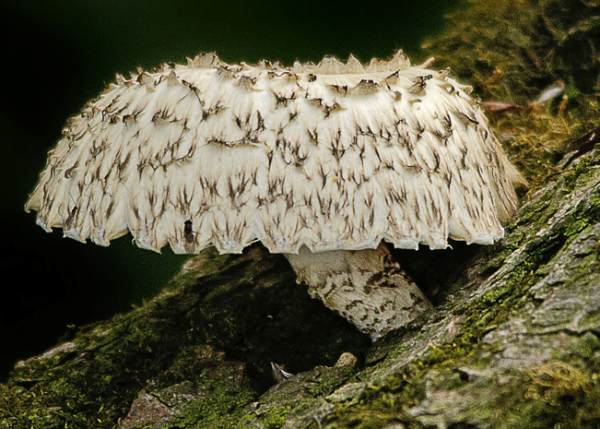
Neolentinus lepideus, commonly known as the scaly lentinus, train wrecker, or scaly sawgill, is a wood-decaying fungus belonging to the family Gloeophyllaceae. It is characterized by its tough, scaly cap, often with reddish-brown to yellowish-brown hues, and its preference for decaying coniferous wood. Despite its common name 'polypore', it is a gilled mushroom, though its gills are often thick and somewhat labyrinthine, resembling pores in older specimens. It is a significant decomposer of timber, particularly railroad ties, hence the 'train wrecker' moniker.
How to Identify
- Cap
- The cap is typically 5-20 cm (2-8 inches) in diameter, convex to flat, sometimes depressed in the center, and often irregular in shape. The color ranges from whitish to yellowish-brown, often with reddish-brown to dark brown scales, especially towards the center. The margin is usually inrolled when young, becoming wavy or lobed with age. The surface is dry and distinctly scaly.
- Gills
- The gills are decurrent (running down the stem), broad, and widely spaced. They are white to cream-colored, becoming yellowish with age. A key feature is that the gill edges are serrated or 'saw-toothed', which is characteristic of the genus Neolentinus. In older specimens, the gills can become somewhat labyrinthine or anastomosing, giving a pore-like appearance.
- Stem
- The stem is 3-10 cm (1.2-4 inches) long and 1-3 cm (0.4-1.2 inches) thick, central or eccentric, tough, and fibrous. It is typically whitish to yellowish, often with scales similar to the cap, especially towards the base. It can be solid or hollow with age.
- Flesh
- The flesh is tough, white, and fibrous, not changing color when bruised or cut. It has a mild, somewhat mealy or indistinct odor and taste.
- Fruiting body
- The fruiting body is tough, leathery, and often eccentric or centrally stemmed. It can grow quite large, sometimes solitary but often in scattered groups.
- Habitat
- Saprobic, growing on dead or decaying coniferous wood, especially pine, spruce, and fir. It is commonly found on stumps, logs, fallen branches, and sometimes on structural timber like railroad ties, utility poles, and wooden bridges. It causes a brown rot.
Key Facts
- Cap surfaces: Dry, scaly, often with reddish-brown to dark brown scales
- Growth Form: Solitary to scattered groups
- Spore Print: White
- Body color: Whitish to yellowish-brown, with darker scales
- Odor: Mild, mealy
- Flesh bruises: No color change
- Height: 3-10 cm (1.2-4 inches)
- Cap Diameter: 5-20 cm (2-8 inches)
- Nutrient gathering: Saprobic (wood decay)
Safe
SafeNeolentinus lepideus is generally considered inedible due to its extremely tough and fibrous texture, especially when mature. While not known to be toxic, its culinary value is negligible. There are no reported toxins or adverse reactions from consumption, but it is not recommended for eating.
Quick Check
- Odor: Mild, somewhat mealy or indistinct
- Fruiting: Late spring to autumn
- Substrate: Dead coniferous wood (pine, spruce, fir)
Where to Find
North America
Widespread across coniferous forests, particularly in the eastern and western regions.
Europe
Common in coniferous and mixed forests.
Asia
Reported in various parts of Asia where suitable coniferous hosts are present.
Finding Tips
Substrate Preference
Focus your search on dead coniferous wood, such as pine, spruce, and fir logs, stumps, and fallen branches. It is less common on hardwoods.
Seasonal Availability
Typically fruits from late spring through autumn, with peak fruiting often occurring in summer months, especially after rain.
Look for Scales
The prominent scales on the cap are a key identifying feature. Look for caps with a scaly texture, often darker in the center.
Check Gill Edges
Carefully examine the gill edges for the characteristic serrated or 'saw-toothed' appearance, which helps distinguish it from other gilled fungi.
Similar Species
Lentinus tigrinus
fungus
Also known as: Tiger Sawgill
Polyporus squamosus
fungus
Also known as: Dryad's Saddle, Pheasant's Back Polypore
Scientific Classification
- Phylum
- Basidiomycota
- Class
- Agaricomycetes
- Order
- Gloeophyllales
- Family
- Gloeophyllaceae
- Genus
- Neolentinus
Storage Information
- Max Temperature: 4°C
- Freezing duration: 6 months
- Min Temperature: 0°C
- Refrigeration: 3 days
How to Clean
Due to its tough texture, Neolentinus lepideus is not typically consumed. If one were to prepare it, brushing off debris and wiping with a damp cloth would be sufficient. Avoid washing under running water as it can absorb excess moisture.
Explore Red-capped scaly polypore
Identify mushrooms anywhere
Free on iOS, Android, and Web. Photo identification, full database, and your personal collection.