
How to identify Scarletina Bolete
Neoboletus luridiformis
Got a photo? Identify mushrooms instantly with the Mushby app
Open the appTo correctly identify Scarletina Bolete (Neoboletus luridiformis), check each of these features in order. Misidentification is the most common cause of mushroom poisoning, so cross-reference multiple sources.
Step-by-step identification
- 1
Cap
Shape, color, surface texture, and diameter.
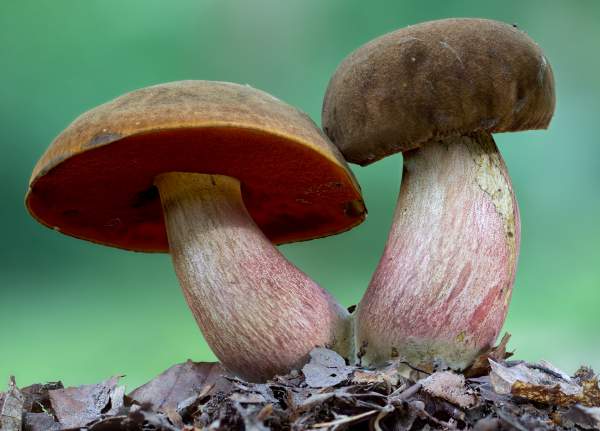
The cap is convex to flattened, ranging from 5 to 15 cm in diameter. Its color is variable, often displaying shades of red, orange, or brown, sometimes with yellowish or olive tinges. The surface is dry and can be slightly velvety when young, becoming smoother with age. It bruises blue when handled.
- 2
Gills
Attachment to stem, color, and spacing.
This mushroom does not have gills. Instead, it has pores on the underside of the cap. The pores are small, round, and initially yellow, turning orange to red with maturity. They bruise blue when touched.
- 3
Stem
Length, shape, surface, and any ring.
The stem is stout, cylindrical, and typically 5 to 12 cm long and 1 to 3 cm thick. It is usually yellow at the apex and red towards the base, often covered with a fine network of reddish or brownish reticulation. The stem also bruises blue when handled.
- 4
Flesh
Color, texture, and bruising reaction.
The flesh is firm and yellowish, quickly turning blue when cut or bruised. This color change is a key identifying feature.
- 5
Fruiting body
Overall growth pattern.
The fruiting body of Neoboletus luridiformis is a fleshy mushroom with a distinct cap and stem. It typically grows to a medium to large size.
- 6
Habitat
Where it grows and on what substrate.
Neoboletus luridiformis is found in deciduous and coniferous forests, forming mycorrhizal associations with trees such as oak, beech, and birch. It typically fruits from summer to autumn.
Key Facts
- Cap surfaces
- Dry, slightly velvety when young, becoming smoother with age.
- Growth Form
- Solitary or in small groups.
- Spore Print
- Olive-brown.
- Body color
- Variable, often red, orange, or brown with yellowish or olive tinges.
- Odor
- Mild and fungal.
- Flesh bruises
- Quickly turns blue when cut or bruised.
- Height
- 5-12 cm
- Cap Diameter
- 5-15 cm
Fruit body characteristics
- Gill attachment: Pores, not gills.
- Stem shape: Cylindrical.
- Stem surface: Often covered with a fine network of reddish or brownish reticulation.
- Ring: Absent.
- Stem cross-section: Solid.
Explore Scarletina Bolete
Identify mushrooms anywhere
Free on iOS, Android, and Web. Photo identification, full database, and your personal collection.