
Got a photo? Identify mushrooms instantly with the Mushby app
Open the appDescription
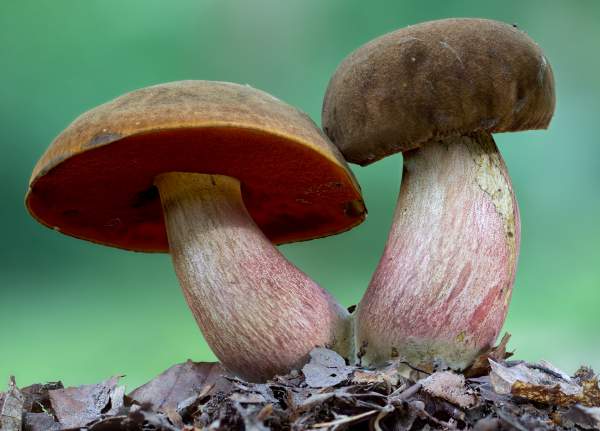
Neoboletus luridiformis, commonly known as the Scarletina Bolete, is a striking mushroom characterized by its vibrant colors and distinctive features. It is a mycorrhizal fungus, forming symbiotic relationships with various trees, particularly broadleaf species. This bolete is appreciated for its culinary value, but caution is advised due to its potential toxicity when raw or undercooked.
How to Identify
- Cap
- The cap is convex to flattened, ranging from 5 to 15 cm in diameter. Its color is variable, often displaying shades of red, orange, or brown, sometimes with yellowish or olive tinges. The surface is dry and can be slightly velvety when young, becoming smoother with age. It bruises blue when handled.
- Gills
- This mushroom does not have gills. Instead, it has pores on the underside of the cap. The pores are small, round, and initially yellow, turning orange to red with maturity. They bruise blue when touched.
- Stem
- The stem is stout, cylindrical, and typically 5 to 12 cm long and 1 to 3 cm thick. It is usually yellow at the apex and red towards the base, often covered with a fine network of reddish or brownish reticulation. The stem also bruises blue when handled.
- Flesh
- The flesh is firm and yellowish, quickly turning blue when cut or bruised. This color change is a key identifying feature.
- Fruiting body
- The fruiting body of Neoboletus luridiformis is a fleshy mushroom with a distinct cap and stem. It typically grows to a medium to large size.
- Habitat
- Neoboletus luridiformis is found in deciduous and coniferous forests, forming mycorrhizal associations with trees such as oak, beech, and birch. It typically fruits from summer to autumn.
Key Facts
- Cap surfaces: Dry, slightly velvety when young, becoming smoother with age.
- Growth Form: Solitary or in small groups.
- Spore Print: Olive-brown.
- Body color: Variable, often red, orange, or brown with yellowish or olive tinges.
- Odor: Mild and fungal.
- Flesh bruises: Quickly turns blue when cut or bruised.
- Height: 5-12 cm
- Cap Diameter: 5-15 cm
- Nutrient gathering: Mycorrhizal
Toxic
Moderate ToxicityNeoboletus luridiformis is toxic when raw or undercooked, causing gastrointestinal distress. It must be thoroughly cooked before consumption to neutralize the toxins.
Quick Check
- Odor: Mild and fungal, not distinctive.
- Fruiting: Summer to Autumn
- Substrate: Soil, in mycorrhizal association with trees.
Where to Find
Europe
Common throughout Europe, particularly in deciduous and mixed forests.
North America
Occasionally found in North America, especially in regions with similar forest ecosystems.
Finding Tips
Look Near Host Trees
Search for this bolete near oak, beech, and birch trees, as it forms mycorrhizal relationships with these species.
Check in Summer and Autumn
The fruiting season is typically from summer to autumn, so these are the best times to search.
Examine Forest Edges
Check along forest edges and in areas with dappled sunlight, as these conditions are often favorable for bolete growth.
Similar Species
Bitter Beech Bolete
Mushroom
Also known as: Caloboletus calopus
Scientific Classification
- Phylum
- Basidiomycota
- Class
- Agaricomycetes
- Order
- Boletales
- Family
- Boletaceae
- Genus
- Neoboletus
Explore Scarletina Bolete
Identify mushrooms anywhere
Free on iOS, Android, and Web. Photo identification, full database, and your personal collection.