
How to identify Red-footed Bolete
Neoboletus erythropus
Got a photo? Identify mushrooms instantly with the Mushby app
Open the appTo correctly identify Red-footed Bolete (Neoboletus erythropus), check each of these features in order. Misidentification is the most common cause of mushroom poisoning, so cross-reference multiple sources.
Step-by-step identification
- 1
Cap
Shape, color, surface texture, and diameter.
5-20 cm (2-8 inches) in diameter, convex to broadly convex, sometimes becoming nearly flat with age. The color ranges from dark brown, reddish-brown, to olive-brown, often with a velvety or finely tomentose (hairy) surface when young, becoming smoother with age. The margin is usually incurved when young. It does not bruise blue on the cap surface.
- 2
Gills
Attachment to stem, color, and spacing.
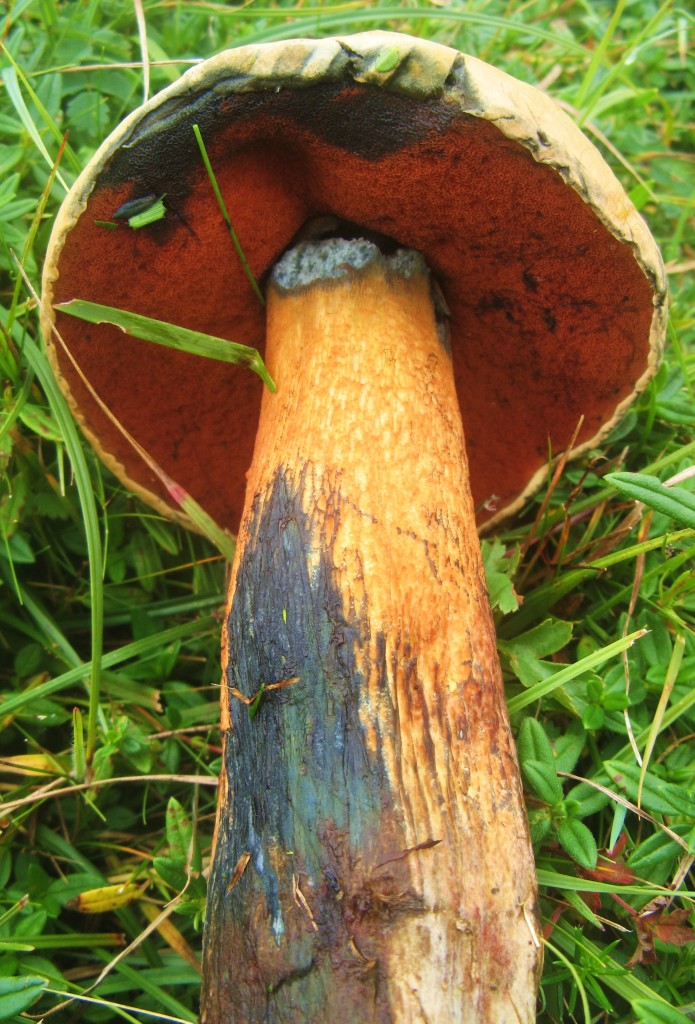
Pore surface is bright yellow to orange-yellow, becoming more orange-red with age. Pores are small and round. They bruise instantly and intensely dark blue to blackish-blue upon touch. Tubes are concolorous with the pore surface, 1-2.5 cm deep, adnexed to depressed.
- 3
Stem
Length, shape, surface, and any ring.
5-15 cm (2-6 inches) long, 1.5-4 cm (0.6-1.6 inches) thick, stout, cylindrical to clavate (club-shaped) or ventricose (swollen in the middle). The background color is yellow, but it is densely covered with fine red to orange-red granules or punctations, giving it a reddish appearance. Crucially, it lacks a reticulate (net-like) pattern. The base may be slightly tapered or pointed. The flesh of the stem also stains blue when cut.
- 4
Flesh
Color, texture, and bruising reaction.
Pale yellow to yellowish-white, firm. Instantly and intensely stains dark blue when cut or bruised, especially in the cap and upper stem. This bluing reaction is a key identification feature.
- 5
Fruiting body
Overall growth pattern.
Robust, fleshy, and typically found growing solitarily or in small scattered groups.
- 6
Habitat
Where it grows and on what substrate.
Mycorrhizal with various deciduous and coniferous trees, often found under oak, beech, spruce, and fir. Prefers acidic to neutral soils.
Key Facts
- Cap surfaces
- Velvety to smooth, dark brown to reddish-brown
- Growth Form
- Solitary to scattered
- Spore Print
- Olive-brown
- Body color
- Dark brown cap, yellow pores, red-punctate stem
- Odor
- Mild
- Flesh bruises
- Instantly and intensely dark blue
- Height
- 5-15 cm
- Cap Diameter
- 5-20 cm
Fruit body characteristics
- Gill attachment: Adnexed to depressed (pores)
- Stem shape: Cylindrical, clavate, or ventricose
- Stem surface: Yellow background with dense red to orange-red punctations/granules, no reticulation
- Ring: Absent
- Stem cross-section: Solid
Explore Red-footed Bolete
Identify mushrooms anywhere
Free on iOS, Android, and Web. Photo identification, full database, and your personal collection.