
Got a photo? Identify mushrooms instantly with the Mushby app
Open the appDescription
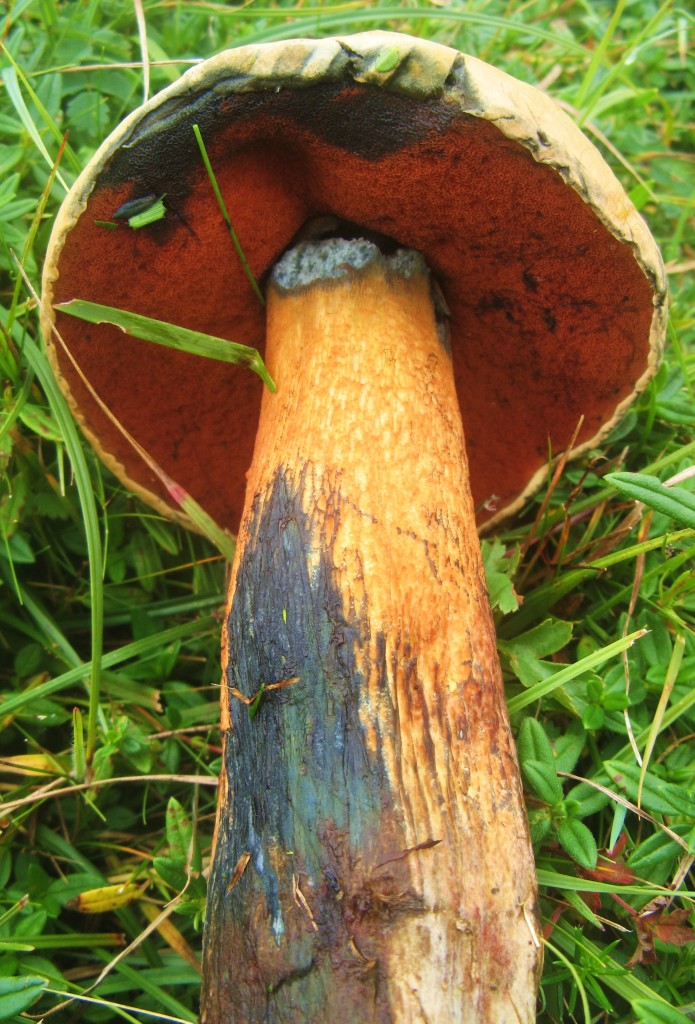
The Red-footed Bolete (Neoboletus erythropus) is a striking and robust mushroom belonging to the Boletaceae family. It is characterized by its dark brown cap, yellow pores that instantly bruise dark blue upon touching, and a stem covered in distinctive red to orange-red granules or punctations, lacking a reticulate (net-like) pattern. It is a popular edible mushroom in many parts of Europe, but requires thorough cooking due to its raw toxicity.
How to Identify
- Cap
- 5-20 cm (2-8 inches) in diameter, convex to broadly convex, sometimes becoming nearly flat with age. The color ranges from dark brown, reddish-brown, to olive-brown, often with a velvety or finely tomentose (hairy) surface when young, becoming smoother with age. The margin is usually incurved when young. It does not bruise blue on the cap surface.
- Gills
- Pore surface is bright yellow to orange-yellow, becoming more orange-red with age. Pores are small and round. They bruise instantly and intensely dark blue to blackish-blue upon touch. Tubes are concolorous with the pore surface, 1-2.5 cm deep, adnexed to depressed.
- Stem
- 5-15 cm (2-6 inches) long, 1.5-4 cm (0.6-1.6 inches) thick, stout, cylindrical to clavate (club-shaped) or ventricose (swollen in the middle). The background color is yellow, but it is densely covered with fine red to orange-red granules or punctations, giving it a reddish appearance. Crucially, it lacks a reticulate (net-like) pattern. The base may be slightly tapered or pointed. The flesh of the stem also stains blue when cut.
- Flesh
- Pale yellow to yellowish-white, firm. Instantly and intensely stains dark blue when cut or bruised, especially in the cap and upper stem. This bluing reaction is a key identification feature.
- Fruiting body
- Robust, fleshy, and typically found growing solitarily or in small scattered groups.
- Habitat
- Mycorrhizal with various deciduous and coniferous trees, often found under oak, beech, spruce, and fir. Prefers acidic to neutral soils.
Key Facts
- Cap surfaces: Velvety to smooth, dark brown to reddish-brown
- Growth Form: Solitary to scattered
- Spore Print: Olive-brown
- Body color: Dark brown cap, yellow pores, red-punctate stem
- Odor: Mild
- Flesh bruises: Instantly and intensely dark blue
- Height: 5-15 cm
- Cap Diameter: 5-20 cm
- Nutrient gathering: Mycorrhizal
Toxic
Moderate ToxicityNeoboletus erythropus is toxic when raw. It contains compounds that can cause gastrointestinal upset (nausea, vomiting, diarrhea) if consumed uncooked or insufficiently cooked. It is considered a good edible mushroom only after thorough cooking. It should never be eaten raw or lightly cooked.
Quick Check
- Odor: Mild, pleasant, mushroomy
- Fruiting: Summer to Autumn
- Substrate: Soil, mycorrhizal with trees
Where to Find
Europe
Widespread and common across most of Europe, particularly in broadleaf and mixed forests.
North America
Found in eastern North America, though some populations previously identified as N. erythropus may represent distinct, closely related species (e.g., Neoboletus subvelutipes).
Finding Tips
Look for the Red Granules
The most distinctive feature is the stem covered in red to orange-red granules, not a net-like pattern. This differentiates it from many other blue-staining boletes.
Check for Instant Bluing
Gently press the pore surface or cut the flesh. The rapid and intense blue staining is a reliable indicator.
Habitat Preference
Search in deciduous and coniferous woodlands, especially under oak, beech, spruce, and fir trees.
Seasonal Availability
Typically fruits from summer through autumn, with peak season often in late summer and early autumn.
Similar Species
Devil's Bolete
Rubroboletus
Also known as: Rubroboletus satanas
Scarletina Bolete
Neoboletus
Also known as: Neoboletus luridiformis
Bitter Bolete
Tylopilus
Also known as: Tylopilus felleus
Scientific Classification
- Phylum
- Basidiomycota
- Class
- Agaricomycetes
- Order
- Boletales
- Family
- Boletaceae
- Genus
- Neoboletus
Explore Red-footed Bolete
Identify mushrooms anywhere
Free on iOS, Android, and Web. Photo identification, full database, and your personal collection.