
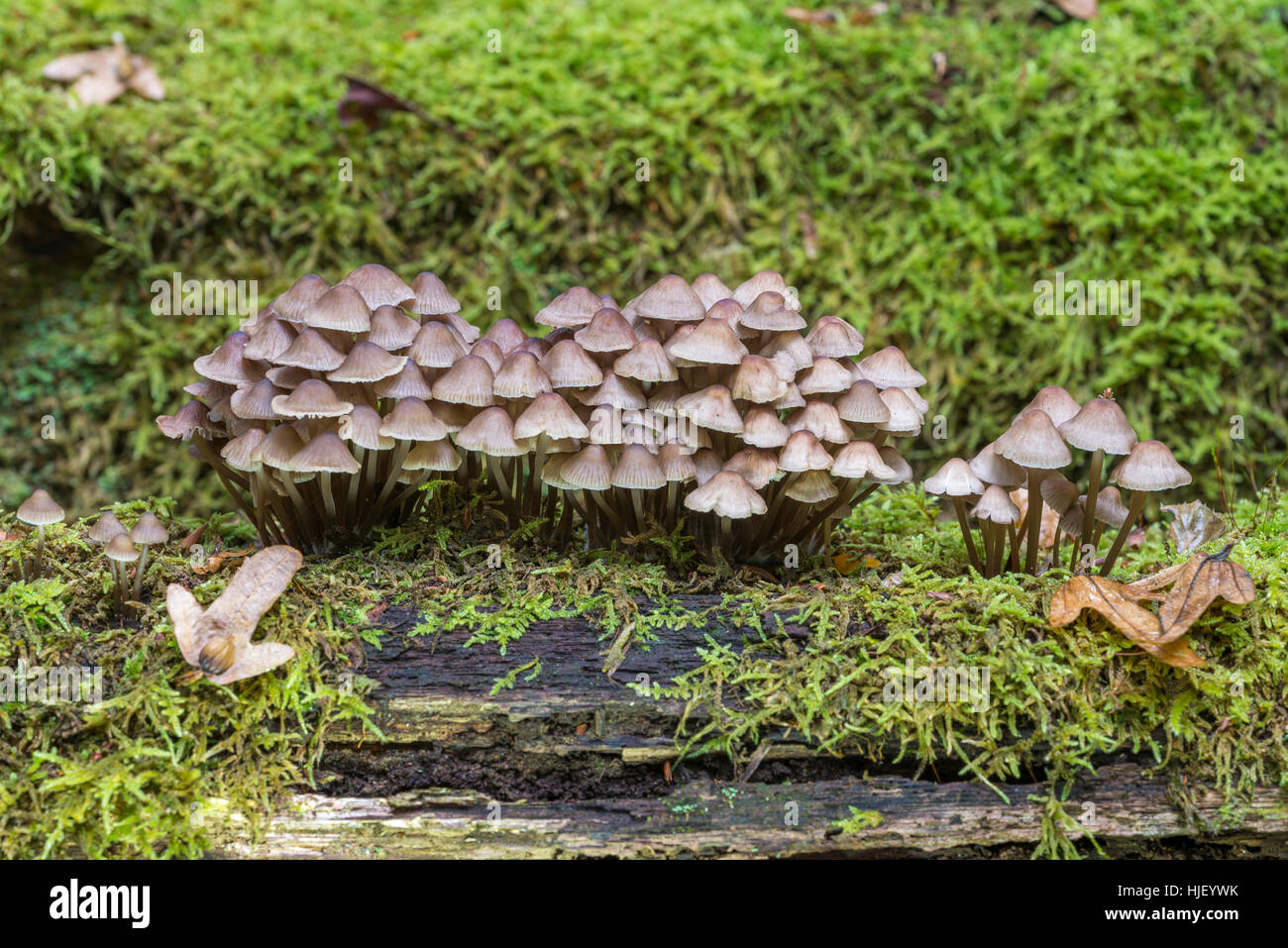
How to identify Brown Bonnet
Mycena metata
Got a photo? Identify mushrooms instantly with the Mushby app
Open the appTo correctly identify Brown Bonnet (Mycena metata), check each of these features in order. Misidentification is the most common cause of mushroom poisoning, so cross-reference multiple sources.
Step-by-step identification
- 1
Cap
Shape, color, surface texture, and diameter.
The cap is 1-3 cm in diameter, initially conical or bell-shaped, expanding to convex or broadly conical, often with a small central umbo. The margin is striate, especially when moist, and can be slightly wavy. The color varies from reddish-brown, pinkish-brown, or grayish-brown to pale buff, often fading with age or drying. It is hygrophanous, meaning its color changes depending on moisture content. The surface is smooth and somewhat translucent-striate when wet.
- 2
Gills
Attachment to stem, color, and spacing.
The gills are adnate to adnexed, sometimes with a decurrent tooth, and are moderately crowded. They are initially whitish or pale gray, often developing a distinct pinkish tint with maturity due to the spores. There are numerous lamellulae (short gills).
- 3
Stem
Length, shape, surface, and any ring.
The stem is 3-8 cm long and 1-3 mm thick, slender, cylindrical, and often slightly tapering upwards. It is hollow, fragile, and smooth. The color is typically whitish to pale brownish, often darker towards the base, and can be pruinose (finely powdered) at the apex. The base is often covered with fine, whitish hairs (mycelium).
- 4
Flesh
Color, texture, and bruising reaction.
The flesh is very thin, fragile, and whitish to pale brownish. It has a mild, sometimes slightly radish-like or indistinct odor and taste.
- 5
Fruiting body
Overall growth pattern.
The fruiting body is typically small and slender, characteristic of the genus Mycena.
- 6
Habitat
Where it grows and on what substrate.
Saprobic, growing gregariously or scattered on decaying wood debris (often buried), leaf litter, mossy ground, or conifer needles in coniferous, mixed, and occasionally deciduous forests.
Key Facts
- Cap surfaces
- Smooth, translucent-striate when moist.
- Growth Form
- Gregarious or scattered.
- Spore Print
- White to pale pinkish.
- Body color
- Cap reddish-brown to pinkish-brown or grayish-brown; stem whitish to pale brownish.
- Odor
- Mild, sometimes slightly radish-like.
- Flesh bruises
- Does not bruise significantly.
- Height
- 3-8 cm
- Cap Diameter
- 1-3 cm
Fruit body characteristics
- Gill attachment: Adnate to adnexed, sometimes with a decurrent tooth.
- Stem shape: Cylindrical, often slightly tapering upwards.
- Stem surface: Smooth, sometimes pruinose at apex, base often hairy.
- Ring: Absent
- Stem cross-section: Hollow
Explore Brown Bonnet
Identify mushrooms anywhere
Free on iOS, Android, and Web. Photo identification, full database, and your personal collection.