
Got a photo? Identify mushrooms instantly with the Mushby app
Open the appDescription
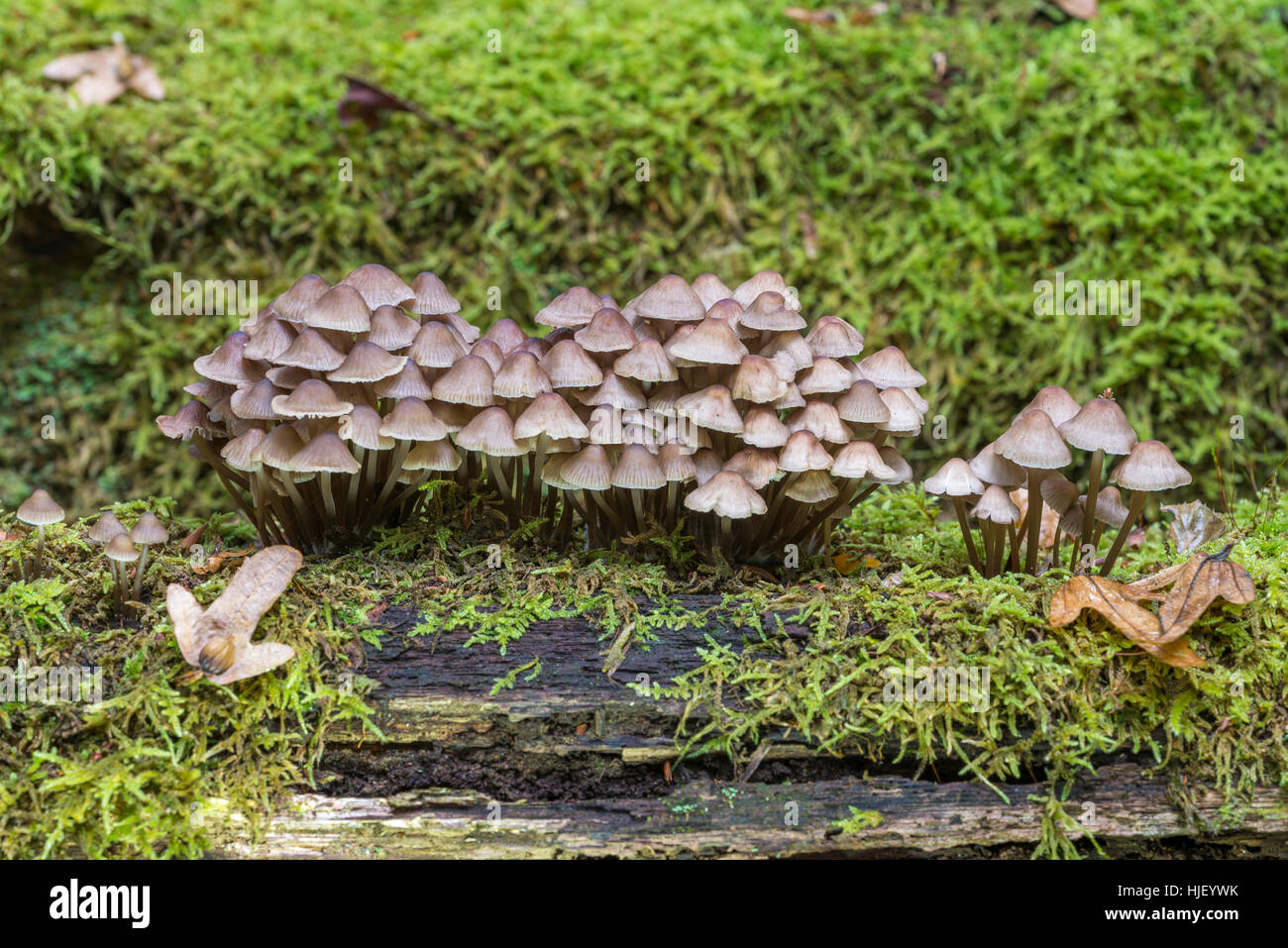
Mycena metata, commonly known as the Brown Bonnet or Pink-gilled Mycena, is a small, delicate saprobic mushroom belonging to the family Mycenaceae. It is characterized by its typically brownish cap, often with a pinkish or reddish tint, and its pale gills that can develop a pinkish hue with age due to spore deposit. This species is widespread in temperate regions, growing on decaying wood debris, leaf litter, or mossy ground in coniferous and mixed forests.
How to Identify
- Cap
- The cap is 1-3 cm in diameter, initially conical or bell-shaped, expanding to convex or broadly conical, often with a small central umbo. The margin is striate, especially when moist, and can be slightly wavy. The color varies from reddish-brown, pinkish-brown, or grayish-brown to pale buff, often fading with age or drying. It is hygrophanous, meaning its color changes depending on moisture content. The surface is smooth and somewhat translucent-striate when wet.
- Gills
- The gills are adnate to adnexed, sometimes with a decurrent tooth, and are moderately crowded. They are initially whitish or pale gray, often developing a distinct pinkish tint with maturity due to the spores. There are numerous lamellulae (short gills).
- Stem
- The stem is 3-8 cm long and 1-3 mm thick, slender, cylindrical, and often slightly tapering upwards. It is hollow, fragile, and smooth. The color is typically whitish to pale brownish, often darker towards the base, and can be pruinose (finely powdered) at the apex. The base is often covered with fine, whitish hairs (mycelium).
- Flesh
- The flesh is very thin, fragile, and whitish to pale brownish. It has a mild, sometimes slightly radish-like or indistinct odor and taste.
- Fruiting body
- The fruiting body is typically small and slender, characteristic of the genus Mycena.
- Habitat
- Saprobic, growing gregariously or scattered on decaying wood debris (often buried), leaf litter, mossy ground, or conifer needles in coniferous, mixed, and occasionally deciduous forests.
Key Facts
- Cap surfaces: Smooth, translucent-striate when moist.
- Growth Form: Gregarious or scattered.
- Spore Print: White to pale pinkish.
- Body color: Cap reddish-brown to pinkish-brown or grayish-brown; stem whitish to pale brownish.
- Odor: Mild, sometimes slightly radish-like.
- Flesh bruises: Does not bruise significantly.
- Height: 3-8 cm
- Cap Diameter: 1-3 cm
- Nutrient gathering: Saprobic
Safe
SafeMycena metata is generally considered inedible due to its small size, fragile nature, and lack of culinary value. While not reported as toxic, it is not recommended for consumption. Many Mycena species contain various compounds, and some are known to be toxic or hallucinogenic. Due to the difficulty in distinguishing between many small Mycena species, and the potential for confusion with toxic look-alikes, it is best to avoid consuming any mushroom from this genus.
Quick Check
- Odor: Mild, sometimes slightly radish-like or indistinct.
- Fruiting: Late summer to late autumn.
- Substrate: Decaying wood debris, leaf litter, mossy ground.
Where to Find
North America
Widespread across temperate regions, particularly in the Pacific Northwest and northeastern United States and Canada.
Europe
Common throughout Europe, especially in coniferous and mixed woodlands.
Asia
Reported from parts of Asia with similar temperate forest ecosystems.
Finding Tips
Substrate Preference
Look for Mycena metata on decaying wood, leaf litter, or mossy ground, often in damp, shaded areas of forests. It can be found on both conifer and hardwood debris.
Seasonal Availability
Typically fruits from late summer through autumn, and sometimes into early winter in milder climates, especially after periods of rain.
Gregarious Growth
This species often grows in groups, so if you find one, look closely for others nearby.
Microscopic Examination
For definitive identification, especially to differentiate from similar Mycena species, microscopic features such as spore size and shape, and the presence/absence of cheilocystidia and pleurocystidia, are crucial.
Similar Species
Rosy Bonnet
Mycena
Also known as: Mycena rosea
Common Bonnet
Mycena
Also known as: Mycena galericulata
Stinking Bonnet
Mycena
Also known as: Mycena pura
Scientific Classification
- Phylum
- Basidiomycota
- Class
- Agaricomycetes
- Order
- Agaricales
- Family
- Mycenaceae
- Genus
- Mycena
Storage Information
- Max Temperature: Not applicable
- Freezing duration: Not applicable
- Min Temperature: Not applicable
- Refrigeration: Not applicable
How to Clean
Mycena metata is not considered edible. If handled for identification purposes, gently brush off any debris. Avoid washing as the delicate structure can be easily damaged.
Explore Brown Bonnet
Identify mushrooms anywhere
Free on iOS, Android, and Web. Photo identification, full database, and your personal collection.