
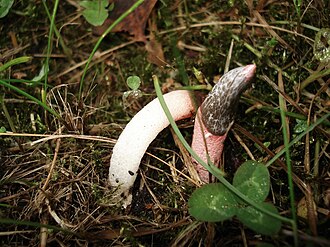
How to identify Dog Stinkhorn
Mutinus caninus
Got a photo? Identify mushrooms instantly with the Mushby app
Open the appTo correctly identify Dog Stinkhorn (Mutinus caninus), check each of these features in order. Misidentification is the most common cause of mushroom poisoning, so cross-reference multiple sources.
Step-by-step identification
- 1
Cap
Shape, color, surface texture, and diameter.
The 'cap' is technically the gleba, a conical, sporulating mass at the apex of the receptacle. It is initially olive-green to dark green, slimy, and covered in a foul-smelling, spore-containing mucus. As spores are dispersed by insects, the gleba may become paler, revealing the white, porous surface of the receptacle beneath. It is typically 1-3 cm tall.
- 2
Gills
Attachment to stem, color, and spacing.
Mutinus caninus, like all Gasteromycetes, does not have gills. Spores are produced in the gleba, which is a slimy, odoriferous mass.
- 3
Stem
Length, shape, surface, and any ring.
The stem, or receptacle, is cylindrical, hollow, and tapers slightly towards the apex. It is typically white to pinkish-orange, often more intensely colored towards the base. The surface is porous and somewhat spongy. It measures 8-15 cm in height and 0.5-1.5 cm in diameter.
- 4
Flesh
Color, texture, and bruising reaction.
The 'flesh' of the receptacle is thin, hollow, and porous, with a spongy and somewhat brittle texture. The 'egg' stage has a firmer, gelatinous interior.
- 5
Fruiting body
Overall growth pattern.
The fruiting body emerges from a subterranean 'egg' (volva) that is whitish to pale brown and gelatinous when cut. As it matures, a cylindrical, hollow, porous stem (receptacle) emerges from the egg, topped with a conical, olive-green gleba.
- 6
Habitat
Where it grows and on what substrate.
Saprobic, growing singly or in small groups on rotting wood, woody debris, well-rotted sawdust, woodchip paths, or sometimes directly on soil rich in organic matter. Often found in deciduous and mixed woodlands, hedgerows, and gardens.
Key Facts
- Cap surfaces
- Slimy, olive-green to dark green gleba on a porose white to pinkish-orange receptacle
- Growth Form
- Emergent from a subterranean 'egg', developing into an erect cylindrical body
- Spore Print
- Olive-brown (spores embedded in the slimy gleba)
- Body color
- White to pale brown (egg); white to pinkish-orange (receptacle); olive-green to dark green (gleba)
- Odor
- Strongly fetid (carrion-like) from the gleba; slight radish-like or faint when in 'egg' stage
- Flesh bruises
- Does not bruise, but the gleba is easily smudged
- Height
- Egg: 2-4 cm in diameter; Mature stem: 8-15 cm tall, 0.5-1.5 cm diameter
- Cap Diameter
- 1-3 cm (gleba)
Fruit body characteristics
- Gill attachment: No gills present
- Stem shape: Cylindrical, tapering slightly towards the apex
- Stem surface: Porous, spongy, white to pinkish-orange
- Ring: No true ring; the remnants of the volva (egg sac) may form a cup-like structure at the base of the stem
- Stem cross-section: Hollow
Explore Dog Stinkhorn
Identify mushrooms anywhere
Free on iOS, Android, and Web. Photo identification, full database, and your personal collection.