
Got a photo? Identify mushrooms instantly with the Mushby app
Open the appDescription
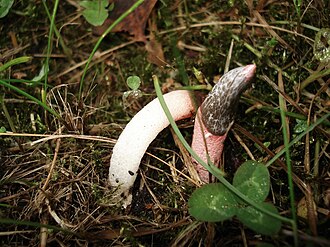
Mutinus caninus, commonly known as the Dog Stinkhorn, is a fascinating saprobic fungus found in woodlands. It emerges from an 'egg' stage, developing into a slender, columnar receptacle topped with a spore-bearing cap known as the gleba. This gleba is initially olive-green and has a fetid odor designed to attract insects, which then aid in spore dispersal. Its rapid growth and distinctive appearance, especially the 'egg' and the elongated mature form, are key identifying features. It is generally smaller and more delicately built than other stinkhorn species.
How to Identify
- Cap
- The 'cap' is technically the gleba, a conical, sporulating mass at the apex of the receptacle. It is initially olive-green to dark green, slimy, and covered in a foul-smelling, spore-containing mucus. As spores are dispersed by insects, the gleba may become paler, revealing the white, porous surface of the receptacle beneath. It is typically 1-3 cm tall.
- Gills
- Mutinus caninus, like all Gasteromycetes, does not have gills. Spores are produced in the gleba, which is a slimy, odoriferous mass.
- Stem
- The stem, or receptacle, is cylindrical, hollow, and tapers slightly towards the apex. It is typically white to pinkish-orange, often more intensely colored towards the base. The surface is porous and somewhat spongy. It measures 8-15 cm in height and 0.5-1.5 cm in diameter.
- Flesh
- The 'flesh' of the receptacle is thin, hollow, and porous, with a spongy and somewhat brittle texture. The 'egg' stage has a firmer, gelatinous interior.
- Fruiting body
- The fruiting body emerges from a subterranean 'egg' (volva) that is whitish to pale brown and gelatinous when cut. As it matures, a cylindrical, hollow, porous stem (receptacle) emerges from the egg, topped with a conical, olive-green gleba.
- Habitat
- Saprobic, growing singly or in small groups on rotting wood, woody debris, well-rotted sawdust, woodchip paths, or sometimes directly on soil rich in organic matter. Often found in deciduous and mixed woodlands, hedgerows, and gardens.
Key Facts
- Cap surfaces: Slimy, olive-green to dark green gleba on a porose white to pinkish-orange receptacle
- Growth Form: Emergent from a subterranean 'egg', developing into an erect cylindrical body
- Spore Print: Olive-brown (spores embedded in the slimy gleba)
- Body color: White to pale brown (egg); white to pinkish-orange (receptacle); olive-green to dark green (gleba)
- Odor: Strongly fetid (carrion-like) from the gleba; slight radish-like or faint when in 'egg' stage
- Flesh bruises: Does not bruise, but the gleba is easily smudged
- Height: Egg: 2-4 cm in diameter; Mature stem: 8-15 cm tall, 0.5-1.5 cm diameter
- Cap Diameter: 1-3 cm (gleba)
- Nutrient gathering: Saprobic
Safe
SafeThe 'egg' stage of Mutinus caninus is considered edible by some, particularly after the outer gelatinous layer and inner core are removed, leaving only the firm, white 'button' or 'egg white' layer. However, the mature fruiting body, with its foul-smelling gleba, is generally considered inedible due to its repulsive odor and slimy texture. There are no known toxins associated with Mutinus caninus. Caution is always advised when consuming any wild mushroom. While generally considered harmless, individual sensitivities can vary. Do not consume if aroma or appearance is off-putting.
Quick Check
- Odor: Strongly fetid, carrion-like (mature gleba); mild, radish-like (egg stage)
- Fruiting: Late summer to late autumn, sometimes earlier in warm, humid conditions
- Substrate: Rotting wood, woody debris, organic-rich soil
Where to Find
Deciduous and Mixed Woodlands
Commonly found in areas with an abundance of leaf litter and decaying wood.
Gardens and Parks
Can appear in mulched garden beds, compost heaps, or areas with woodchips.
Finding Tips
Look for the 'egg' stage
Often, the initial white to pale brown 'egg' is visible before the mature stinkhorn emerges. These can be found slightly buried in soil or leaf litter.
Follow your nose
The strong, fetid odor of the mature gleba is a primary indicator of its presence, especially on still, warm days.
Check decaying wood
Focus searches around stumps, logs, wood chip paths, and areas with significant woody debris.
Seasonal appearance
Most prevalent from late summer through autumn, though it can appear earlier in warm, humid conditions.
Similar Species
Common Stinkhorn
Stinkhorn
Also known as: Phallus impudicus
Elegant Stinkhorn
Stinkhorn
Also known as: Mutinus elegans
Columned Stinkhorn
Stinkhorn
Also known as: Phallus ravenelii
Scientific Classification
- Phylum
- Basidiomycota
- Class
- Agaricomycetes
- Order
- Phallales
- Family
- Phallaceae
- Genus
- Mutinus
Storage Information
- Max Temperature: 4
- Freezing duration: 0
- Min Temperature: 1
- Refrigeration: 2
How to Clean
The 'egg' stage can be gently wiped clean with a damp cloth if consumed. The mature fruiting body is rarely collected for consumption due to its odor and texture.
Explore Dog Stinkhorn
Identify mushrooms anywhere
Free on iOS, Android, and Web. Photo identification, full database, and your personal collection.