
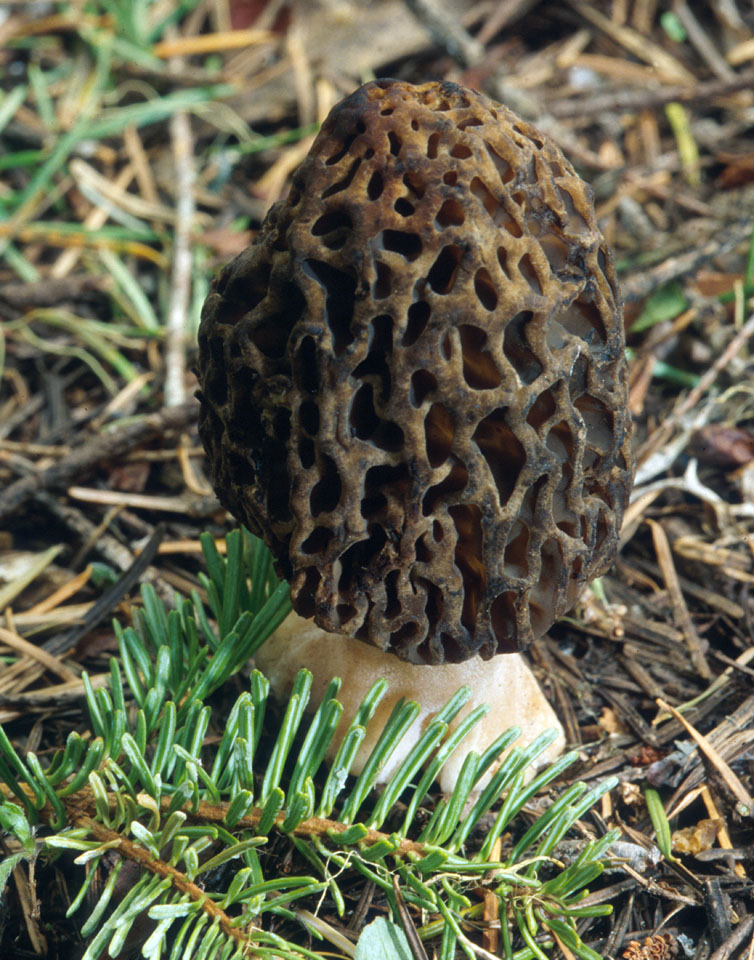
How to identify Black Morel
Morchella elata
Got a photo? Identify mushrooms instantly with the Mushby app
Open the appTo correctly identify Black Morel (Morchella elata), check each of these features in order. Misidentification is the most common cause of mushroom poisoning, so cross-reference multiple sources.
Step-by-step identification
- 1
Cap
Shape, color, surface texture, and diameter.
Conical to ovoid or occasionally rounded, 3-10 cm tall and 2-6 cm wide, deeply pitted and ridged. The pits and ridges create a honeycomb-like appearance. Ridges are typically darker than the pits, ranging from dark brown to almost black, while pits are often grayish-brown to olive-brown. The cap is entirely fused to the stem at the lower margin, forming a continuous hollow chamber.
- 2
Gills
Attachment to stem, color, and spacing.
Absent, as Morels are ascomycetes and produce spores on the inner surfaces of the pits (hymenium).
- 3
Stem
Length, shape, surface, and any ring.
Cylindrical to slightly club-shaped, 3-10 cm long and 1-3 cm thick, whitish to pale cream, sometimes darkening near the base. The surface can be smooth or finely granular/furfuraceous. It is hollow and continuous with the hollow interior of the cap.
- 4
Flesh
Color, texture, and bruising reaction.
Thin, brittle, whitish to pale cream, and entirely hollow from the apex of the cap down through the stem.
- 5
Fruiting body
Overall growth pattern.
Ascocarp composed of a distinctive, pitted cap and a hollow stem. Overall height ranges from 5 to 15 cm (rarely up to 20 cm).
- 6
Habitat
Where it grows and on what substrate.
Typically terrestrial, growing alone or in scattered groups. Strongly associated with certain trees (especially dying or recently dead trees within the family Rosaceae like apple, cherry, ash, elm, sycamore) and particularly abundant in disturbed areas, such as post-fire conifer forests (especially a year or two after a wildfire), logging sites, and old orchards. Also found in deciduous and mixed woodlands.
Key Facts
- Cap surfaces
- Deeply pitted and ridged, resembling a honeycomb
- Growth Form
- Solitary to scattered
- Spore Print
- Creamy to pale ochre
- Body color
- Dark brown to black ridges, grayish-brown to olive-brown pits; whitish stem
- Odor
- Mushroomy, earthy
- Flesh bruises
- Does not bruise distinctly
- Height
- 5-15 cm
- Cap Diameter
- 2-6 cm (width at base of cap)
Fruit body characteristics
- Gill attachment: N/A (ascomycete, no gills)
- Stem shape: Cylindrical to slightly club-shaped
- Stem surface: Smooth to finely granular/furfuraceous
- Ring: Absent
- Stem cross-section: Hollow
Explore Black Morel
Identify mushrooms anywhere
Free on iOS, Android, and Web. Photo identification, full database, and your personal collection.