
Got a photo? Identify mushrooms instantly with the Mushby app
Open the appDescription
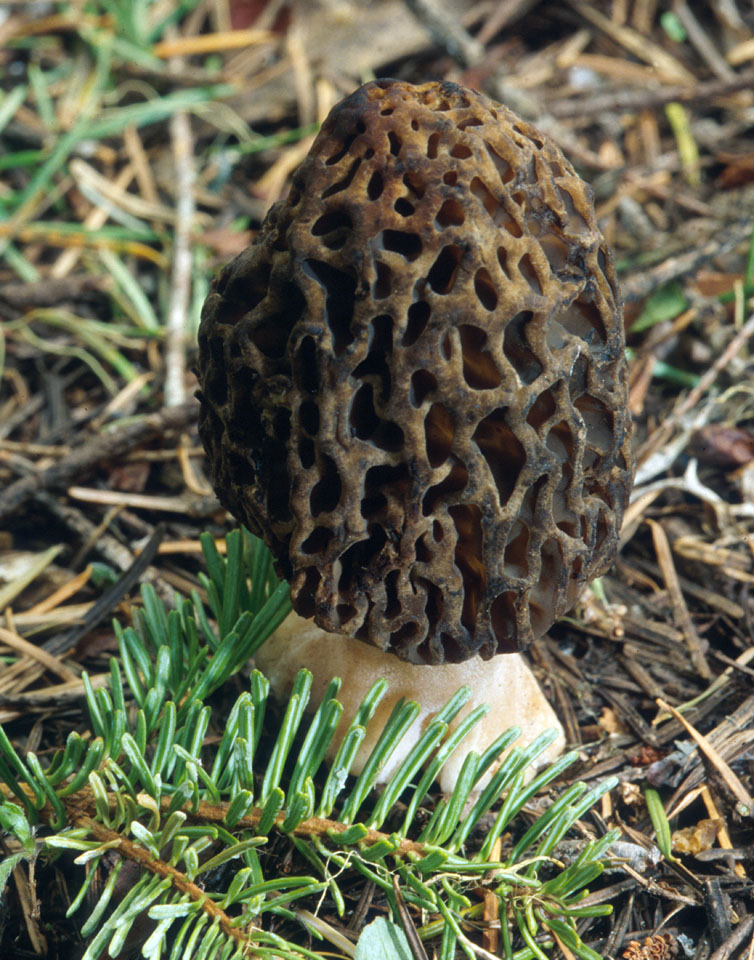
The Black Morel, belonging to the Morchella elata phylogenetic complex, is a highly prized edible mushroom distinguished by its dark, conical to ovoid, pitted cap and hollow interior. It is renowned for its distinctive flavor and appears in spring, often associated with disturbed ground, especially after forest fires.
How to Identify
- Cap
- Conical to ovoid or occasionally rounded, 3-10 cm tall and 2-6 cm wide, deeply pitted and ridged. The pits and ridges create a honeycomb-like appearance. Ridges are typically darker than the pits, ranging from dark brown to almost black, while pits are often grayish-brown to olive-brown. The cap is entirely fused to the stem at the lower margin, forming a continuous hollow chamber.
- Gills
- Absent, as Morels are ascomycetes and produce spores on the inner surfaces of the pits (hymenium).
- Stem
- Cylindrical to slightly club-shaped, 3-10 cm long and 1-3 cm thick, whitish to pale cream, sometimes darkening near the base. The surface can be smooth or finely granular/furfuraceous. It is hollow and continuous with the hollow interior of the cap.
- Flesh
- Thin, brittle, whitish to pale cream, and entirely hollow from the apex of the cap down through the stem.
- Fruiting body
- Ascocarp composed of a distinctive, pitted cap and a hollow stem. Overall height ranges from 5 to 15 cm (rarely up to 20 cm).
- Habitat
- Typically terrestrial, growing alone or in scattered groups. Strongly associated with certain trees (especially dying or recently dead trees within the family Rosaceae like apple, cherry, ash, elm, sycamore) and particularly abundant in disturbed areas, such as post-fire conifer forests (especially a year or two after a wildfire), logging sites, and old orchards. Also found in deciduous and mixed woodlands.
Key Facts
- Cap surfaces: Deeply pitted and ridged, resembling a honeycomb
- Growth Form: Solitary to scattered
- Spore Print: Creamy to pale ochre
- Body color: Dark brown to black ridges, grayish-brown to olive-brown pits; whitish stem
- Odor: Mushroomy, earthy
- Flesh bruises: Does not bruise distinctly
- Height: 5-15 cm
- Cap Diameter: 2-6 cm (width at base of cap)
- Nutrient gathering: Saprobic (on decaying wood/roots) and mycorrhizal (symbiotic with living trees); mechanism can vary by species within the complex.
Safe
Mild ToxicityRAW Black Morels contain small amounts of hydrazine toxins (e.g., gyromitrin-like compounds, though different from Gyromitra). These toxins are largely destroyed by thorough cooking. Consuming raw or undercooked Morels can lead to gastrointestinal distress (nausea, vomiting, diarrhea) and can be toxic. There are also rare reports of neurotoxic reactions (e.g., ataxia, dizziness) in some individuals even after proper cooking, though the mechanism is not fully understood.
Quick Check
- Odor: Pleasant, earthy, mushroomy.
- Fruiting: Spring
- Substrate: Terrestrial, often associated with specific trees or disturbed ground (especially post-fire).
Where to Find
North America
Widely distributed across temperate regions, particularly in the Pacific Northwest and Rocky Mountains (after fires) and eastern North America (in association with certain trees).
Europe
Found across various European countries, often in woodland clearings, riverbanks, and disturbed ground.
Asia
Reported in parts of Asia, though regional variations and species complexes are still under study.
Finding Tips
Timing is Key
Morels appear in spring, typically from April to June, depending on latitude and elevation. Look for them after a few days of warm temperatures and spring rains, particularly after nighttime temperatures consistently remain above 40°F (4°C).
Post-Fire Ecosystems
In Western North America, Black Morels are famously prolific in coniferous forests (e.g., Ponderosa Pine, Douglas Fir) one to two years after a significant wildfire. These 'burn morels' are a major foraging target.
Tree Associations
In Eastern North America, focus on areas with dying or diseased Elm, Ash, Sycamore, and old Apple trees. They often fruit around the base of these trees or where they have recently fallen.
Disturbed Ground
Check old logging roads, creek beds, flood plains, and disturbed soil near woodland edges.
Look Low and Slow
Morels can be camouflaged by leaf litter. Walk slowly, scanning the ground carefully. Once you find one, stop and search the immediate vicinity thoroughly, as they often grow in patches.
Similar Species
Yellow Morel
Morchella esculentoides, Morchella americana
Also known as: Morchella esculenta group
Half-Free Morel
Morchella punctipes, Morchella populiphila
Also known as: Morchella semilibera
False Morel
Gyromitra esculenta
Also known as: Brain mushroom, Turban fungus
Verpa bohemica
Verpa
Also known as: Early Morel, Thimble Morel
Scientific Classification
- Phylum
- Ascomycota
- Class
- Pezizomycetes
- Order
- Pezizales
- Family
- Morchellaceae
- Genus
- Morchella
Storage Information
- Max Temperature: 4°C (39°F)
- Freezing duration: 12 months
- Min Temperature: 0°C (32°F)
- Refrigeration: 7 days
How to Clean
Gently brush off any dirt or debris with a soft-bristled brush or damp cloth. For more thorough cleaning, a quick rinse under cold water is acceptable, but avoid prolonged soaking as they can become waterlogged. Slice them lengthwise to check for insects and ensure the interior is hollow and clean.
Explore Black Morel
Identify mushrooms anywhere
Free on iOS, Android, and Web. Photo identification, full database, and your personal collection.