
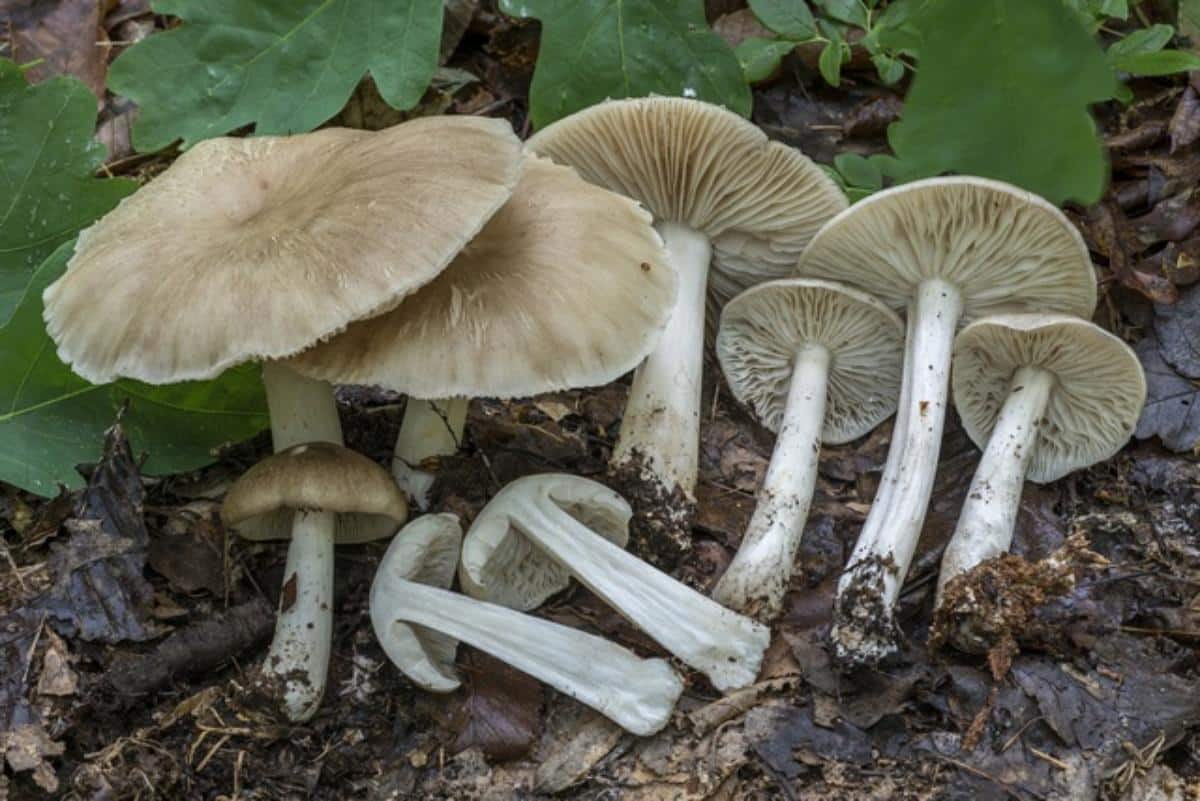
How to identify Platterful Mushroom
Megacollybia rodmanii
Got a photo? Identify mushrooms instantly with the Mushby app
Open the appTo correctly identify Platterful Mushroom (Megacollybia rodmanii), check each of these features in order. Misidentification is the most common cause of mushroom poisoning, so cross-reference multiple sources.
Step-by-step identification
- 1
Cap
Shape, color, surface texture, and diameter.
The cap ranges from 5 to 20 cm (2 to 8 inches) in diameter, initially convex, becoming broadly convex to flat, often with a central depression or umbo in maturity. The margin can be wavy or irregular. The color varies from grayish-brown to dark brown, sometimes with a reddish tint, often paler towards the margin. The surface is dry, smooth, or finely fibrillose, sometimes cracking in age.
- 2
Gills
Attachment to stem, color, and spacing.
The gills are broadly attached to the stem (adnexed to adnate), very broad, and widely spaced. They are white to cream-colored, sometimes developing yellowish or pinkish tones with age. The gill edges are often serrated or uneven.
- 3
Stem
Length, shape, surface, and any ring.
The stem is 5 to 15 cm (2 to 6 inches) long and 1 to 3 cm (0.4 to 1.2 inches) thick, central, solid, and fibrous. It is typically white to grayish-white, often with fine longitudinal striations or fibrils, especially towards the base. The base is often enlarged or somewhat bulbous, and it frequently extends into the substrate, attaching to buried wood.
- 4
Flesh
Color, texture, and bruising reaction.
The flesh is thick, firm, and white, not changing color when cut or bruised. It has a mild taste and a slightly fungoid odor.
- 5
Fruiting body
Overall growth pattern.
The fruiting body is typically large and robust, with a prominent cap and stem. It grows solitarily or in small scattered groups.
- 6
Habitat
Where it grows and on what substrate.
Saprobic, growing on decaying wood, often from buried logs or roots of deciduous trees, particularly oaks. It can also be found on well-rotted stumps or woody debris. It is commonly found in mixed hardwood forests.
Key Facts
- Cap surfaces
- Dry, smooth to finely fibrillose, sometimes cracking
- Growth Form
- Solitary to scattered
- Spore Print
- White
- Body color
- Grayish-brown to dark brown cap, white to grayish-white stem
- Odor
- Mild, slightly fungoid
- Flesh bruises
- No
- Height
- 5-15 cm (2-6 inches)
- Cap Diameter
- 5-20 cm (2-8 inches)
Fruit body characteristics
- Gill attachment: Adnexed to adnate
- Stem shape: Cylindrical, often enlarged or bulbous at base
- Stem surface: Smooth to finely fibrillose, longitudinally striate
- Ring: Absent
- Stem cross-section: Solid
Explore Platterful Mushroom
Identify mushrooms anywhere
Free on iOS, Android, and Web. Photo identification, full database, and your personal collection.