
Got a photo? Identify mushrooms instantly with the Mushby app
Open the appDescription
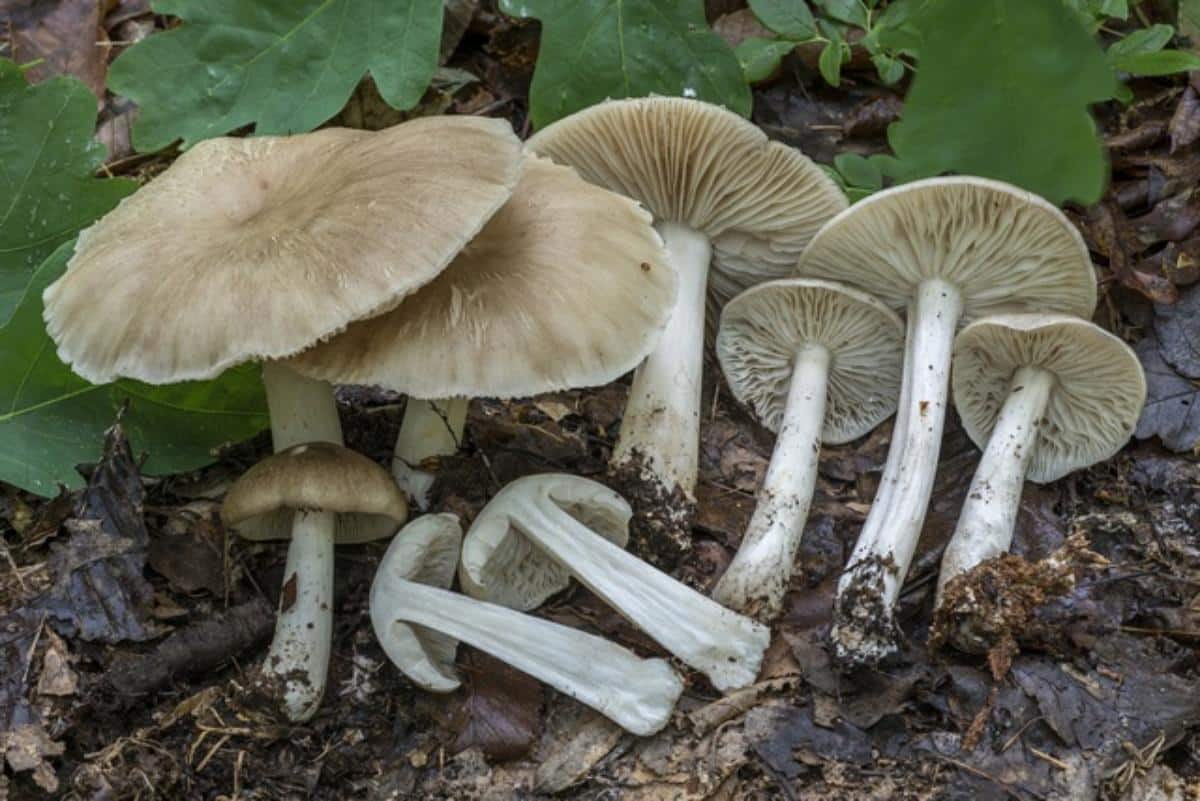
Megacollybia rodmanii, commonly known as the Platterful Mushroom, is a large, robust saprobic mushroom found primarily in eastern North America. It is characterized by its broad, often flattened cap, widely spaced gills, and a sturdy stem. It is a significant decomposer of woody debris, particularly buried wood.
How to Identify
- Cap
- The cap ranges from 5 to 20 cm (2 to 8 inches) in diameter, initially convex, becoming broadly convex to flat, often with a central depression or umbo in maturity. The margin can be wavy or irregular. The color varies from grayish-brown to dark brown, sometimes with a reddish tint, often paler towards the margin. The surface is dry, smooth, or finely fibrillose, sometimes cracking in age.
- Gills
- The gills are broadly attached to the stem (adnexed to adnate), very broad, and widely spaced. They are white to cream-colored, sometimes developing yellowish or pinkish tones with age. The gill edges are often serrated or uneven.
- Stem
- The stem is 5 to 15 cm (2 to 6 inches) long and 1 to 3 cm (0.4 to 1.2 inches) thick, central, solid, and fibrous. It is typically white to grayish-white, often with fine longitudinal striations or fibrils, especially towards the base. The base is often enlarged or somewhat bulbous, and it frequently extends into the substrate, attaching to buried wood.
- Flesh
- The flesh is thick, firm, and white, not changing color when cut or bruised. It has a mild taste and a slightly fungoid odor.
- Fruiting body
- The fruiting body is typically large and robust, with a prominent cap and stem. It grows solitarily or in small scattered groups.
- Habitat
- Saprobic, growing on decaying wood, often from buried logs or roots of deciduous trees, particularly oaks. It can also be found on well-rotted stumps or woody debris. It is commonly found in mixed hardwood forests.
Key Facts
- Cap surfaces: Dry, smooth to finely fibrillose, sometimes cracking
- Growth Form: Solitary to scattered
- Spore Print: White
- Body color: Grayish-brown to dark brown cap, white to grayish-white stem
- Odor: Mild, slightly fungoid
- Flesh bruises: No
- Height: 5-15 cm (2-6 inches)
- Cap Diameter: 5-20 cm (2-8 inches)
- Nutrient gathering: Saprobic
Safe
SafeMegacollybia rodmanii is generally considered edible, but it is not highly regarded for its culinary qualities. Some sources report it as edible but bland, while others suggest it can be tough. There are no known toxins associated with this species. However, always exercise caution when consuming wild mushrooms. Misidentification with toxic look-alikes is a significant risk.
Quick Check
- Odor: Mild, slightly fungoid
- Fruiting: Spring to fall
- Substrate: Decaying buried wood (hardwoods)
Where to Find
Eastern North America
Primarily found in the eastern United States and Canada, extending west to the Great Plains.
Deciduous Forests
Common in hardwood forests, especially those dominated by oak species.
Finding Tips
Look for Buried Wood
This mushroom often fruits from buried wood, so look for it growing seemingly from the ground in areas with decaying trees or stumps.
Check After Rain
Like many mushrooms, it is more likely to fruit after periods of significant rainfall.
Examine Gill Spacing
The very broad and widely spaced gills are a key identifying feature.
Similar Species
Megacollybia platyphylla
Megacollybia
Also known as: Broad-gilled Collybia
Megacollybia fallax
Megacollybia
Also known as: False Broad-gilled Collybia
Scientific Classification
- Phylum
- Basidiomycota
- Class
- Agaricomycetes
- Order
- Agaricales
- Family
- Marasmiaceae
- Genus
- Megacollybia
Storage Information
- Max Temperature: 4°C
- Freezing duration: 6 months
- Min Temperature: 0°C
- Refrigeration: 5-7 days
How to Clean
Gently brush off any debris with a soft brush or damp cloth. Avoid washing under running water unless absolutely necessary, as mushrooms can absorb water and become soggy. If washing is needed, do so quickly and pat dry immediately.
Explore Platterful Mushroom
Identify mushrooms anywhere
Free on iOS, Android, and Web. Photo identification, full database, and your personal collection.