
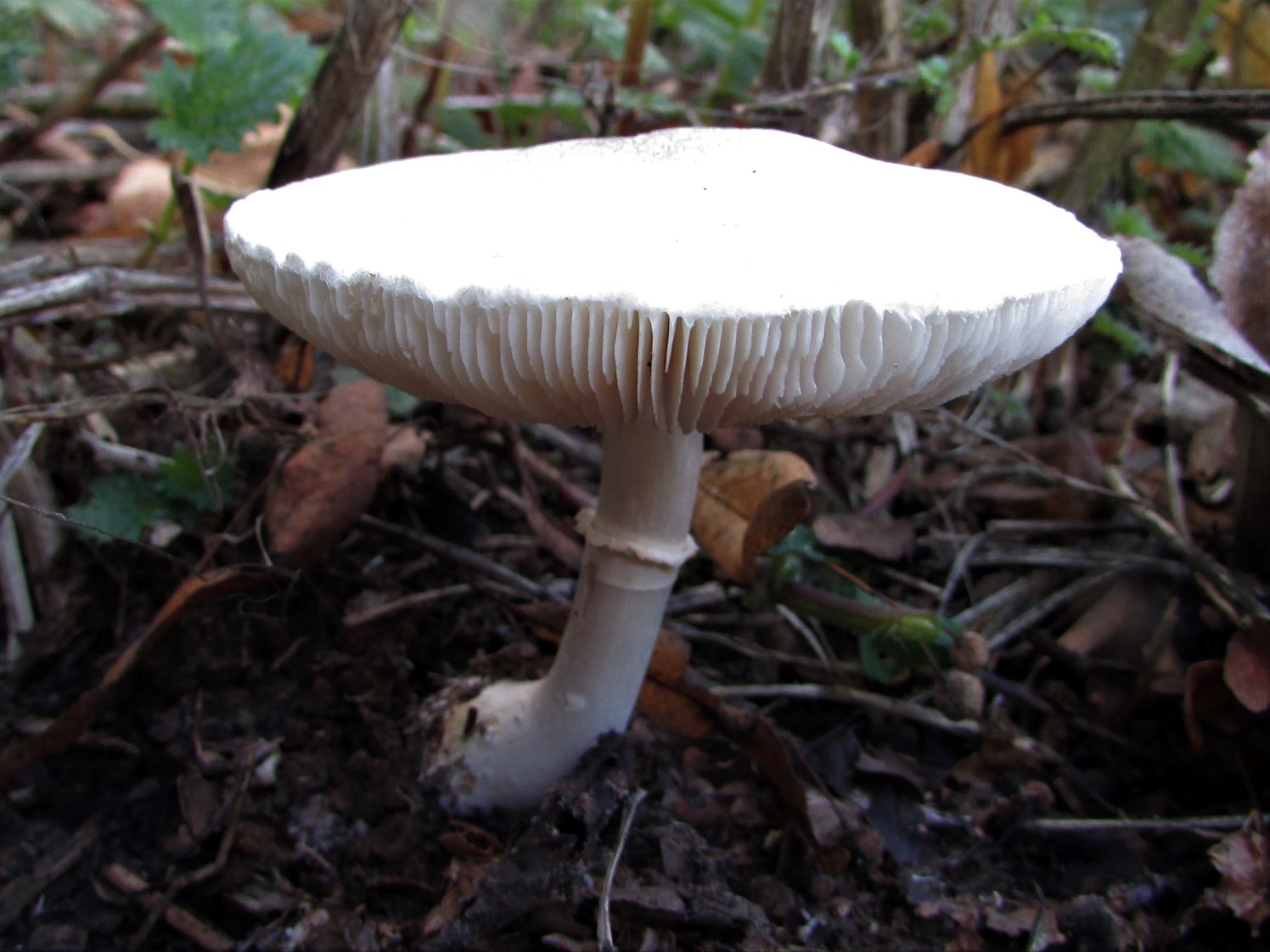
How to identify White Dapperling
Leucocoprinus cepistipes
Got a photo? Identify mushrooms instantly with the Mushby app
Open the appTo correctly identify White Dapperling (Leucocoprinus cepistipes), check each of these features in order. Misidentification is the most common cause of mushroom poisoning, so cross-reference multiple sources.
Step-by-step identification
- 1
Cap
Shape, color, surface texture, and diameter.
Initially ovoid or bell-shaped, expanding to convex or broadly umbonate, 2-6 cm in diameter. The surface is dry, covered with fine, powdery to fibrillose scales, especially towards the margin, often leaving the center smoother and slightly darker (ochraceous to brownish). The margin is often striate or grooved, especially when mature.
- 2
Gills
Attachment to stem, color, and spacing.
Free from the stem, crowded, thin, and white to cream-colored, sometimes developing a yellowish tint with age. They are often interveined.
- 3
Stem
Length, shape, surface, and any ring.
3-10 cm long and 0.3-0.8 cm thick, central, slender, hollow, and tapering slightly upwards from a distinctly bulbous base (often resembling an onion bulb). The surface is white, smooth to finely fibrillose. A persistent, membranous, white ring is present, often movable, located in the upper part of the stem.
- 4
Flesh
Color, texture, and bruising reaction.
Thin, white, and fragile, with no distinctive odor or taste.
- 5
Fruiting body
Overall growth pattern.
Small to medium-sized, delicate, and entirely white to cream-colored, often with a slightly darker, yellowish-brownish center on the cap. It has a distinct ring on the stem and a bulbous base.
- 6
Habitat
Where it grows and on what substrate.
Saprobic, growing solitarily or in small clusters on decaying wood, wood chips, compost, leaf litter, and rich garden soils. It is very common in greenhouses, potted plants, and disturbed urban environments.
Key Facts
- Cap surfaces
- Dry, powdery to fibrillose scales, often smoother and darker in the center
- Growth Form
- Solitary to gregarious
- Spore Print
- White
- Body color
- White to cream, sometimes with a yellowish-brownish center
- Odor
- Indistinct or slightly radish-like
- Flesh bruises
- No significant bruising reaction
- Height
- 3-10 cm
- Cap Diameter
- 2-6 cm
Fruit body characteristics
- Gill attachment: Free
- Stem shape: Cylindrical with a bulbous base
- Stem surface: Smooth to finely fibrillose, white
- Ring: Present, membranous, white, often movable
- Stem cross-section: Hollow
Explore White Dapperling
Identify mushrooms anywhere
Free on iOS, Android, and Web. Photo identification, full database, and your personal collection.