
Got a photo? Identify mushrooms instantly with the Mushby app
Open the appDescription
Leucocoprinus cepistipes, commonly known as the White Dapperling or Onion-stalked Parasol, is a delicate, saprobic mushroom characterized by its white to cream coloration, often with a slightly darker center on the cap, and a distinctive bulbous base to its stem. It is frequently found growing in disturbed soils, compost, wood chips, and potted plants, particularly in greenhouses and gardens. Its ephemeral nature means it often appears quickly after rain and can disappear just as fast. While visually appealing, it is considered inedible and potentially toxic.
How to Identify
- Cap
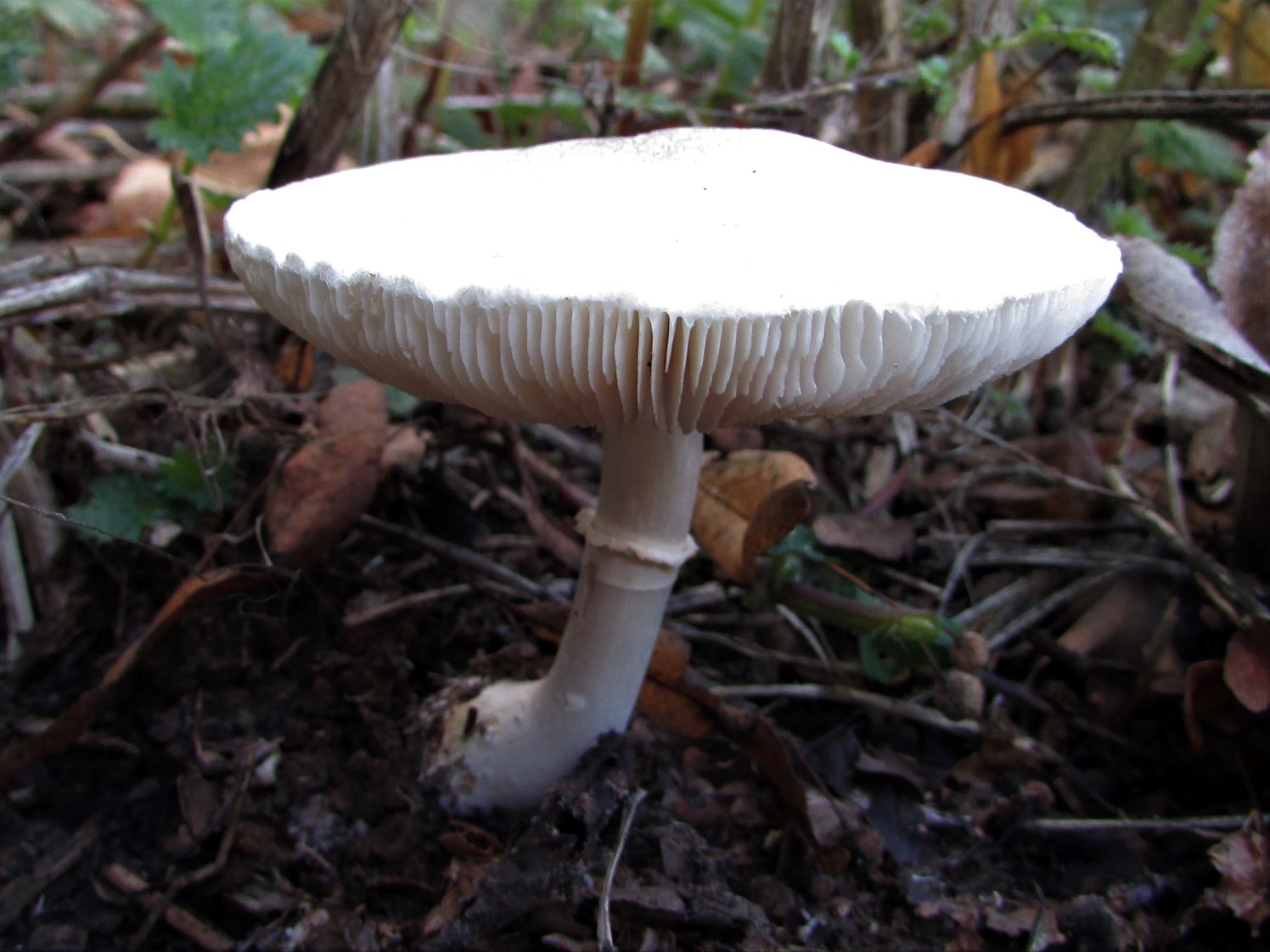
- Initially ovoid or bell-shaped, expanding to convex or broadly umbonate, 2-6 cm in diameter. The surface is dry, covered with fine, powdery to fibrillose scales, especially towards the margin, often leaving the center smoother and slightly darker (ochraceous to brownish). The margin is often striate or grooved, especially when mature.
- Gills
- Free from the stem, crowded, thin, and white to cream-colored, sometimes developing a yellowish tint with age. They are often interveined.
- Stem
- 3-10 cm long and 0.3-0.8 cm thick, central, slender, hollow, and tapering slightly upwards from a distinctly bulbous base (often resembling an onion bulb). The surface is white, smooth to finely fibrillose. A persistent, membranous, white ring is present, often movable, located in the upper part of the stem.
- Flesh
- Thin, white, and fragile, with no distinctive odor or taste.
- Fruiting body
- Small to medium-sized, delicate, and entirely white to cream-colored, often with a slightly darker, yellowish-brownish center on the cap. It has a distinct ring on the stem and a bulbous base.
- Habitat
- Saprobic, growing solitarily or in small clusters on decaying wood, wood chips, compost, leaf litter, and rich garden soils. It is very common in greenhouses, potted plants, and disturbed urban environments.
Key Facts
- Cap surfaces: Dry, powdery to fibrillose scales, often smoother and darker in the center
- Growth Form: Solitary to gregarious
- Spore Print: White
- Body color: White to cream, sometimes with a yellowish-brownish center
- Odor: Indistinct or slightly radish-like
- Flesh bruises: No significant bruising reaction
- Height: 3-10 cm
- Cap Diameter: 2-6 cm
- Nutrient gathering: Saprobic
Toxic
Moderate ToxicityLeucocoprinus cepistipes is considered inedible and potentially toxic. While not typically deadly, ingestion can cause gastrointestinal upset, including nausea, vomiting, diarrhea, and abdominal pain. The exact toxins are not fully understood but are believed to be gastrointestinal irritants. Due to its delicate nature and small size, it is not typically sought for consumption, but accidental ingestion, especially by children or pets, should be avoided. It is crucial to distinguish it from edible species, though its small size and habitat usually prevent confusion with larger edible parasols.
Quick Check
- Odor: Indistinct or slightly radish-like
- Fruiting: Solitary to gregarious
- Substrate: Decaying wood, wood chips, compost, rich soil, potted plants
Where to Find
Gardens and Parks
Commonly found in mulched garden beds, compost piles, and disturbed soil in urban and suburban parks.
Greenhouses and Potted Plants
Frequently appears in the soil of potted plants, both indoors and outdoors, due to the rich organic matter and consistent moisture.
Wooded Areas
Can be found on decaying wood debris, leaf litter, and wood chip paths in deciduous and mixed forests.
Finding Tips
Look in disturbed areas
Focus on areas with rich organic matter, such as compost heaps, wood chip beds, and recently mulched gardens.
Check potted plants
Inspect the soil of indoor and outdoor potted plants, especially after watering.
Seasonal appearance
Most common during warm, humid periods, often appearing quickly after rain.
Similar Species
Yellow Dapperling
Leucocoprinus
Also known as: Plantpot Parasol
Green-spored Parasol
Chlorophyllum
Also known as: False Parasol
Shaggy Parasol
Chlorophyllum
Also known as: Shaggy Lepiota
Scientific Classification
- Phylum
- Basidiomycota
- Class
- Agaricomycetes
- Order
- Agaricales
- Family
- Agaricaceae
- Genus
- Leucocoprinus
Explore White Dapperling
Identify mushrooms anywhere
Free on iOS, Android, and Web. Photo identification, full database, and your personal collection.